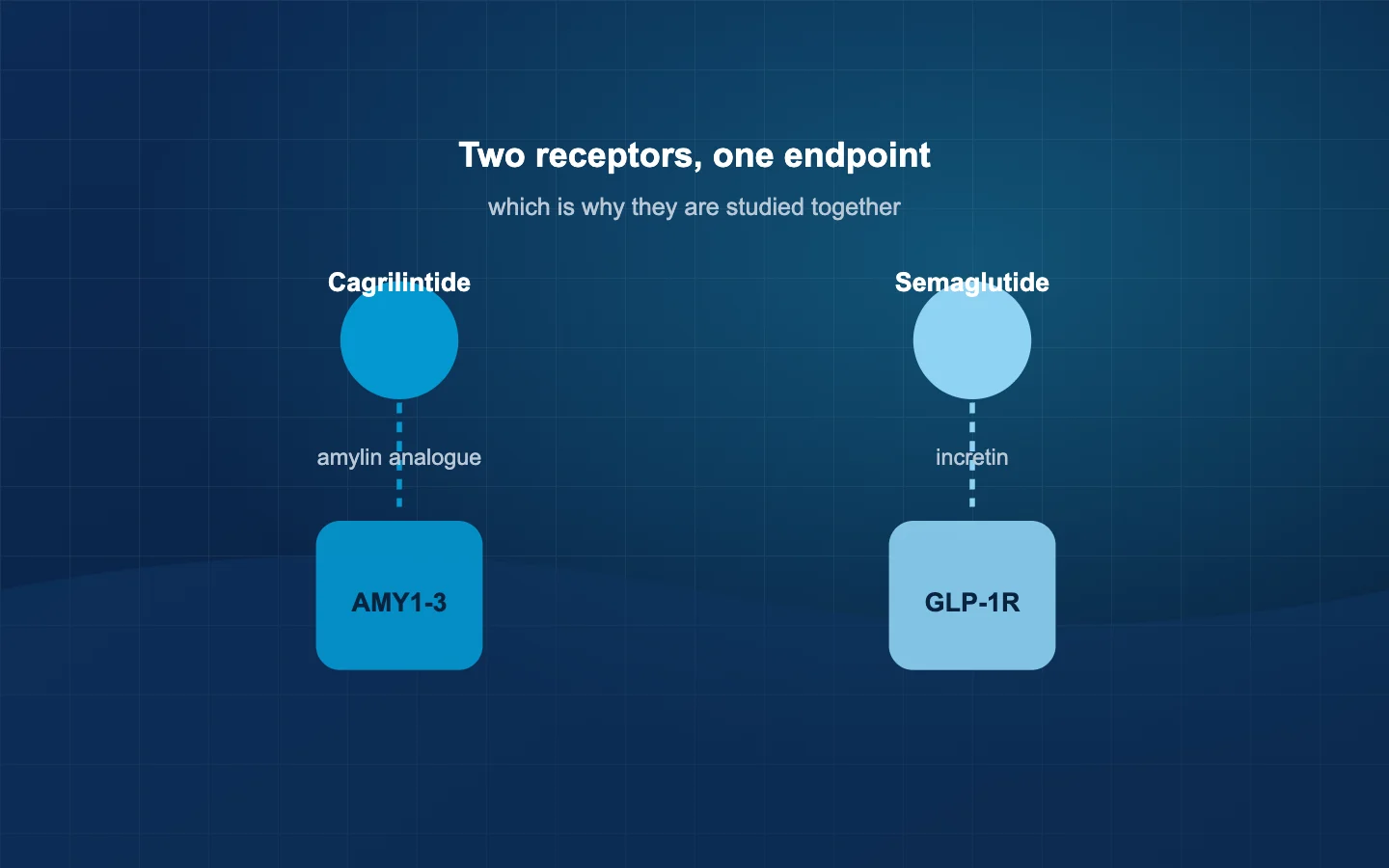
Every discussion of metabolic research peptides eventually arrives at the GLP-1 receptor, and then stops there. Amylin is the other half of the picture, and it is a genuinely separate system — a different hormone, a different receptor family, and a different set of physiological effects that happen to converge on the same endpoints. Understanding why cagrilintide sits in a GLP-1 category without being a GLP-1 agonist is the difference between reading the literature and repeating marketing copy.
What is amylin?
Amylin, also called islet amyloid polypeptide, is a 37-amino-acid hormone co-secreted with insulin from pancreatic beta cells. The two come out of the same granules in roughly fixed proportion, which means anything that stimulates insulin release stimulates amylin release alongside it.
Its described actions are on gastric emptying, on glucagon secretion, and on satiation signalling in the hindbrain. Those are complementary to insulin's action on glucose disposal rather than duplicative — insulin handles the glucose that has arrived, amylin influences the rate at which more arrives.
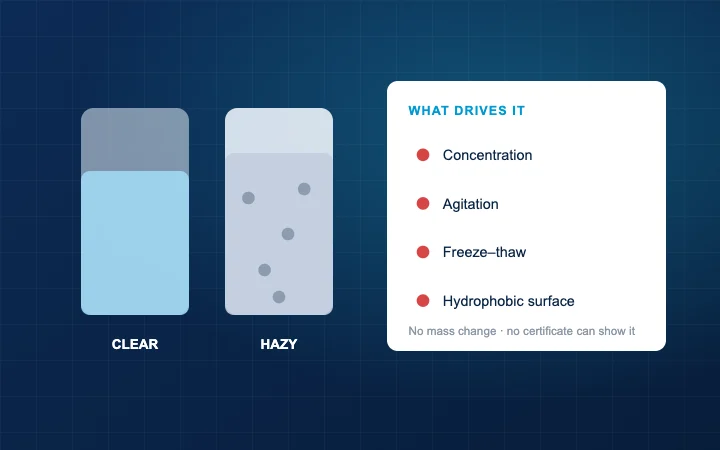
Native human amylin has a practical problem that shaped everything downstream: it aggregates readily into amyloid fibrils. That property is the reason the hormone itself is not a usable therapeutic and the reason every analogue in existence carries substitutions designed around it.
Which receptor does it act on?
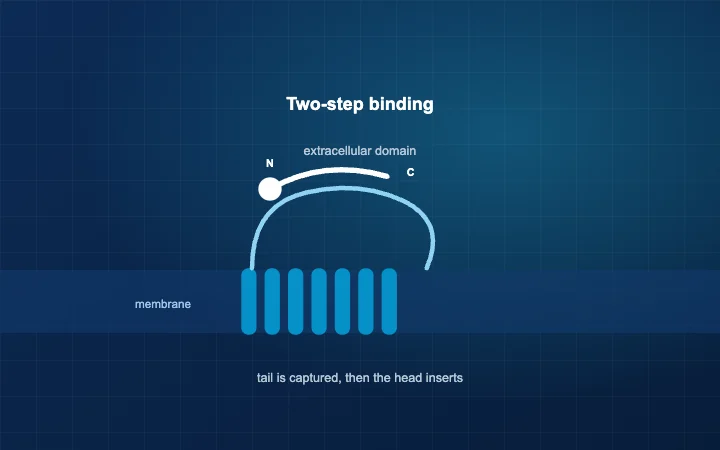
This is the part that matters for study design. Amylin does not have a dedicated receptor gene. It signals through calcitonin receptors in complex with receptor activity-modifying proteins — the calcitonin receptor paired with RAMP1, RAMP2 or RAMP3 produces the AMY1, AMY2 and AMY3 receptor phenotypes respectively.
The consequence is that amylin pharmacology sits in the calcitonin receptor family, which is class B like the GLP-1 receptor but a different branch of it. An amylin analogue and a GLP-1 agonist are acting on different proteins.
That is the whole basis of the combination. When two compounds act on separate receptors and produce overlapping downstream effects, a combination study can distinguish additive effects from redundant ones — and either answer is informative. Two drugs hitting the same receptor cannot tell you that.
| Amylin analogues | GLP-1 receptor agonists | |
|---|---|---|
| Parent hormone | Amylin (37 aa), beta cell | GLP-1, intestinal L cell |
| Receptor | Calcitonin receptor + RAMP (AMY1-3) | GLP-1 receptor |
| Example in this catalogue | Cagrilintide | Semaglutide |
| Described actions | Gastric emptying, glucagon, satiation | Insulin secretion, gastric emptying, appetite |
| Class | Not an incretin | Incretin |
What does cagrilintide change?
Cagrilintide is a long-acting acylated analogue of amylin. Two modifications do the work.
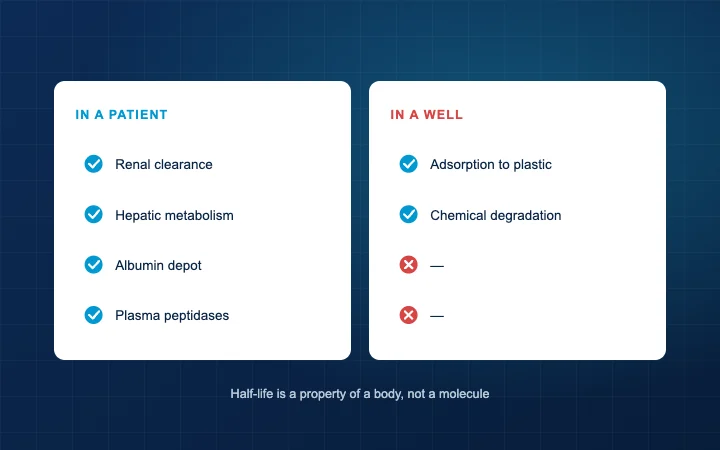
Acylation attaches a fatty-acid chain, which promotes reversible albumin binding and extends the circulating half-life from minutes to something supporting weekly administration. This is the same design principle behind semaglutide's acylation, arrived at independently for the same reason.
Sequence substitutions address the aggregation problem. The design borrows from the observation that amylin from some other species does not fibrillate the way the human sequence does.
PubChem lists cagrilintide as C194H312N54O59S2 at 4,409 g/mol — a substantially larger molecule than the 37-residue native hormone would suggest, because the acyl chain and its linker add mass. That figure is on our cagrilintide product page with the PubChem identifier, so you can check it against the public record.
What has actually been published?
Two phase 2 trials are the reference points, and it is worth being precise about what they were.
Lau and colleagues, Lancet 2021 — a multicentre, randomised, double-blind, placebo-controlled and active-controlled dose-finding trial of once-weekly cagrilintide in people with overweight and obesity. This established the dose range and characterised cagrilintide as a single agent.
Frias and colleagues, Lancet 2023 — a randomised, double-blind, active-controlled phase 2 trial of co-administered once-weekly cagrilintide 2.4 mg with once-weekly semaglutide 2.4 mg in type 2 diabetes. This is the combination study that put the two classes together in humans.
These are clinical trials in human participants. They describe neither the material sold on this site nor any laboratory use of it. They are cited here because they are the primary literature on the compound class, and because a researcher reading about cagrilintide should be reading the trials rather than a supplier's summary of them. Everything in this catalogue is for in-vitro laboratory research only.
What does this mean for a research design?
If you are studying an amylin analogue, the controls that matter are different from the ones a GLP-1 experiment needs. Receptor selectivity work has to account for the RAMP dependence — the same calcitonin receptor gives different pharmacology depending on which RAMP is present, so the expression system determines what you are measuring. A cell line expressing calcitonin receptor without RAMPs is not an amylin receptor system.
For combination work, the useful design runs three arms plus control: each compound alone and both together. Without the single-agent arms, an observed effect cannot be attributed. Our catalogue lists cagrilintide and semaglutide separately as well as a co-lyophilized retatrutide and cagrilintide blend for designs where a fixed ratio is wanted — though as the blends post argues, a blend fixes the ratio at manufacture and the singles keep it adjustable.
Frequently asked questions
Is cagrilintide the same as pramlintide?
No. Both are amylin analogues, but pramlintide is a short-acting, unacylated analogue with a different substitution pattern, and its pharmacokinetics require frequent administration. Cagrilintide is acylated for a long half-life.
Why is cagrilintide listed under GLP-1 and metabolic if it is not a GLP-1 agonist?
Category names are shelving, not pharmacology. It sits there because that is where researchers working on metabolic pathways will look for it, and because it is most often studied alongside the incretin compounds. The product page states plainly what it actually is.
Does amylin act on the same appetite pathways as GLP-1?
There is overlap in the endpoints and separation in the routes. Both have described effects on gastric emptying and on satiation signalling, but through different receptors and, in the hindbrain literature, partly different populations of neurons. That partial overlap is precisely why the combination is an interesting experiment rather than an obvious one.
What is the aggregation problem you mentioned?
Human amylin readily forms amyloid fibrils, and those deposits are a recognised feature of pancreatic islets in type 2 diabetes. For a researcher the practical consequence is handling: native and poorly-designed amylin sequences can aggregate in solution, so reconstituted material should be inspected for haze and prepared fresh where the readout is sensitive. Our post on solution stability covers aggregation as a failure mode.
References
- Lau DCW, Erichsen L, Francisco AM, et al. Once-weekly cagrilintide for weight management in people with overweight and obesity: a multicentre, randomised, double-blind, placebo-controlled and active-controlled, dose-finding phase 2 trial. The Lancet 2021;398(10317):2160-2172. doi.org/10.1016/S0140-6736(21)01751-7
- Frias JP, Deenadayalan S, Erichsen L, et al. Efficacy and safety of co-administered once-weekly cagrilintide 2·4 mg with once-weekly semaglutide 2·4 mg in type 2 diabetes: a multicentre, randomised, double-blind, active-controlled, phase 2 trial. The Lancet 2023;402(10403):720-730. doi.org/10.1016/S0140-6736(23)01163-7
- PubChem CID 171397054 — cagrilintide: molecular formula C194H312N54O59S2, molecular weight 4409. pubchem.ncbi.nlm.nih.gov/compound/171397054
Every product mentioned is sold for laboratory research use only and is not for human or animal use. Nothing on this page describes or recommends use of the material sold here in humans or animals.