
Certificates for blends are the least standardised documents in this catalogue, and the most common failure is simple: a blend is issued a certificate shaped like a single compound's, with one purity figure standing in for two.
That figure is not false so much as uninformative. Here is what a blend certificate has to do instead, and how to tell when it has not.
Why one purity number does not work
Purity answers a single question: of everything present, how much is the intended compound? For a one-compound vial that is clean.
For a two-component blend the question splits in two, and a combined figure answers neither half.
Consider a bottle intended to hold equal amounts of A and B. Suppose it actually holds 70% A, 29% B and 1% everything else. A combined purity assay reports 99% peptide — entirely true, and entirely silent about the fact that the ratio is badly off.
Nothing in that number is wrong. It simply is not measuring the thing most likely to have gone wrong.
The four panels a blend certificate needs
Identity, per component. Two observed masses, each matched against its own theoretical value. Not one mass confirmed and the second inferred from the recipe.
Purity, per component. How much of the A present is A, and how much of the B present is B, reported as separate figures.
Content, per component. The actual quantity of each compound in the container — which is where net peptide content matters doubly, since each powder arrives with its own water and counter-ion fraction.
Ratio, measured. The proportion between the two, determined on the finished solution.
That fourth panel is the one most often absent and the one most worth having.
Why the ratio has to be measured
A manufacturer weighs out two quantities and combines them. It is tempting to treat the intended ratio as the delivered one.
Several things intervene between intention and outcome:
- Each powder carries a different water and salt fraction, so equal weights are not equal amounts of peptide
- One component may dissolve less completely than the other during formulation
- Adsorption to vessel and filter surfaces is not necessarily equal between the two
- Transfer losses rarely split evenly
None of these is exotic, and none requires anything to have gone wrong. Together they are enough that the delivered ratio deserves its own measurement rather than an assumption.
A certificate stating "1:1 as formulated" is reporting the recipe. One stating a measured ratio is reporting the product.
The arithmetic that catches people out
Take two powders, both labelled 5 mg, both at 98% HPLC purity. Comfortable numbers. Now add net peptide content: A is 82% peptide by mass, B is 74%, the balance in each being bound water and trifluoroacetate.
The bottle contains roughly 4.1 mg of actual A and 3.7 mg of actual B. That is a measured ratio near 1.11:1, not 1:1, and every figure that produced it was within specification.
Nobody made a mistake. The ratio is simply not what the weights implied, and only a measurement on the finished solution would say so.
How to tell a real blend certificate from a copied one
Three tells, in order of how diagnostic they are.
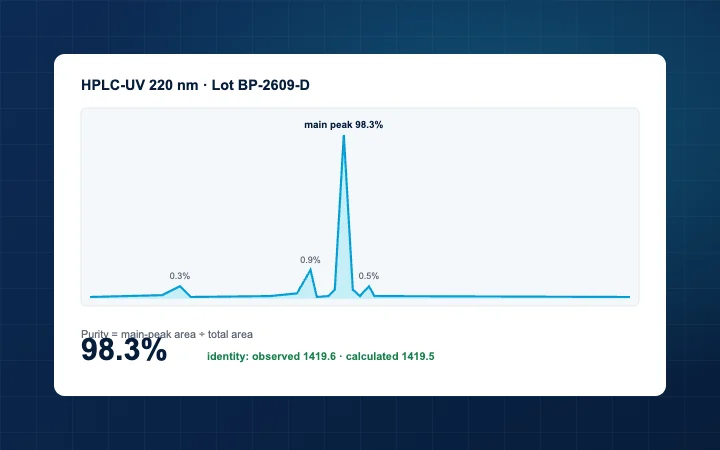
One chromatogram, one peak. Two compounds of different polarity should give two resolved peaks. A single peak means either they co-eluted — in which case the method cannot separate them and both purity figures are suspect — or only one component was run and the document is reporting half a product. This is the strongest signal on the page.
The document looks like a single-compound certificate. One purity figure, one mass, one retention time, one assay row. If the layout does not visibly account for two substances, it was not designed for two.
The ratio is a round number with no method behind it. "1:1" stated without an assay is the formulation intent restated in the language of a result.
For the Selank + Semax blend the two components are similar in character, which makes resolving them a genuine analytical requirement rather than a formality. Similar polarity is exactly the condition under which two peaks try to become one.
What specificity means here
Regulatory guidance on analytical methods uses the word specificity: the method's ability to measure the thing it claims to measure in the presence of everything else in the sample.
On a single compound, "everything else" means impurities and degradation products. On a blend it also means the other active component and all of its impurities. The method has to resolve four populations at once, and a method validated on A alone has not been shown to do that.
This is why a blend cannot simply inherit the two methods used for its components. It needs a method validated on the mixture.
What a blend certificate still cannot tell you
Worth being clear about the limits, because a thorough certificate can create more confidence than it has earned.
It describes one batch at one moment — the material tested, on the day it was tested. It does not describe your bottle after six months in your conditions.
It says nothing about ratio drift over time. Two components are not obliged to degrade at the same rate, so a proportion that was correct at release can move while both components remain individually within specification. Only a stability study on the blend addresses that.
And it carries no information about behaviour in your system — a certificate is a description of a substance, not a prediction about an experiment.
Blends in this catalogue
Several products here are multi-component, and each should carry per-component reporting:
- Selank + Semax liquid spray, 5 mg of each in 10 mL
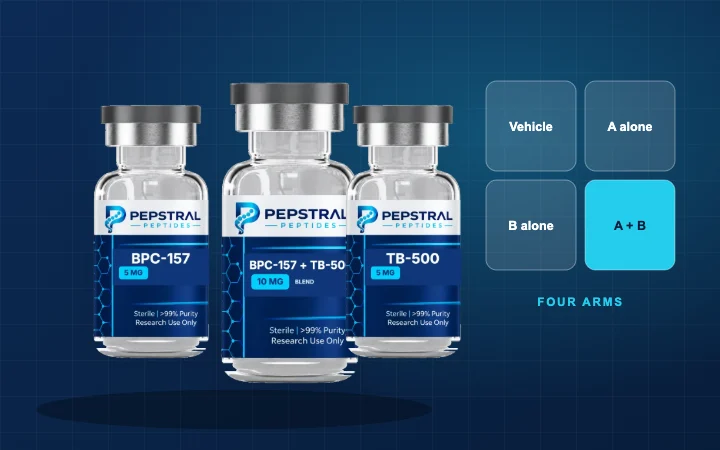
- BPC-157 + TB-500 blend
- CJC-1295 + Ipamorelin blend
Why a given pairing is chemically workable is a separate question from how it is verified — why Selank and Semax can share a bottle covers the compatibility side.
The short version
Ask three questions of any blend certificate:
- Are both compounds confirmed by mass, independently?
- Is purity reported separately for each?
- Was the ratio measured on the finished solution, or is it the recipe restated?
If the third answer is uncomfortable, that is the one to chase. A high combined purity and a wrong ratio are entirely compatible findings, and only one of the two appears on most certificates.
Every product referenced here is supplied for laboratory research use only and is not for human or animal use.
References
- Bachem. Quality Control of Amino Acids and Peptides: A Guide. www.bachem.com/knowledge-center/quality-control-of-amino-acids-peptides-a-guide
- United States Pharmacopeia. General Chapter <1503> Quality Attributes of Synthetic Peptide Drug Substances.
- International Council for Harmonisation. ICH Q2(R2): Validation of Analytical Procedures. www.ich.org/page/quality-guidelines
- Manning MC, Chou DK, Murphy BM, Payne RW, Katayama DS. Stability of protein pharmaceuticals: an update. Pharmaceutical Research 2010;27(4):544-575. doi.org/10.1007/s11095-009-0045-6
Every product mentioned is sold for laboratory research use only and is not for human or animal use. Nothing on this page describes or recommends use of the material sold here in humans or animals.