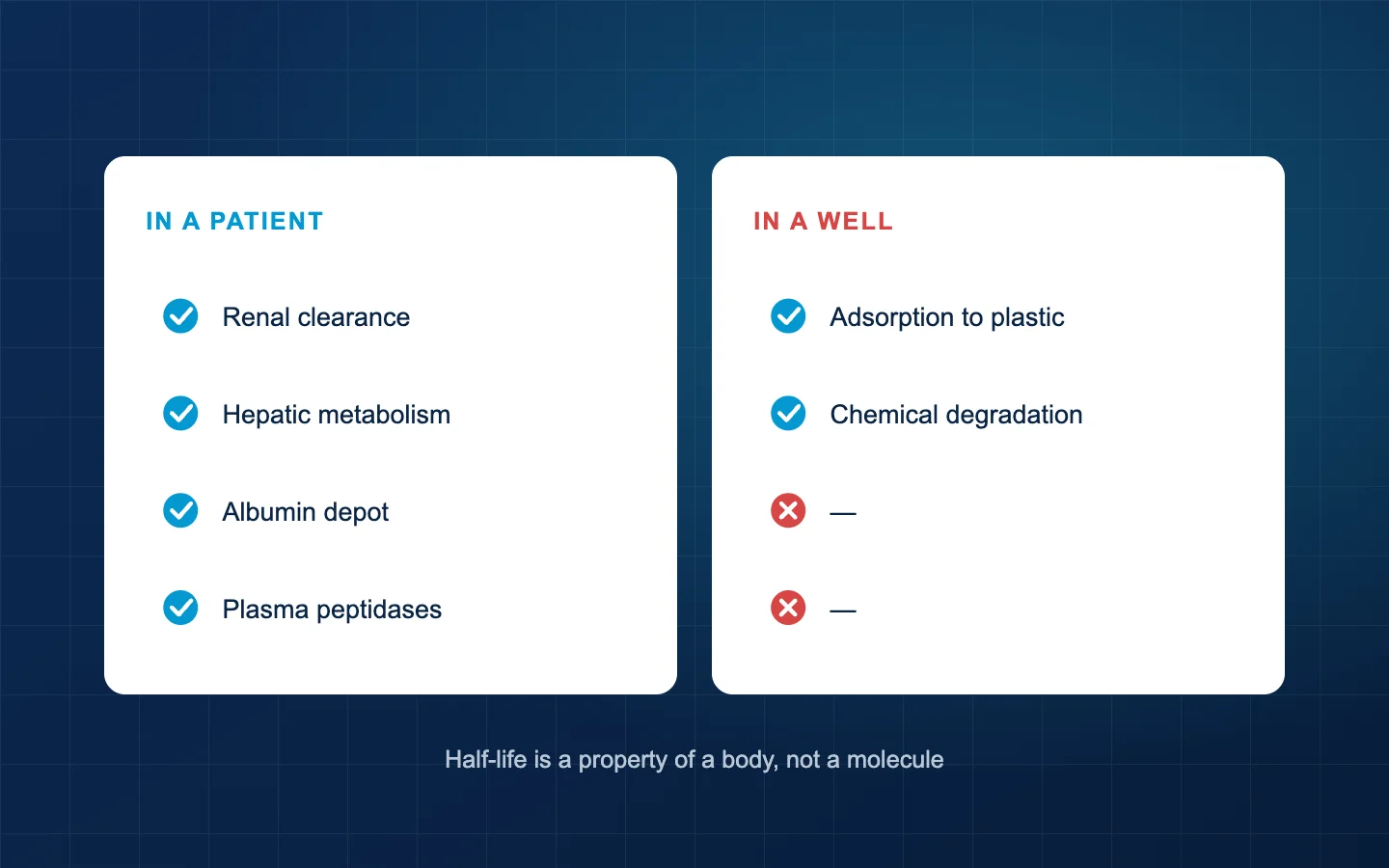
The literature behind the metabolic peptides is mostly clinical. Papers report weekly doses in milligrams, plasma concentrations over days, and outcomes in human participants. Somebody planning an in-vitro experiment then has to work out what, if anything, those numbers mean in a well — and the honest answer is: almost none of them transfer. Not because the trials are irrelevant, but because they measure a system that a culture plate does not contain.
Why is half-life a property of a body, not a molecule?
Semaglutide's long half-life is the headline property of the compound, and it exists because of things that are absent from your plate:
- Renal filtration removes small molecules. There is no kidney in a well.
- Hepatic metabolism processes them. There is no liver.
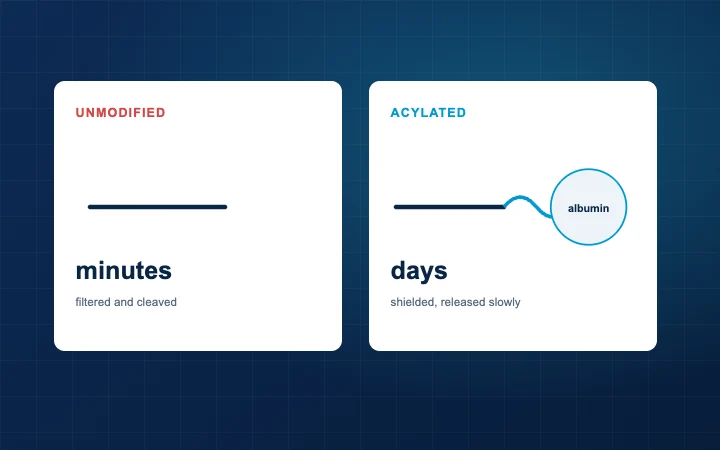
- Albumin binding creates a circulating depot, which is the entire mechanism behind acylation, covered in our acylation post.
- Peptidases in plasma and tissue cleave peptides. Culture media contains some enzymatic activity, but not that.
Remove all four and "half-life" no longer describes anything. What governs how long a peptide persists in a well is a different list entirely: chemical degradation in solution, adsorption to the plasticware, and whatever the cells themselves do to it. Those are the subject of our solution stability post, and none of them is what a trial measured.
| Factor | In a patient | In a well |
|---|---|---|
| Renal clearance | Dominant for small peptides | Absent |
| Hepatic metabolism | Significant | Absent |
| Albumin depot | Sets the duration for acylated peptides | Present only if serum is in the medium |
| Plasma peptidases | Continuous | Largely absent |
| Adsorption to surfaces | Negligible | Can be substantial |
| Chemical degradation | Minor over hours | The main route over days |
What is the albumin trap?
There is one clinical mechanism that does partly transfer, and it is the one people miss.
If your medium contains fetal bovine serum, it contains albumin. An acylated peptide — semaglutide, cagrilintide, retatrutide, tirzepatide — was specifically engineered to bind albumin. So it will, in your well, and the free concentration available to your cells is lower than the concentration you calculated from mass and volume.
How much lower depends on the serum percentage, the albumin concentration and the compound's affinity. The number is not knowable from first principles for most setups, which is why it needs handling by design rather than by calculation:
- Run serum-free or at low, fixed serum where the biology allows.
- Keep the serum percentage constant across every condition, including controls.
- State it in the methods, because a reader cannot interpret your concentrations without it.
An unmodified peptide — sermorelin, ipamorelin, the bioregulators — does not have this problem in the same way, because it has no albumin-binding chain. This is a case where two compounds behaving identically in a buffer diverge in serum.
Why you cannot convert a clinical dose
The arithmetic looks tempting: take a 2.4 mg weekly dose, divide by a volume of distribution, get a concentration. It does not survive scrutiny.
Volume of distribution is itself a derived parameter — it is the volume that would explain the observed plasma concentration if the drug distributed evenly, which it does not. Using it to produce a well concentration compounds an approximation with an irrelevance. Meanwhile the trial's exposure was continuous over a week, at varying concentration; your well is a single addition at a fixed one.
The workable approach is the ordinary one: run a concentration series and let your own system tell you where the response sits. If published in-vitro work exists for that compound and receptor, its concentrations are the right starting point — not the clinical dose.
What are trial papers genuinely good for?
Plenty, once you stop mining them for numbers:
Mechanism and target. Lau and colleagues' cagrilintide trial establishes what the compound is and which receptor system it engages — the framing our amylin post builds on.
Comparator choice. If a trial ran a compound against a specific alternative, that pairing reflects a considered judgement about what the meaningful comparison is.
Endpoints worth modelling. Which outcomes a clinical programme cared about tells you which in-vitro readouts have a plausible line to something.
What is not yet known. Limitations sections are the most underread part of a trial paper and often the most useful.
Lundquist and Artursson's review of peptide absorption is a good example of the opposite direction — a paper about why peptides behave as they do in a real system, which is exactly the kind of context that makes trial data interpretable rather than transferable.
One framing that matters
Everything in this catalogue is sold for in-vitro laboratory research only. When we cite a clinical trial on a product page or in a post, we are pointing at the primary literature on a compound class — not describing, recommending or implying any use of the material sold here. Our editorial policy states that plainly, and it is why every trial reference on this site carries the same qualification.
Frequently asked questions
Can I use the clinical Cmax as a well concentration?
It is a more defensible anchor than a dose, since it is a measured concentration rather than a derived one. But it is a plasma concentration in a system with albumin, clearance and distribution. Treat it as one reference point in a series, not a target.
Does peptide stick to the plate?
Yes, and it matters most at low concentrations and with hydrophobic sequences. Low-binding plasticware helps; so does including carrier protein, though that reintroduces the albumin question.
How long is a peptide good for in a well?
Shorter than in the vial, because the medium is warm, buffered near neutral pH and often contains serum. Where exposure runs over days, a medium change with fresh compound is more defensible than assuming persistence.
Should I cite clinical trials in my methods?
Cite them for what they are — context for the compound. What belongs in your methods is your own material: supplier, lot, purity, net content, diluent and concentration, as our methods post sets out.
References
- Lundquist P, Artursson P. Oral absorption of peptides and nanoparticles across the human intestine: opportunities, limitations and studies in human tissues. Advanced Drug Delivery Reviews 2016;106:256-276. doi.org/10.1016/j.addr.2016.07.007
- Lau DCW, Erichsen L, Francisco AM, et al. Once-weekly cagrilintide for weight management in people with overweight and obesity. The Lancet 2021;398(10317):2160-2172. doi.org/10.1016/S0140-6736(21)01751-7
- Manning MC, Chou DK, Murphy BM, Payne RW, Katayama DS. Stability of protein pharmaceuticals: an update. Pharmaceutical Research 2010;27(4):544-575. doi.org/10.1007/s11095-009-0045-6
Every product mentioned is sold for laboratory research use only and is not for human or animal use. Nothing on this page describes or recommends use of the material sold here in humans or animals.