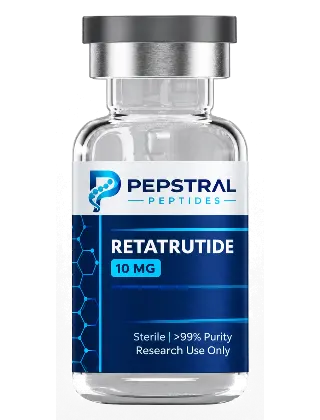
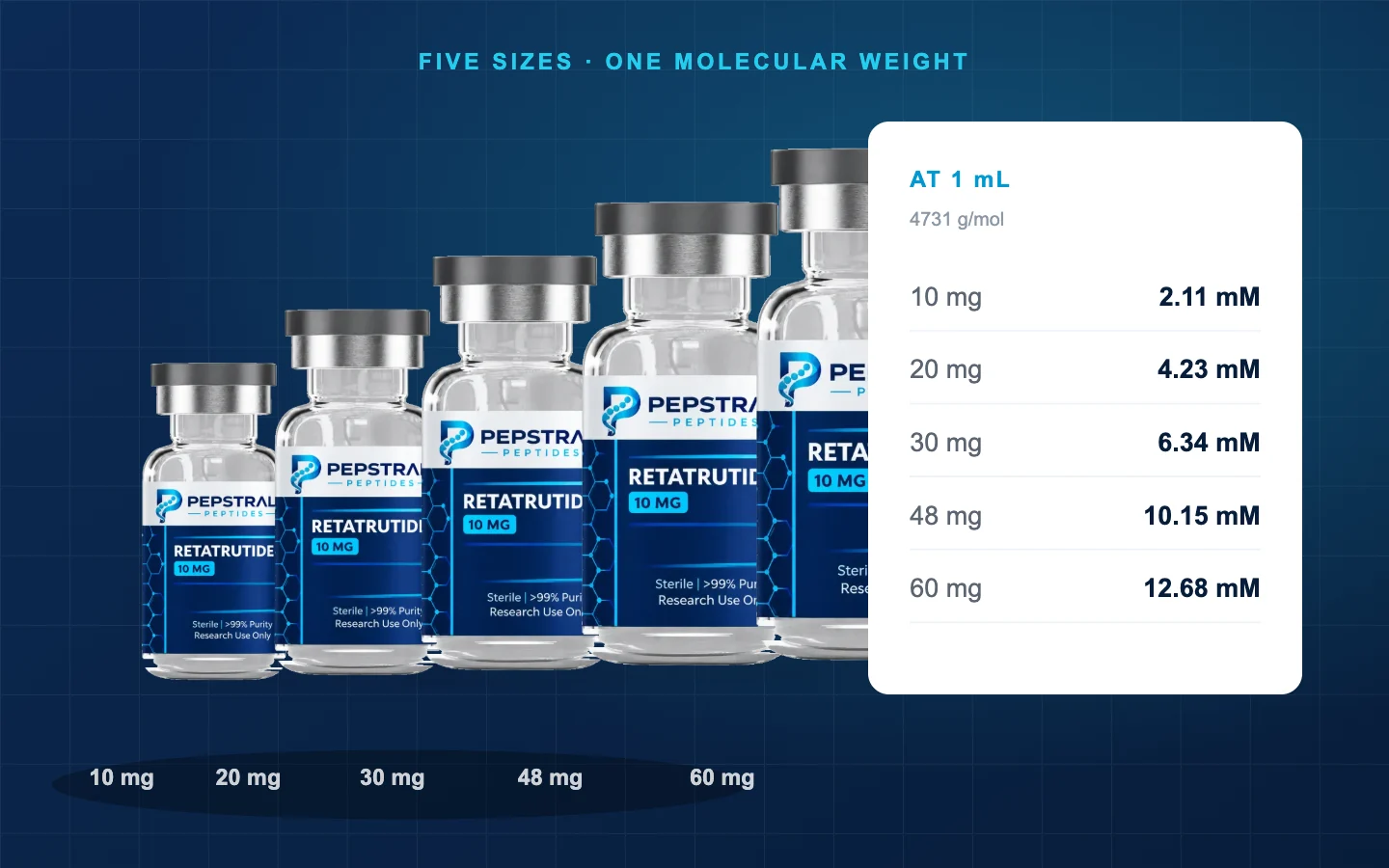
Retatrutide is the heaviest peptide in this catalogue and one of the slowest to dissolve, and it is sold in five sizes that span a sixfold range. Those three facts between them produce most of the questions we get about it, so this post answers them in one place: how to get it into solution, what concentration you end up with, and how to decide which vial to buy before you buy it.
If you want the mechanism rather than the method, the glucagon-arm post covers what the compound is.
Start with the molar amount, not the milligrams
Retatrutide's molecular weight is 4731 g/mol (PubChem CID 171390338). That is heavy — more than three times the mass of BPC-157 — and heavy means a given mass is a much smaller molar amount than intuition suggests.
| Vial | Mass | Molar amount |
|---|---|---|
| 10 mg | 10 mg | 2.11 µmol |
| 20 mg | 20 mg | 4.23 µmol |
| 30 mg | 30 mg | 6.34 µmol |
| 48 mg | 48 mg | 10.15 µmol |
| 60 mg | 60 mg | 12.68 µmol |
Even so, 2.11 µmol is a great deal of compound for cell work. A 96-well plate at 100 nM in 200 µL per well uses 20 pmol per well — about 1.9 nmol for the whole plate. The smallest vial we sell would run roughly a thousand such plates. Our molarity post is the long version of why equal masses are not equal amounts, and it matters here more than for any other compound in the catalogue.
The method
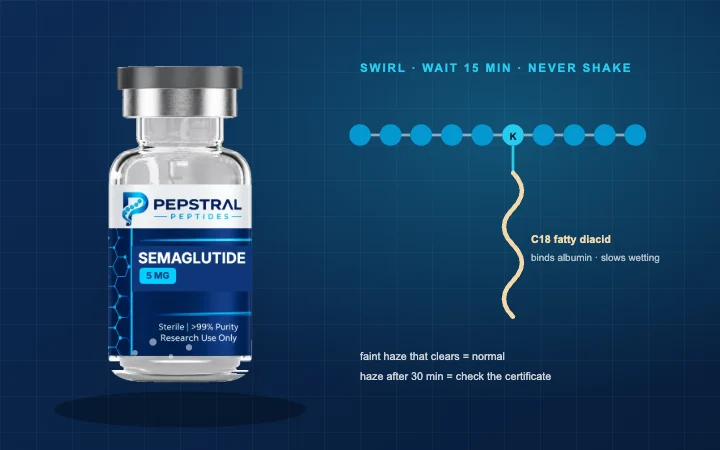
The C20 fatty diacid on retatrutide's lysine side chain is the reason it circulates for days — and the reason the powder behaves like something part fat, part peptide when you add water to it. Wetting is slow, the molecules self-associate, and a clear solution takes minutes rather than seconds.
- Bring both to room temperature. Vial and diluent. Cold solvent onto cold powder is the slowest possible start.
- Add the diluent down the vial wall, not onto the cake. A stream directed at the powder drives it up the sides where it will not redissolve.
- Swirl gently. Do not shake. Shaking an acylated peptide introduces air, and the air–water interface is where these molecules unfold and aggregate. There is no situation in which shaking this compound helps.
- Wait ten to fifteen minutes at room temperature, then swirl again. This is the step people skip. The solution that looks hazy at two minutes is usually clear at twelve.
- Do not warm it above room temperature to speed things up. You will trade minutes for degradation.
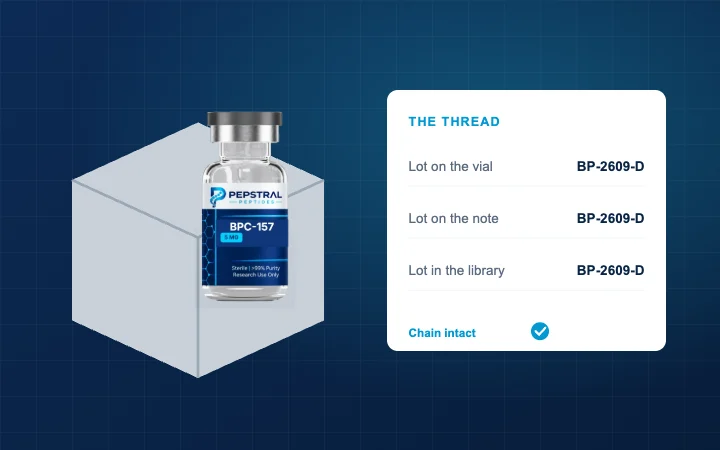
Haze that clears with time is normal and expected. Haze that is still there after fifteen minutes, or anything you would describe as a particle, is not a reconstitution problem — it is a question for the lot certificate. Our aggregation post covers the failure a certificate will never show you.
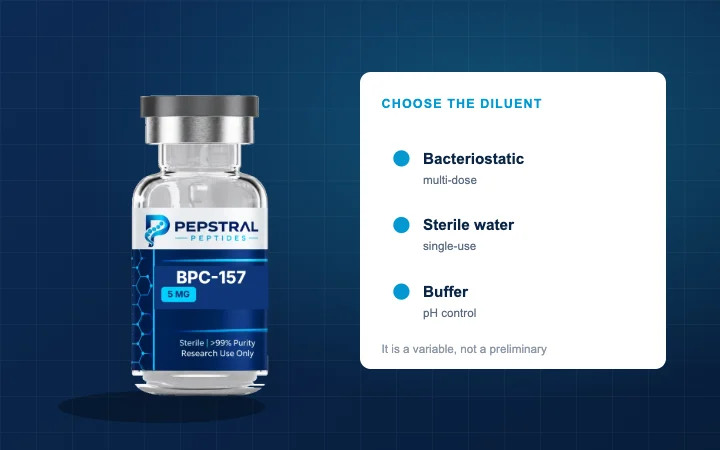
On diluent: bacteriostatic water for anything you will draw from more than once, sterile water for a single use, and be aware that the benzyl alcohol preservative is not inert in every assay — the preservative post has the cases where it matters. Our choosing a diluent post covers the rest.
The concentration table
Every size at four common fill volumes. Concentration in mg/mL, with millimolar in brackets at 4731 g/mol.
| Vial | 1 mL | 2 mL | 3 mL | 5 mL |
|---|---|---|---|---|
| 10 mg | 10.00 mg/mL (2.11 mM) | 5.00 mg/mL (1.06 mM) | 3.33 mg/mL (0.70 mM) | 2.00 mg/mL (0.42 mM) |
| 20 mg | 20.00 mg/mL (4.23 mM) | 10.00 mg/mL (2.11 mM) | 6.67 mg/mL (1.41 mM) | 4.00 mg/mL (0.85 mM) |
| 30 mg | 30.00 mg/mL (6.34 mM) | 15.00 mg/mL (3.17 mM) | 10.00 mg/mL (2.11 mM) | 6.00 mg/mL (1.27 mM) |
| 48 mg | 48.00 mg/mL (10.15 mM) | 24.00 mg/mL (5.07 mM) | 16.00 mg/mL (3.38 mM) | 9.60 mg/mL (2.03 mM) |
| 60 mg | 60.00 mg/mL (12.68 mM) | 30.00 mg/mL (6.34 mM) | 20.00 mg/mL (4.23 mM) | 12.00 mg/mL (2.54 mM) |
Two things to read off it.
Lower is better, within reason. Self-association is concentration-dependent. A 10 mg vial in 3 mL clears faster and stays clearer than the same vial in 1 mL, and if your protocol can accommodate the larger draw volume, take it. The concentration table for every vial shows the same trade-off across the whole catalogue.
The large vials get impractical fast. A 60 mg vial in 1 mL is 12.68 mM, which is a viscous, slow-clearing solution you will mostly be diluting anyway. If you are buying 60 mg, plan on 3 to 5 mL and an aliquoting step.
Which vial to buy
Two separate questions, and they pull against each other.
What you will actually use. If a study runs six months and consumes 4 mg, a 60 mg vial is not a saving — it is 56 mg of compound ageing in a freezer through repeated freeze-thaw. Buy for the study in front of you.
What it costs per milligram. For completeness, at current catalogue prices:
| Vial | Price | Per mg |
|---|---|---|
| 10 mg | $105.00 | $10.50 |
| 20 mg | $159.60 | $7.98 |
| 30 mg | $215.60 | $7.19 |
| 48 mg | $397.60 | $8.28 |
| 60 mg | $361.20 | $6.02 |
The 60 mg vial is the cheapest per milligram, as you would expect. The 48 mg is not on the curve — check the current product page before assuming that table still holds, because prices move.
Our post on how to choose a vial size works through the waste-versus-reorder arithmetic properly, and why prices vary between suppliers covers what a low per-milligram figure can hide.
Storage, aliquoting and the 28-day window
Sealed, lyophilized, in its carton, at −20°C: the powder is stable long-term and the certificate window applies from reconstitution, not from arrival.
Once reconstituted:
- Aliquot immediately, in single-use volumes, before the first freeze. Every thaw cycle costs you a little, and every septum puncture is a contamination opportunity.
- 2 to 8°C, in the dark. Retatrutide is light-sensitive; keep it in the carton or use amber vials.
- 28 days is the window we state on the certificate for reconstituted material in bacteriostatic water at 2–8°C. How long a reconstituted peptide lasts covers what drives that number.
- Record the date on the vial. Not the date you plan to use it — the date you added the water.
Frequently asked questions
Can I reconstitute a 60 mg vial and store it for a year?
You can store it; the question is what you have at the end. The stability window is stated for a reason, and a year of repeated access to one vial is a slow, invisible loss of material with no marker on the label to tell you it happened. If a study will run that long, buy the size that matches the phase you are in, or aliquot and freeze at the point of reconstitution.
How much diluent should I add if my protocol specifies a molar concentration?
Work backwards from the table. If you need a 2 mM stock and you have a 30 mg vial, 30 mg is 6.34 µmol, so 6.34 µmol ÷ 2 mM = 3.17 mL. Round to 3 mL and you have 2.11 mM, which is close enough for a stock you will dilute anyway — just record the actual figure rather than the intended one.
Does the fatty chain come off in solution?
Not under normal handling. The diacid is attached through a stable linker on a lysine side chain, not adsorbed. What does happen in solution is self-association driven by that chain, which is a physical process and reversible with time and dilution rather than a chemical loss.
My solution is slightly yellow. Is that a problem?
It should be colourless. Unlike GHK-Cu, where blue is the compound, there is nothing in retatrutide that should carry colour. Yellow is worth a question to us with the lot number.
Does the blend reconstitute the same way?
The retatrutide and cagrilintide blend contains 12.5 mg and 2.5 mg respectively, and both components are acylated, so the method is identical — down the wall, swirl, wait. The arithmetic is not: you have two compounds at two molecular weights in one volume, and a single "mg/mL" figure hides that. Our blends post covers the study-design consequences of that, which are larger than the handling ones.
References
- Lau J, Bloch P, Schäffer L, et al. Discovery of the once-weekly glucagon-like peptide-1 (GLP-1) analogue semaglutide. Journal of Medicinal Chemistry 2015;58(18):7370-7380. The fatty-diacid and albumin-binding design strategy later reused for tirzepatide and retatrutide. doi.org/10.1021/acs.jmedchem.5b00726
- Coskun T, Urva S, Roell WC, et al. LY3437943, a novel triple glucagon, GIP, and GLP-1 receptor agonist for glycemic control and weight loss: from discovery to clinical proof of concept. Cell Metabolism 2022;34(9):1234-1247.e9. doi.org/10.1016/j.cmet.2022.07.013
- PubChem CID 171390338 (record titled "Triple G"): molecular formula C221H342N46O68, molecular weight 4731. pubchem.ncbi.nlm.nih.gov/compound/171390338
Every product mentioned is sold for laboratory research use only and is not for human or animal use. Nothing on this page describes or recommends use of the material sold here in humans or animals.