
Melanotan-1 is a thirteen-residue linear peptide with two deliberate changes from the native hormone alpha-melanocyte-stimulating hormone: a norleucine in place of methionine at position 4 and a D-phenylalanine in place of L-phenylalanine at position 7. The analogue was first described by Sawyer and colleagues in 1980, and its generic name is afamelanotide. It is sold here as a 10 mg lyophilized vial with a certificate for the lot.
This post reads that certificate, COA3394 for lot MT110-0318, line by line. It also states a fact that research-peptide product pages tend to leave out: the same molecule is an approved prescription drug in another form, and that is a matter of record rather than an inconvenience. The melanotan-1 and melanotan-2 certificates post compares the two analogues; the melanocortin receptors post covers the receptor family. This page stays with one lot of one compound.
What is the molecule?
Ac-Ser-Tyr-Ser-Nle-Glu-His-D-Phe-Arg-Trp-Gly-Lys-Pro-Val-NH2. Thirteen residues, acetylated at the N-terminus and amidated at the C-terminus like the native hormone, formula C78H111N21O19, average mass 1646.9.
The two substitutions do specific chemical jobs. Native alpha-MSH has a methionine at position 4, and methionine oxidises. Norleucine is the same shape without the sulfur, so the analogue loses the hormone's main oxidation route. The D-phenylalanine at position 7 sits in the core His-Phe-Arg-Trp motif that all melanocortin ligands share, and the D-configuration makes that bond resistant to the proteases that cut the native hormone there. Both changes were made to make a longer-lived molecule, and the 1980 paper's title says so.
What remains from the native sequence is the tryptophan at position 9, which is light-sensitive, and the histidine, which is pH-sensitive in its charge. Those two residues decide the handling section below.
What does the certificate for lot MT110-0318 report?
Issued by Bioviridian Inc. on 3 April 2026. Four tests.
| Test | Method | Result | What it establishes |
|---|---|---|---|
| Identity | MALDI-MS | 1646.8 observed | The molecular ion matches the formula to within 0.1 |
| Purity | RP-HPLC, 214 nm | 99.8% | 99.8% of UV-absorbing material is the main peak, retention 6.86 minutes |
| Content | Gravimetric against label | 10.78 mg | Eight percent over the 10 mg label |
| Endotoxin | LAL | ≤ 0.05 EU/mL | At or below the reporting limit |
This lot's certificate has four lines rather than the five or six some newer lots carry; there is no heavy-metals or sterility line. That is a statement about what was tested, not about what was found, and the post on what a certificate does not test for is the right frame for reading an absence.
Identity. MALDI-MS reports the molecular ion. 1646.8 against a predicted 1646.9 is as close as the method reports. For a thirteen-residue peptide a single mass does not formally fix the sequence, but it does rule out the two things a buyer most needs ruled out: the melanotan-2 analogue, which is cyclic and has a mass of 1024.2, and oxidised material, which would be 16 heavier. The LC-MS post explains why a tandem method would be stronger still.
Purity. At 214 nm, by area. A thirteen-residue peptide with tyrosine, phenylalanine, tryptophan and histidine retains well and separates cleanly, so 99.8% is a discriminating figure. The area-percent post explains what it measures.
Content. 10.78 mg measured against a 10 mg label. Use the measured figure in your calculations, as the lot-to-lot post recommends.
How many micromoles is 10 mg?
The label's 10 mg at 1646.9 g/mol is 6.07 micromoles; the measured 10.78 mg is 6.55. Dissolved in 1 mL the stock is about 6 millimolar. Receptor-binding and cell-based melanocortin assays in the literature work in the nanomolar range, so one vial is an almost inexhaustible supply for in-vitro work. The concentration table has the dilutions, and the molarity post the method.
How is it handled?
- Light. The tryptophan at position 9 photo-oxidises. Keep the lyophilized vial boxed and solutions in amber tubes. This is the single most important handling point for any melanocortin peptide.
- Oxidation. The norleucine substitution removed the methionine, so this analogue is much less oxidation-prone than native alpha-MSH. Tryptophan can still oxidise under light; degassing is a reasonable precaution for sensitive assays but not essential.
- pH. The histidine's charge changes around pH 6. Buffer the working solution and record the pH, as the pH and buffer post recommends.
- Adsorption. Net positive charge and three aromatic residues: a peptide that sticks to plastic. Low-binding tubes at the nanomolar end; the adsorption post has the mechanism.
- Storage. Lyophilized at minus 20 °C in the dark. Aliquot solutions, freeze, thaw once.
- Diluent. Water or buffer. Reconstitution solution only for a preserved multi-entry stock.
What is the regulatory status, and why does a research product page state it?
Afamelanotide is an FDA-approved prescription drug. The approval, under NDA 210797, was granted on 8 October 2019 for an implant formulation, for a rare inherited photodermatosis. In the European Union the same drug was approved earlier under a different route.
Those facts do not change what is in the vial sold here, which is the research-grade peptide with the certificate above, sold for laboratory research use only and not for human or animal use. They do change what an honest product page must say. A buyer deserves to know that the molecule they are purchasing as a research reagent is, in another formulation and through another channel, a regulated medicine, because that is the fact that governs how it may lawfully be sold and used. This site states it rather than leaving it to be discovered. The research-use post explains why that designation is a boundary and not a disclaimer, and the legality post covers the wider frame.
Frequently asked questions
Is melanotan-1 the same as melanotan-2?
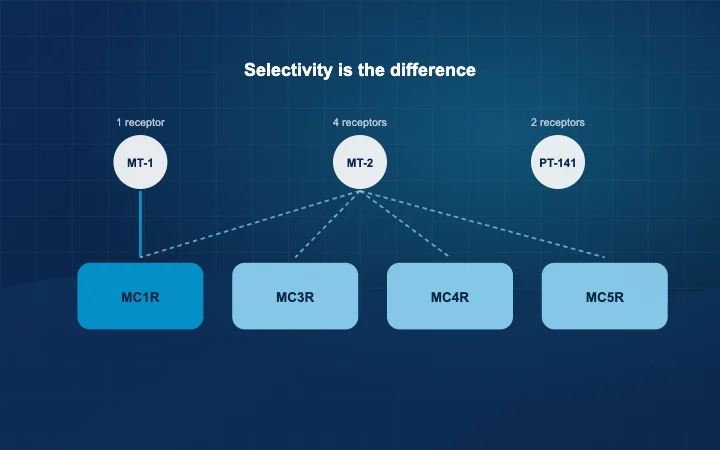
No. Melanotan-1 is the linear thirteen-residue analogue described here, mass 1646.9. Melanotan-2 is a cyclic seven-residue analogue, mass 1024.2, with different receptor selectivity. The comparison page and the certificates post deal with the two together.
Why does the certificate have four lines rather than six?
Because four tests were run on this lot. Newer lots on the site often carry heavy metals and sometimes sterility as well. The absence of a line means it was not tested, not that it was tested and failed.
What does "Nle4" mean?
Norleucine at position 4, replacing the methionine of the native hormone. Norleucine is methionine's shape without the sulfur, so the analogue does not oxidise at that position.
How light-sensitive is it, really?
Tryptophan photo-oxidation is real and measurable over hours of bench light in solution. It is the reason for amber tubes and boxed vials, and the reason a stock that has sat in a clear tube on a lit bench should be re-checked by HPLC before it is trusted.
Is afamelanotide the same molecule as melanotan-1?
Yes. Afamelanotide is the generic name for [Nle4, D-Phe7]-alpha-MSH. The approved product is a different formulation of the same peptide, sold through a different channel for a different purpose. What is sold here is the research reagent, for laboratory use only.
References
- PubChem, National Library of Medicine. Afamelanotide, CID 16197727, C78H111N21O19, CAS 75921-69-6. Read 2 October 2026. pubchem.ncbi.nlm.nih.gov/compound/16197727
- Sawyer TK, Sanfilippo PJ, Hruby VJ, et al. 4-Norleucine, 7-D-phenylalanine-alpha-melanocyte-stimulating hormone: a highly potent alpha-melanotropin with ultralong biological activity. Proceedings of the National Academy of Sciences 1980;77(10):5754-5758. doi.org/10.1073/pnas.77.10.5754
- U.S. Food and Drug Administration. Scenesse (afamelanotide) implant, NDA 210797, approved 8 October 2019. Drugs@FDA. www.accessdata.fda.gov/scripts/cder/daf/index.cfm?event=overview.process&ApplNo=210797
- Bioviridian Inc. Certificate of analysis COA3394, lot MT110-0318, issued 3 April 2026. Verification code on the certificate. bioviridians.com/coa-search.html
Every product mentioned is sold for laboratory research use only and is not for human or animal use. Nothing on this page describes or recommends use of the material sold here in humans or animals.