Research peptides are sold in the United States as laboratory chemicals for in-vitro and preclinical use. Buying them for that purpose is how every university, contract lab and independent researcher gets them. What the law regulates is intended use: a peptide marketed for laboratory research is treated as a research chemical, and the same peptide marketed or used for treating people is treated as an unapproved drug.
This page explains the framework as it stands in September 2026, what the FDA changed this year, what its 2026 warning letters to peptide sellers say, and what it means when you order. It is a description of the rules, not legal advice, and your institution's compliance office is the authority for your situation.
How does the FDA decide what a product is?
The Federal Food, Drug and Cosmetic Act defines a drug by its intended use, and the FDA reads intended use from everything a seller says and does: labels, website copy, marketing, customer communications, even what the seller's staff say in chat. A compound sold with laboratory labelling, sold to laboratory customers and described in laboratory terms is a research chemical. The same compound sold with dosing guides, before-and-after claims or a wellness framing is a drug being marketed without approval, whatever the label says.
The phrase "research use only" itself comes from the FDA's labelling rules for in-vitro diagnostic products, which require that wording and forbid representing the product as effective for clinical use. For chemicals the phrase is a trade convention rather than a regulation, but the FDA applies the same intended-use test to it. That is why a serious research supplier's site reads the way this one does, and why support will not answer questions about personal use.
What do the 2026 warning letters say?
The clearest statement of the test is in the FDA's own enforcement. In a warning letter dated 17 June 2026 to a peptide seller, the agency wrote that evidence from the company's product labelling, including its website, established that the products were intended to be drugs for human use, despite statements that they were for research and not for human consumption. The claims it pointed to were benefit statements on product pages. The products were cited as unapproved new drugs, and the company was given fifteen business days to respond with corrective steps.
Two lessons follow for a buyer. First, the disclaimer on a vial does not decide what the product is; the seller's whole site does. Second, a supplier whose pages carry benefit or dosing language is exposed to exactly this action, and the vetting checklist treats that language as a red flag for that reason.
What is the Category 2 list and what changed in 2026?
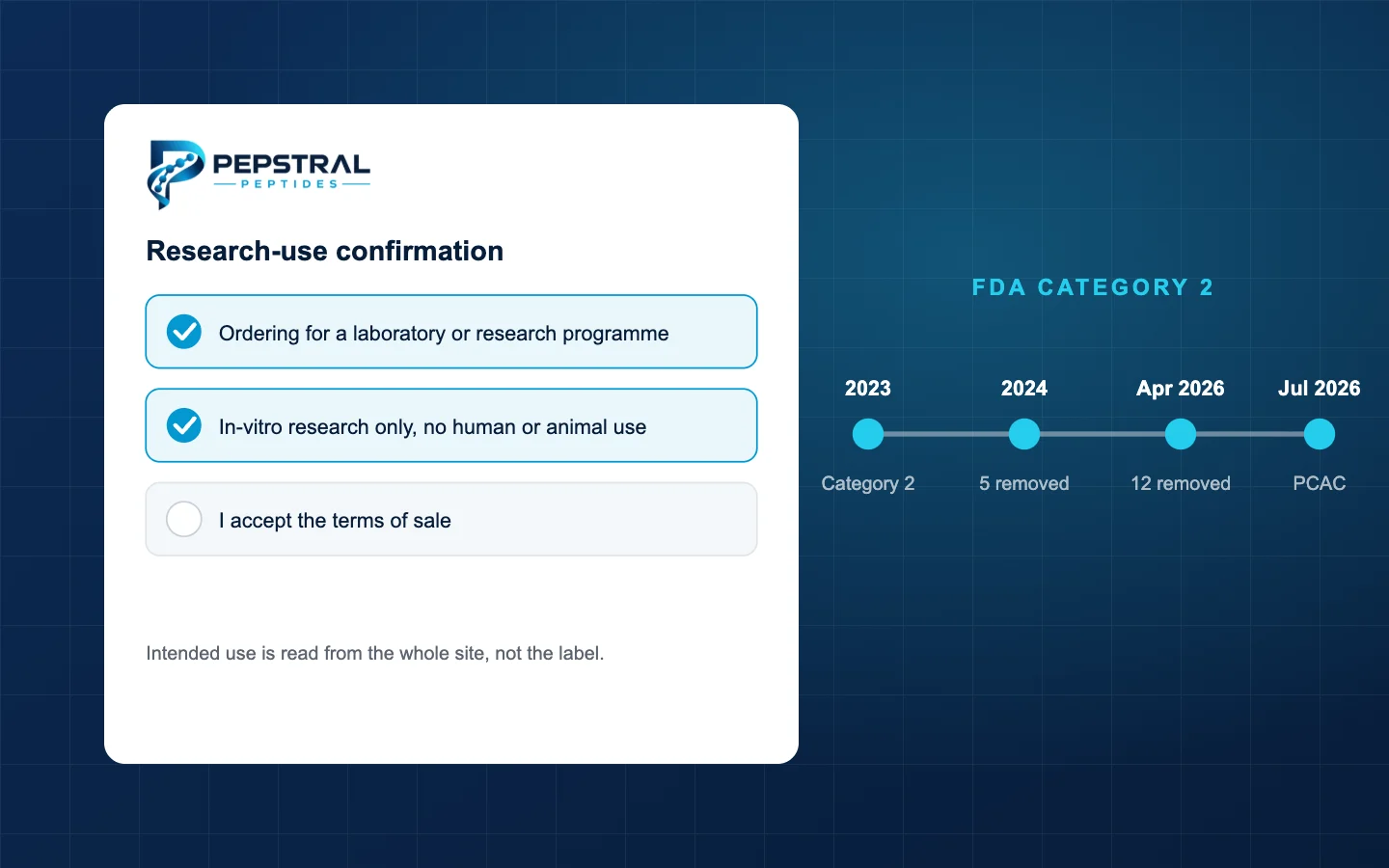
Compounding pharmacies can make drugs from bulk substances only if those substances are approved drugs, have a monograph, or appear on the FDA's 503A bulks list. Substances nominated for that list but not yet evaluated sit in interim categories. Category 1 substances may be compounded while the FDA finishes its review. Category 2 substances are those the FDA has flagged as raising significant safety risks, and pharmacies may not compound them.
| Date | Action | Compounds in this catalog affected |
|---|---|---|
| September 2023 | FDA places a group of peptides in Category 2 | BPC-157, CJC-1295, ipamorelin, injectable GHK-Cu, MOTS-c, a thymosin beta-4 fragment |
| September 2024 | Five removed after nominations withdrawn | CJC-1295, ipamorelin |
| 15 April 2026 | Twelve more removed, effective a week later | BPC-157, TB-500, injectable GHK-Cu, MOTS-c |
| 23 and 24 July 2026 | Pharmacy Compounding Advisory Committee meets on the removed peptides | Outcome to be published |
| Before end of February 2027 | Second committee meeting scheduled |
Two things the 2026 change does not do. Removal from Category 2 does not place a peptide on the 503A bulks list or in Category 1; until the committee acts and the FDA decides, the substances sit between categories. And none of it touches approval. None of the peptides named above is an approved drug. The whole Category 2 story concerns what licensed pharmacies may compound on prescription, which is a different question from what research suppliers may sell for laboratory use.
Which compounds in this catalog are approved drugs?
Semaglutide and tirzepatide are the active ingredients of FDA-approved prescription medicines. Research-grade material of an approved drug's active ingredient can still be sold for laboratory use, but it is not the medicine, is not made under the medicine's approval, and may not be represented as a substitute for it. Retatrutide was an investigational compound in late-stage trials when this page was written.
The remaining compounds, BPC-157, TB-500, GHK-Cu, MOTS-c, ipamorelin, CJC-1295 in the CJC + Ipamorelin blend, tesamorelin in its research form and NAD+, are unapproved for human use and are sold here for research only.
What does this mean for a buyer?
- Buying for laboratory use is the intended path. Institutions and independent researchers purchase research peptides routinely. The research-use confirmation at checkout is the seller recording that intended use.
- Buying for personal use is outside the framework. A seller who sells for that purpose is marketing an unapproved drug, and a buyer who uses a research chemical on themselves is outside any approval, testing or labelling protection. This site does not sell for that purpose and support will not advise on it.
- Athletes have a separate rule set. The World Anti-Doping Agency's prohibited list bans BPC-157 and TB-500 at all times as non-approved substances and bans growth hormone releasing factors such as CJC-1295, ipamorelin and tesamorelin. FDA category changes do not alter the WADA list.
- State law varies. Some states regulate research chemicals or peptide sales more tightly than federal law does. Check your state before ordering into it.
- Customs applies to imports. Peptides ordered from outside the US pass through customs, where the same intended-use questions arise. Ordering from a domestic supplier avoids that step.
How to tell a research supplier from one that is not
The vetting checklist in how to vet a research peptide supplier covers certificates and testing. On the regulatory side, look at the language. A research supplier describes compounds by sequence, mechanism and the models they appear in, posts a research-use statement, and has terms of sale that say who it sells to.
A supplier that publishes protocols for people, cycles, stacks or results has told the FDA what its intended use is. The June 2026 letter shows what happens next, and a payment processor or carrier reading the same page reaches the same conclusion sooner.
Frequently asked questions
Do I need a licence to buy research peptides?
Federal law does not require a licence to buy research chemicals for laboratory use. Suppliers set their own terms; ours asks buyers to confirm they are ordering for research, and wholesale accounts go through the wholesale form.
Did the 2026 FDA change make BPC-157 legal to use?
No. It removed BPC-157 from the Category 2 compounding restriction and referred it to an advisory committee. It did not approve BPC-157, did not add it to the 503A bulks list, and did not change its status as a research chemical.
Is bacteriostatic water regulated the same way?
Bacteriostatic water is a sterile diluent that is itself an FDA-regulated product when sold for injection. Suppliers sell it for laboratory reconstitution under the same research-use terms.
Where can I read the primary sources?
The FDA's warning letters are public and the June 2026 letter is linked in the references. The FDA's compounding pages list the interim categories and the advisory committee schedule, and the Federal Register carries the notices. This page will be updated after the July 2026 committee outcome is published.
References
- US Food and Drug Administration. Warning Letter to Wholesale Peptide, 17 June 2026: website evidence established intended use as drugs despite 'not for human consumption' labelling. www.fda.gov/inspections-compliance-enforcement-and-criminal-investigations/warning-letters/wholesale-peptide-729447-06172026
- Orrick. FDA Announces Removal of 12 Peptides from Category 2 and Schedules PCAC Meetings. April 2026. www.orrick.com/en/Insights/2026/04/FDA-Announces-Removal-of-12-Peptides-from-Category-2-and-Schedules-PCAC-Meetings
- BSCG. What's Changing With Peptide Regulation in 2026. www.bscg.org/blogs/single/whats-changing-with-peptide-regulation-in-2026
- Holt Law. Deep Dive: Regulatory Status of Popular Compounded Peptides (2023 and 2024 Category 2 actions). djholtlaw.com/deep-dive-regulatory-status-of-popular-compounded-peptides
- FDA. Distribution of In Vitro Diagnostic Products Labeled for Research Use Only or Investigational Use Only: Guidance for Industry and FDA Staff. www.fda.gov/files/medical%20devices/published/Distribution-of-In-Vitro-Diagnostic-Products-Labeled-for-Research-Use-Only-or-Investigational-Use-Only---Guidance-for-Industry-and-FDA-Staff.pdf
Every product mentioned is sold for laboratory research use only and is not for human or animal use. Nothing on this page describes or recommends use of the material sold here in humans or animals.