
There is no universal answer, and a supplier who gives you one is answering a different question. The pH a peptide solution should sit at is decided by two constraints that frequently disagree: the pH at which that particular sequence degrades slowest, and the pH your downstream assay will actually accept. Where there is freedom to choose, slightly acidic is the common default, because most of the non-enzymatic routes that destroy peptides speed up as pH climbs towards neutral and beyond. Where there is no freedom — a cell assay needs a physiological buffer, a mass spectrometer needs a volatile one — the assay wins and the stock is prepared to survive the shortest possible time in the wrong conditions.
The isoelectric point, and why solubility collapses there
Every peptide has a pH at which its positive and negative charges exactly cancel. That is the isoelectric point, or pI, and it is the worst place to keep a solution.
The reason is the same reason a peptide aggregates at all. Charge does two useful things: it makes the molecule interact with water, and it makes molecules of the same peptide repel each other. At the pI both effects vanish at once. Nothing holds neighbouring molecules apart, and solubility passes through a minimum — which is why "avoid the isoelectric point" appears in our aggregation post as one of the drivers to control.
You cannot read the pI off a molecular formula. Sulfur, carbon and nitrogen counts say nothing about it; you need the sequence. The logic is a count:
- Basic residues — arginine, lysine, histidine — plus the free N-terminus, push the pI up.
- Acidic residues — aspartate, glutamate — plus the free C-terminus, pull it down.
- A C-terminal amide removes a negative charge, so an amidated peptide has a higher pI than the same sequence as a free acid. This is one of the reasons the amide-versus-acid distinction in the Semax post is more than notation.
Two sequences we have already published make the contrast concrete. Kisspeptin-10 is Tyr-Asn-Trp-Asn-Ser-Phe-Gly-Leu-Arg-Phe-NH₂: an arginine, an amidated C-terminus, and no aspartate or glutamate at all — a basic peptide, comfortably soluble on the acidic side and nowhere near its pI there. Epithalon is Ala-Glu-Asp-Gly: one glutamate, one aspartate, no basic residues — an acidic peptide whose charge behaviour is the mirror image.
Sequence-based pI calculators are worth using and worth distrusting slightly. Different algorithms use different side-chain constants and disagree by a few tenths of a unit, which is fine for deciding which side of neutral to work on and not fine as a precise number.
Why slightly acidic is the usual default
Most of the chemistry that ruins a peptide in water is base-catalysed or thiolate-dependent, so it gets faster as pH rises.
| Route | What pH does to it | Covered in |
|---|---|---|
| Deamidation of asparagine and glutamine | Accelerates markedly at neutral and alkaline pH | How long a reconstituted peptide lasts |
| Thiol oxidation | The reactive species is the deprotonated thiolate, and raising pH produces more of it | Why glutathione oxidises |
| Disulfide scrambling | Thiol-disulfide exchange is favoured at alkaline pH | Disulfide bonds and cysteine |
| Aggregation | Worst near the pI, whatever that value is | Aggregation explained |
| Acid-catalysed hydrolysis | The one route that gets worse as pH falls, particularly at aspartate-containing bonds | How long a reconstituted peptide lasts |
That last row is why the default is slightly acidic rather than strongly acidic. Pushing pH down trades one set of reactions for another, and Manning's review is explicit that each peptide has its own pH of maximum stability rather than the field having a single one.
Two practical footnotes. A peptide supplied as a TFA salt already brings a little acid with it, which is part of what the TFA and acetate post is about — a solution in plain water is not necessarily at pH 7. And dilute acetic acid is the conventional first thing to reach for with a stubborn basic peptide, which works by putting the molecule far from its pI rather than by any special property of acetate.
Which buffer, and what it costs downstream
Buffer choice is rarely about stability alone. It is mostly about what the next instrument or cell will tolerate. The following is general laboratory practice rather than a recommendation for any compound sold here.
| Buffer | Volatile? | Where it helps | What it costs |
|---|---|---|---|
| Unbuffered water | n/a | Simple stocks intended for dilution into assay buffer; nothing to interfere with anything | No buffering capacity at all; pH set by the counter-ion and drifting with dissolved CO₂ |
| Acetic acid / acetate | Yes | Acidic range; good for poorly soluble basic peptides; largely removed by lyophilisation; mass-spectrometry friendly | Acetate is a nutrient and a metabolite, so it is not inert in cell work |
| Ammonium acetate | Yes | The standard volatile buffer for LC-MS work near neutral | Ammonium adducts if not fully removed |
| Ammonium bicarbonate | Yes | Sublimes away during freeze-drying, which is why it is the conventional choice when a sample must be dried and the buffer must disappear | Mildly alkaline — the wrong direction for thiols and methionine — and it decomposes on warming, so the pH is not stable in an open vessel |
| Phosphate | No | Physiologically relevant, well-behaved near pH 7, cheap | Shifts pH sharply on freezing (below); precipitates with divalent cations, which is one reason GHK-Cu dislikes it; stays behind entirely in a lyophilised cake |
| Tris | No | Common in protein biochemistry, good buffering above pH 7.5 | pH moves with temperature; the primary amine competes in amine-reactive labelling chemistry |
| HEPES, MOPS and the other zwitterions | No | Stable in cell culture, little metal binding | Non-volatile, and generally unhelpful for mass spectrometry |
| PBS or saline | No | What the cells want | Salt load is a problem for both mass spectrometry and freeze-drying |
The general shape of the decision: keep the stock simple and buffer at the assay step. A concentrated stock in water or dilute acid, diluted into whatever the experiment needs, gives you one solution to store and no buffer components sitting around for months with the peptide.
What freezing does to a buffered solution
This is the part that surprises people, and it is the strongest argument for keeping buffer concentrations low in anything that will be frozen.
As ice forms, the solutes left behind concentrate in a shrinking volume of unfrozen liquid. If one component of a buffer pair crystallises out before the other, the ratio between them changes, and the pH moves with it. Gómez, Pikal and Rodríguez-Hornedo measured this directly in sodium phosphate. Precipitation of the disodium salt caused abrupt pH drops as ice formed, and at an initial pH of 7.4 the solutions reached pH 4.2 ± 0.1 at −10°C at 50 and 100 mM, while 8 mM solutions reached only 5.2 ± 0.2. Lower initial concentration and lower initial pH both produced smaller shifts.
Read that as a warning about two ordinary operations.
Freeze-drying. A peptide frozen in strong phosphate at neutral pH experiences an acidic excursion during freezing that it never saw on the bench, and it experiences it while it is still mobile enough for chemistry to happen. Tang and Pikal's practical account of freeze-drying process design is the standard starting point for thinking about the rest of that cycle.
Freezing aliquots. The same physics applies to a working solution put in a freezer, which is part of why freeze-thaw cycling appears as its own driver in the aggregation post. The peptide is not only being frozen — for a while it is sitting in a concentrated, pH-shifted liquid.
There is also a plain material consequence. Volatile buffers mostly leave with the water; non-volatile ones stay in the cake. A milligram of peptide lyophilised out of concentrated phosphate comes back as a re-dissolved buffer with some peptide in it, which changes the cake's appearance as well as its contents — the subject of why the vial looks empty.
A short decision order
- Ask whether pH is a stability question or an assay question here. If the material will be diluted into assay buffer within the hour, the stock's pH matters much less than its solubility.
- Find out roughly where the pI is from the sequence, and stay away from it.
- Default to the acidic side for storage unless the sequence or the assay says otherwise.
- Pick the buffer for the downstream method, not for the storage step — volatile for mass spectrometry and for anything that will be dried, physiological for cells.
- Keep buffer concentration as low as will do the job if anything will be frozen.
- Record what you used, as the methods-reporting post sets out. Diluent and buffer are the two variables most often missing from a methods section and most often the explanation for a result that will not reproduce.
Frequently asked questions
Does the certificate state a pH?
No. We checked all 114 certificates in our library: they report identity, content, purity, endotoxin and heavy metals, with sterility on some lots, and there is no pH line on any of them. That is appropriate for a lyophilised powder, which has no pH — pH is a property of the solution you make, and therefore of your diluent rather than of the vial. The reading-a-COA guide walks through what the lines do say.
Should I measure the pH of my stock?
If the answer changes what you do, yes, with a microelectrode. In practice small volumes make the measurement awkward and it consumes sample, so most work controls pH by preparation — a known diluent, prepared the same way each time — rather than by measurement. Indicator paper is a sanity check, not a number.
What if the peptide will not dissolve at the pH the assay needs?
The standard route is to dissolve it where it is soluble and dilute into where it needs to be: a small volume of a favourable diluent first, then the assay buffer, with gentle mixing rather than shaking. Our diluent post covers the options, and why GLP-1 peptides dissolve slowly covers the case where patience rather than chemistry is the answer.
Does bacteriostatic water buffer anything?
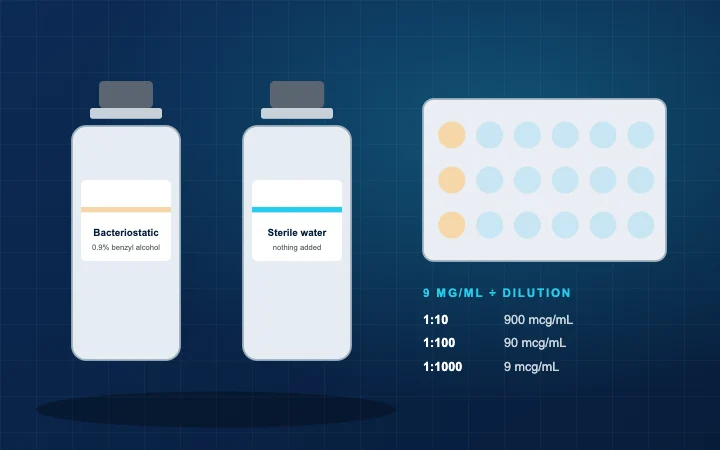
No. Reconstitution solution is sterile water with 0.9% benzyl alcohol as a preservative. It inhibits microbial growth and has essentially no buffering capacity, so the pH of the resulting solution is set by the peptide and its counter-ion, not by the diluent.
Every product referenced here is supplied for laboratory research use only and is not for human or animal use.
References
- Gómez G, Pikal MJ, Rodríguez-Hornedo N. Effect of initial buffer composition on pH changes during far-from-equilibrium freezing of sodium phosphate buffer solutions. Pharmaceutical Research 2001;18(1):90-97. doi.org/10.1023/A:1011082911917
- Manning MC, Chou DK, Murphy BM, Payne RW, Katayama DS. Stability of protein pharmaceuticals: an update. Pharmaceutical Research 2010;27(4):544-575. doi.org/10.1007/s11095-009-0045-6
- Li S, Schöneich C, Borchardt RT. Chemical instability of protein pharmaceuticals: mechanisms of oxidation and strategies for stabilization. Biotechnology and Bioengineering 1995;48(5):490-500. doi.org/10.1002/bit.260480511
- Tang X, Pikal MJ. Design of freeze-drying processes for pharmaceuticals: practical advice. Pharmaceutical Research 2004;21(2):191-200. doi.org/10.1023/B:PHAM.0000016234.73023.75
Every product mentioned is sold for laboratory research use only and is not for human or animal use. Nothing on this page describes or recommends use of the material sold here in humans or animals.