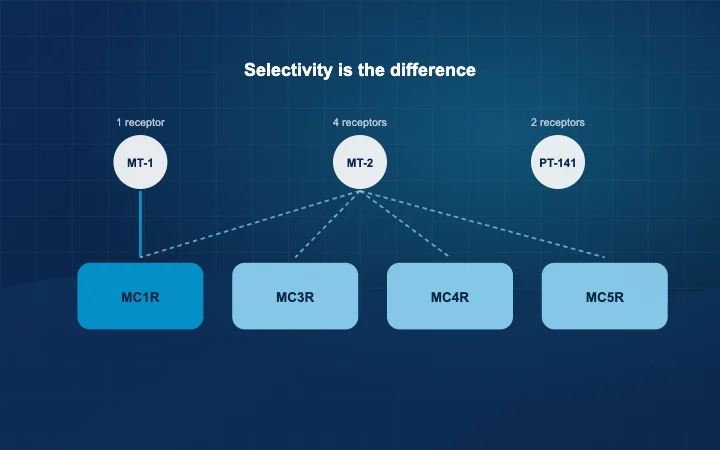

Melanotan-1 is the 13-residue hormone alpha-MSH with two substitutions, norleucine at position 4 and D-phenylalanine at position 7, and a mass of 1646.8. Melanotan-2 is a 7-residue cyclic lactam built around the same receptor-binding motif, with a mass of 1024.2. Both ship as 10 mg vials, and today only melanotan-1 has a certificate on file. This post explains what a certificate for each should report, reads the one that exists, and says plainly why the other is absent. The receptor pharmacology that distinguishes the two is covered in the melanocortin receptor post and the side-by-side comparison; this post is about the paperwork.
What are the two compounds, structurally?
| Melanotan-1 | Melanotan-2 | |
|---|---|---|
| Other names | Afamelanotide (INN), MT-1, [Nle4, D-Phe7]-alpha-MSH | MT-II, MT-2 |
| Origin | Sawyer et al. 1980 | Al-Obeidi, Hruby et al. 1989 |
| Residues | 13, linear | 7, cyclic (lactam between Asp and Lys side chains) |
| Termini | Acetylated N-terminus, amidated C-terminus | Acetylated N-terminus, amidated C-terminus |
| Formula | C78H111N21O19 | C50H69N15O9 |
| Mass | 1646.8 | 1024.2 |
| Catalogue vial | 10 mg | 10 mg |
| Certificate on file | COA3394, lot MT110-0318 | None |
Both keep the His-Phe-Arg-Trp motif that engages the melanocortin receptors, with D-phenylalanine in place of the natural L-residue. Melanotan-1 keeps the rest of the hormone's sequence around it; melanotan-2 discards most of it and closes what remains into a ring. The cyclic peptides post explains why a ring is more resistant to proteolysis and more conformationally fixed, and the five-names post lists afamelanotide among the INNs that supplier pages rarely use.
What should a melanotan-1 certificate report?
An identity mass of 1646.8. The obvious substitutions are all separable by mass: native alpha-MSH is 1664.9, since methionine at position 4 is heavier than norleucine by 18 units; an all-L version of the analogue is the same mass as the D-Phe form and cannot be told apart by mass spectrometry alone, which is the one limit the LC-MS post is honest about. Purity by reversed-phase HPLC, content by quantitation, endotoxin for cell work.
The current certificate, COA3394, was issued by Bioviridian Inc. on 3 April 2026 for lot MT110-0318 against a 10 mg sample of white lyophilized powder, and is published unaltered on the certificate page.
| Certificate line | Result | What it tells you |
|---|---|---|
| Identity, MALDI-MS | MT-1, observed mass 1646.8 | Matches the [Nle4, D-Phe7] analogue; native alpha-MSH would read 1664.9 |
| Content, HPLC quantitation | 10.78 mg | Overage against the 10 mg label |
| Purity, RP-HPLC at 214 nm | 99.8% | One main peak; the chromatogram post covers reading the trace |
| Endotoxin | ≤ 0.05 EU/mL | Suitable for cell work |
| Heavy metals, sterility | Not on this layout | The April 2026 certificates report four tests; June and August layouts add more |
The April date is worth noting. It is the oldest current certificate in the catalogue for a compound of this class, and the lot report shows which compounds were re-certified in August. A laboratory that wants a more recent certificate for melanotan-1 should say so before ordering, and the supplier-vetting post says to ask.
What should a melanotan-2 certificate report, and why is there none?
An identity mass of 1024.2, and this is a case where the mass does real work. Melanotan-2 is made as a linear peptide and then cyclised by forming a lactam between an aspartate side chain and a lysine side chain, which removes one water. The uncyclised precursor is therefore 18 units heavier, at about 1042. A certificate mass of 1024.2 confirms the ring closed; a mass of 1042 means the vial holds the linear peptide, which is a different compound with different receptor behaviour. The blend certificate post makes the same point about masses that differ by small, meaningful amounts.
There is no such certificate on file today. The melanotan-2 product page says so, points to support for lot enquiries, and does not display a lot number, a purity or a test date. That is the honest state of affairs. This site's certificate policy is that every number about testing must come from a published certificate, and there is not one for this compound yet.
What this means in practice: a study that needs certified melanotan-2 should ask whether a certificate for the current lot can be obtained before ordering, and should not use the melanotan-1 certificate as a proxy. The two are different molecules with different masses, and one certificate says nothing about the other.
How do the two compare on the bench?
| Property | Melanotan-1 | Melanotan-2 |
|---|---|---|
| 10 mg is | 6.07 µmol | 9.76 µmol |
| In 1 mL | 6.07 mM | 9.76 mM |
| Solubility in water | Good | Good |
| Proteolytic exposure | Linear, capped ends; interior cleavable | Cyclic, capped; more resistant, per the cyclic peptides post |
| Aggregation | Low at working concentrations | Low |
| Storage | Storage guide windows | Same |
A 10 mg vial of melanotan-2 is 60% more molecules than a 10 mg vial of melanotan-1, because the cyclic peptide is 60% of the mass. A receptor-binding study that compares the two at equal mass concentration is comparing unequal molar concentrations, which the molarity post explains.
Which other catalogue compounds share this chemistry?
PT-141 is melanotan-2 with the C-terminal amide replaced by a free acid, a change the PT-141 post covers, and it is supplied in solution for reasons the solution-format post explains. KPV is the opposite case: the fragment of alpha-MSH that lacks the receptor-binding motif entirely, covered in the KPV post.
Frequently asked questions
Is melanotan-1 the same as afamelanotide?
Yes. Afamelanotide is the INN for [Nle4, D-Phe7]-alpha-MSH. The certificate mass, 1646.8, matches the PubChem entry for afamelanotide.
Can a certificate tell D-phenylalanine from L-phenylalanine?
Not by mass; the two have identical masses. A chiral HPLC method or amino-acid analysis after hydrolysis can, and neither is on the standard certificate. The one-percent post covers what the standard tests do and do not resolve.
Why does melanotan-2 have no certificate when melanotan-1 does?
Because no certificate for a melanotan-2 lot has been published by the laboratory that certifies the catalogue. The product page states this. It is not a claim about the material; it is the absence of a document.
Does the melanotan-1 certificate cover melanotan-2?
No. Different molecule, different mass, different lot. A certificate applies to the lot it names and nothing else.
What should a methods section record for melanotan-1?
"Afamelanotide ([Nle4, D-Phe7]-alpha-MSH)", the supplier, lot MT110-0318, certificate COA3394, the observed mass 1646.8, and the stock concentration in molar terms. The methods-section post has the template.
References
- Sawyer TK, Sanfilippo PJ, Hruby VJ, et al. 4-Norleucine, 7-D-phenylalanine-alpha-melanocyte-stimulating hormone: a highly potent alpha-melanotropin with ultralong biological activity. Proceedings of the National Academy of Sciences 1980;77(10):5754-5758. doi.org/10.1073/pnas.77.10.5754
- Al-Obeidi F, Castrucci AM, Hadley ME, Hruby VJ. Potent and prolonged acting cyclic lactam analogues of alpha-melanotropin: design based on molecular dynamics. Journal of Medicinal Chemistry 1989;32(12):2555-2561. doi.org/10.1021/jm00132a010
- PubChem, National Library of Medicine. Afamelanotide CID 16197727, C78H111N21O19, 1646.8 g/mol; melanotan II CID 92432, C50H69N15O9, 1024.2 g/mol. Read 27 September 2026. pubchem.ncbi.nlm.nih.gov/compound/16197727
Every product mentioned is sold for laboratory research use only and is not for human or animal use. Nothing on this page describes or recommends use of the material sold here in humans or animals.