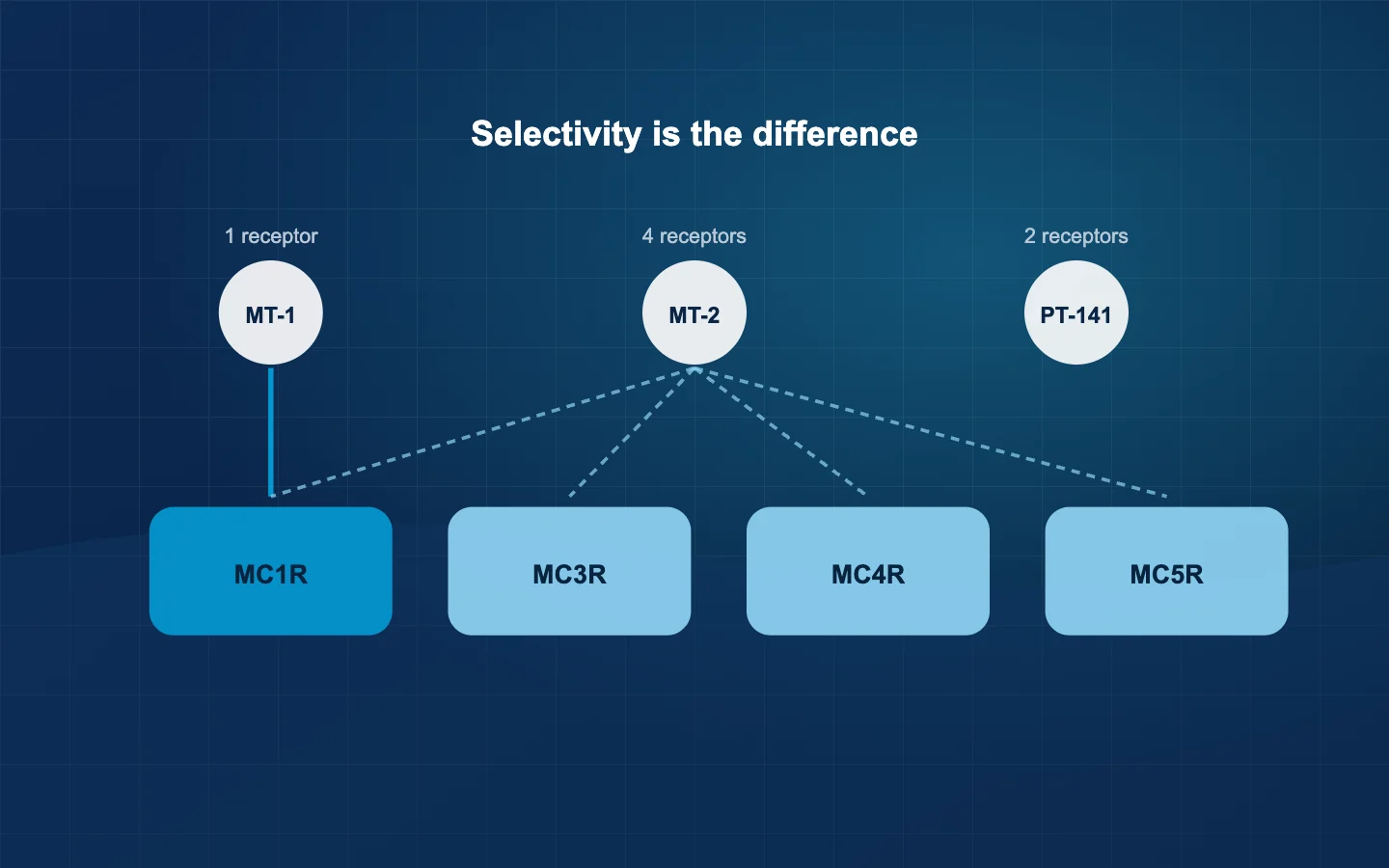
Melanotan-1, melanotan-2, PT-141 and KPV all descend from the same hormone, alpha-melanocyte-stimulating hormone, and they behave very differently. The reason is not potency but selectivity: there are five melanocortin receptors, they sit in different tissues, and each analogue engages a different subset. Getting this straight is the difference between a result you can attribute and one you cannot.
What are the five melanocortin receptors?
| Receptor | Mainly found in | Associated with |
|---|---|---|
| MC1R | Melanocytes | Pigmentation; also inflammatory signalling |
| MC2R | Adrenal cortex | The ACTH receptor — responds to ACTH, not to MSH analogues |
| MC3R | Hypothalamus, periphery | Energy homeostasis, inflammation |
| MC4R | Central nervous system | Appetite and energy balance; central signalling |
| MC5R | Exocrine tissue | Sebaceous and exocrine function |
MC2R is the outlier: it responds to ACTH and not to the MSH-derived analogues, so it is largely out of scope for this family. The pharmacologically interesting spread is MC1R, MC3R, MC4R and MC5R.
Bardhan and colleagues' 2025 review is a useful entry point for the inflammatory side of the family, which gets less attention than pigmentation but is where several of these receptors do their day job.
Which analogue binds which receptor?
Melanotan-1 (afamelanotide) is a linear 13-residue analogue, comparatively selective for MC1R. PubChem lists it at C78H111N21O19, 1,646.8 g/mol. Because it concentrates its activity on one receptor, an effect observed with it is far easier to attribute.
Melanotan-2 is a cyclic lactam heptapeptide — a much smaller molecule at 1,024.2 g/mol — and the cyclisation retains affinity across MC1R, MC3R, MC4R and MC5R. It is not a "stronger melanotan-1"; it is a differently-shaped molecule that hits more targets.
That non-selectivity cuts both ways. For receptor mapping it is useful: one compound probing several receptors. For attribution it is a liability: an observed effect could originate at any of four receptors, and without selective antagonists or knockout systems you cannot say which.
PT-141 (bremelanotide) is a metabolite of melanotan-2 in which the C-terminal amide is replaced by a hydroxyl. That single change shifts the profile away from MC1R and toward MC3R and MC4R — which is why it is studied for central signalling rather than pigmentation, despite being one small step from a tanning compound.
KPV is the family's other end entirely. It is the C-terminal tripeptide of alpha-MSH — lysine-proline-valine, three residues — and retains the anti-inflammatory signalling associated with the parent while dropping the pigmentary activity. It is the clean example of a fragment separating one function from another, and our KPV product page covers it.
Why selectivity decides the experiment
Consider two designs measuring the same downstream readout:
- Using melanotan-1, an effect narrows to MC1R with reasonable confidence.
- Using melanotan-2, the same effect is consistent with MC1R, MC3R, MC4R or MC5R — four hypotheses, not one.
Neither is better; they answer different questions. What is not acceptable is running the non-selective compound and reporting a receptor-specific conclusion. Where the design needs to isolate one receptor, choose the selective analogue or bring in the controls that let you subtract the rest.
This is the same logic that makes ipamorelin useful in growth-axis work — selectivity is what keeps a readout attributable, as our ipamorelin comparison sets out.
Structural note: why cyclic?
Melanotan-2's cyclic lactam locks the backbone into a constrained conformation. Two consequences: it resists peptidase cleavage far better than a linear peptide of the same length, and the fixed geometry is what preserves binding across several receptors at once. Rigidity bought stability and breadth at the cost of selectivity.
Frequently asked questions
Is melanotan-2 simply a more potent melanotan-1?
No. Different size, different structure, different receptor coverage. Treating them as strengths of one thing is the most common error in this family, and our melanotan comparison sets them side by side.
Why is KPV shelved under nootropics and neuro rather than here?
It is catalogued by the research context it appears in — inflammatory and mucosal work — rather than by its ancestry. The product page states the alpha-MSH origin plainly.
Does alpha-MSH itself appear in the catalogue?
Not as the native hormone. Every compound here is an analogue or a fragment, because the native peptide is degraded too quickly to be practical.
Are these compounds related to the ACTH fragments?
Distantly — ACTH and the MSH peptides derive from the same precursor protein, proopiomelanocortin. That is why Semax, an ACTH (4-10) analogue, shares ancestry with this family while acting on entirely different systems.
References
- Bardhan M, et al. Polymorphism of melanocortin receptor genes — association with inflammatory traits and diseases. Diseases 2025;13(9):305. doi.org/10.3390/diseases13090305
- PubChem CID 92432 — melanotan II: C50H69N15O9, 1024.2 g/mol. pubchem.ncbi.nlm.nih.gov/compound/92432
- PubChem CID 16197727 — afamelanotide: C78H111N21O19, 1646.8 g/mol. pubchem.ncbi.nlm.nih.gov/compound/16197727
Every product mentioned is sold for laboratory research use only and is not for human or animal use. Nothing on this page describes or recommends use of the material sold here in humans or animals.