
Most peptides in a catalogue are linear: a chain with a free amino terminus at one end and a free carboxyl at the other. A minority are cyclic, closed into a ring. The difference is not cosmetic, and it explains why the cyclic ones tend to be the more robust products on the shelf.
Oxytocin and PT-141 are both cyclic. Semax, Selank and the bioregulator sequences are linear.
What closing the ring does
It removes the termini. This is the main event. Exopeptidases — the most abundant peptide-degrading enzymes — work inward from a free end. No free end, no foothold. For a short peptide, which has almost nothing but ends, this is the difference between clearance in minutes and something considerably more durable.
It restricts conformation. A linear chain is flexible and flickers between many shapes. A ring cannot. Fewer accessible conformations means the molecule presents more consistently to whatever it binds, and it pays a smaller entropic penalty on binding because it has less freedom to give up.
This is the reasoning behind macrocycles as a structural class in general: a shape held in place is a shape that can be designed around.
What it costs
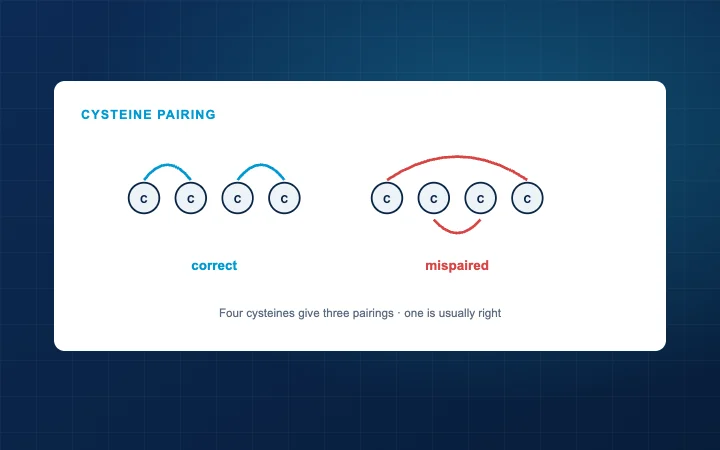
A failure mode that does not exist for a linear peptide: the ring can close in the wrong place.
If a molecule has more than two cysteines, or if a bridge breaks and re-forms, the connectivity can end up different while the atoms stay identical. The result is an isomer with the same molecular formula and the same mass as the intended compound.
For oxytocin, with one bridge, the risk is mainly intermolecular — two molecules linking to each other rather than each closing itself. For peptides with several bridges, the number of wrong ways to fold grows quickly.
The analytical consequence is covered in the disulphide bridge in oxytocin: mass cannot resolve it, so chromatography has to.
How the ring is closed matters
Not all cyclisation is the same chemistry, and the difference decides how fragile the product is.
| Closure | Bond | Reversible? | Practical consequence |
|---|---|---|---|
| Disulphide bridge | S–S between two cysteines | Yes | Sensitive to reductants, alkaline pH, free thiols |
| Head-to-tail amide | Backbone amide | No | Robust; behaves like any peptide bond |
| Side-chain lactam | Amide between side chains | No | Robust; common in designed analogues |
This is the single most useful question to ask about a cyclic peptide. A disulphide-closed ring is reversible chemistry and needs the corresponding care. An amide-closed ring does not.
Oxytocin is disulphide-closed, which is why its handling instructions are specific rather than generic. Lactam-bridged analogues in the melanocortin series are closed differently and are correspondingly less fussy about reducing conditions — relevant background in PT-141 and the melanocortin receptors.
Reading a certificate for a cyclic peptide
The order of evidence shifts compared with a linear peptide.
Mass confirms composition but not connectivity. Necessary, not sufficient. An isomer passes this test.
HPLC carries identity information. A single sharp peak at the expected retention time is evidence the ring closed as intended. Shoulders and satellite peaks near the same mass are the signature of isomers.
Purity is usually higher than for a long linear peptide, because cyclisation is often the last step and unreacted linear precursor separates cleanly. A modest purity figure on a cyclic product is worth a question.
What this means for storage
The general rule: the least stable bond in the molecule sets the storage requirement, and in a cyclic peptide that bond is usually the one closing the ring.
For a disulphide-closed peptide, that means cold, dark, closed, mildly acidic, and no free thiols in the vicinity. For an amide-closed one, ordinary peptide care is enough.
It is a useful habit generally. Identify the weakest bond and you can predict the handling profile without looking it up — the same reasoning that makes why glutathione oxidises in solution predictable from its single thiol.
Every product referenced here is supplied for laboratory research use only and is not for human or animal use.
References
- Driggers EM, Hale SP, Lee J, Terrett NK. The exploration of macrocycles for drug discovery — an underexploited structural class. Nature Reviews Drug Discovery 2008;7(7):608-624.
- Gimpl G, Fahrenholz F. The oxytocin receptor system: structure, function, and regulation. Physiological Reviews 2001;81(2):629-683.
- Bachem. Quality Control of Amino Acids and Peptides: A Guide. www.bachem.com/knowledge-center/quality-control-of-amino-acids-peptides-a-guide
Every product mentioned is sold for laboratory research use only and is not for human or animal use. Nothing on this page describes or recommends use of the material sold here in humans or animals.