A researcher looking for one compound can meet it under four names on four sites and have no way to tell they are the same molecule — or, worse, assume two names are the same when they are not. This is not carelessness by suppliers so much as an accumulation of naming systems that each solve a different problem. This post sorts out where the names come from and how to pin down what you are actually buying.
What are the four kinds of name?
1. The research code. Assigned by whoever developed the compound, usually letters plus a number: CJC-1295, AOD-9604, SS-31, PT-141. These are internal labels that escaped into the world. They carry no information about structure, they are not centrally administered, and they get abbreviated and mangled in transit.
2. The INN. Once a compound enters formal development it is given an International Nonproprietary Name — a generic name coordinated by the WHO, built with stems that signal class. This is why so many incretin compounds end in -tide and monoclonal antibodies in -mab. Semaglutide, tirzepatide, cagrilintide, bremelanotide and afamelanotide are all INNs.
3. The sequence description. A description of what the molecule is: "modified GRF (1-29)", "hGH fragment 176-191", "ACTH (4-10)". These are the most informative names because they tell you the parent and the region, but they are wordy and get truncated.
4. The trade name. A brand. These rarely appear in research supply and are not used in this catalogue.
| Name in the wild | Kind | Same molecule as |
|---|---|---|
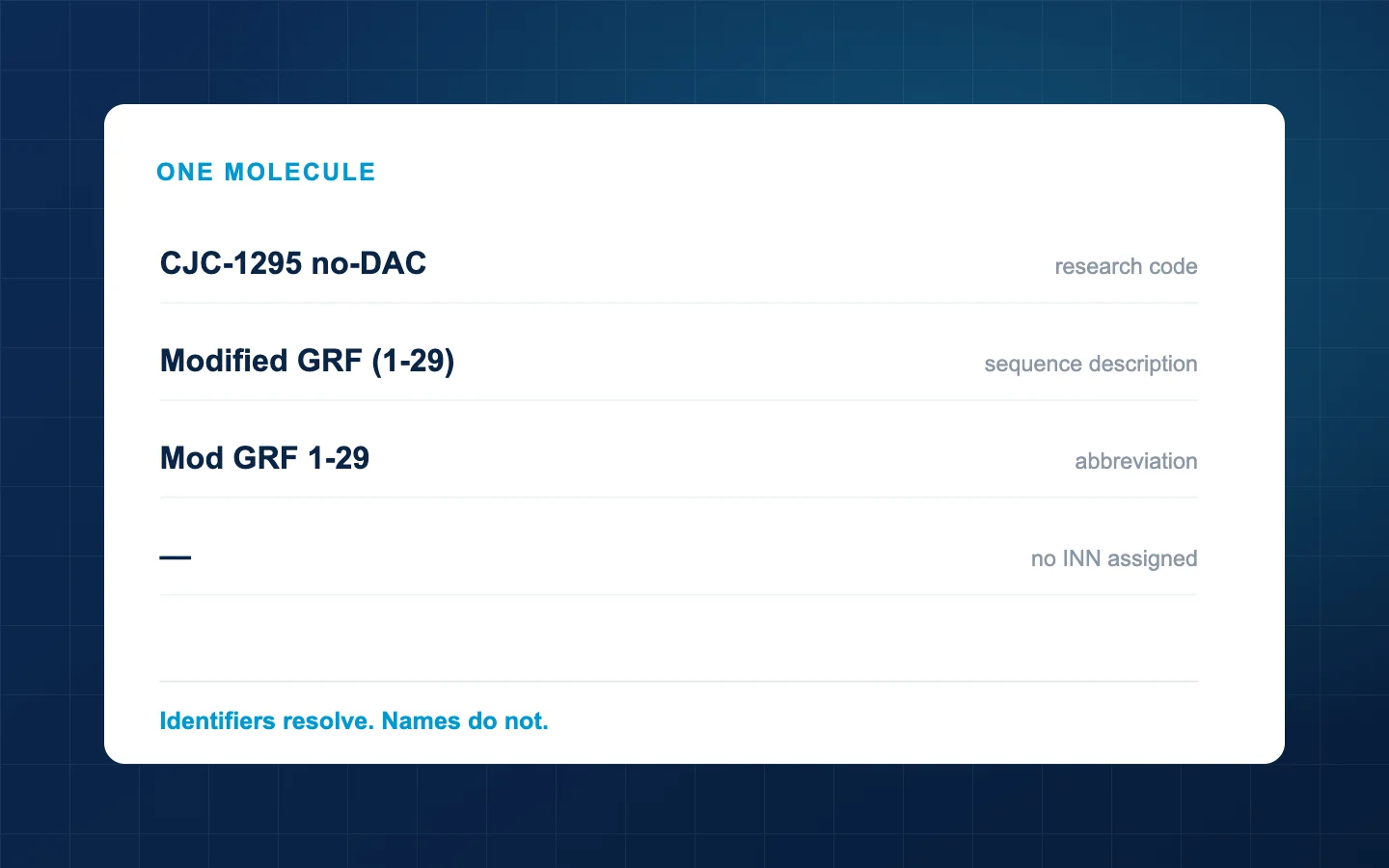
| CJC-1295 no-DAC | Research code | Modified GRF (1-29), Mod GRF 1-29 |
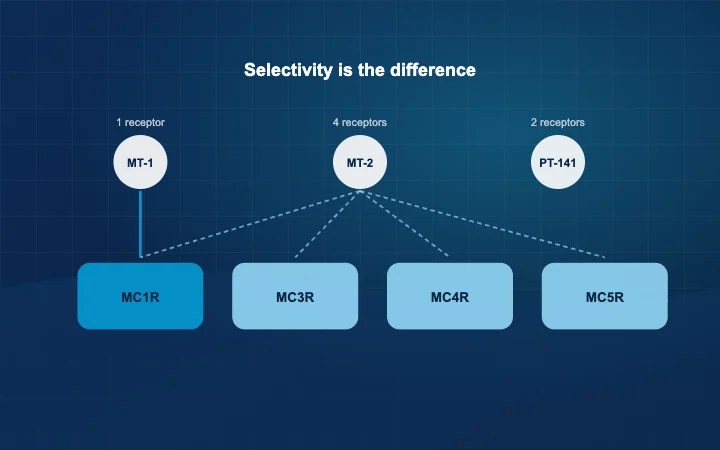
| Bremelanotide | INN | PT-141 |
| Afamelanotide | INN | Melanotan-1, MT-1 |
| Thymalfasin | INN | Thymosin alpha-1 |
| Epitalon | Research code | Epithalon, Ala-Glu-Asp-Gly |
| AOD-9604 | Research code | Tyr-hGH fragment 177-191 |
Where does naming go wrong?
Names that sound the same but are not. TB-500 is the short actin-binding fragment; thymosin beta-4 is the full 43-residue protein. Suppliers routinely list one under the other's name. This catalogue sells the fragment, and the TB-500 product page gives its formula and mass so you can check which you are getting.
The two CJC-1295 forms are the same trap. With DAC and without DAC differ by an albumin-binding complex and behave completely differently — days versus minutes. A listing that says only "CJC-1295" has not told you which. Our comparison post covers why the difference is the whole point.
Names that omit the modification. "Semax" and "N-acetyl Semax amidate" are different molecules — the second is acetylated at one end and amidated at the other, changing mass and charge. The 1972 IUPAC-IUB recommendations define exactly these symbols, which is why a serious listing writes them out.
Names that are a category, not a compound. "Bioregulator" or "copper peptide" describes a class. A product listed only that way has not been specified.
How to pin down what you are buying
Use the identifiers that resolve to one molecule, not the name:
- CAS number. A registry number assigned to one substance. If two listings share a CAS, they are the same compound.
- PubChem CID. A public record with formula, mass and structure. Every compound page on this site links its CID where PubChem publishes one.
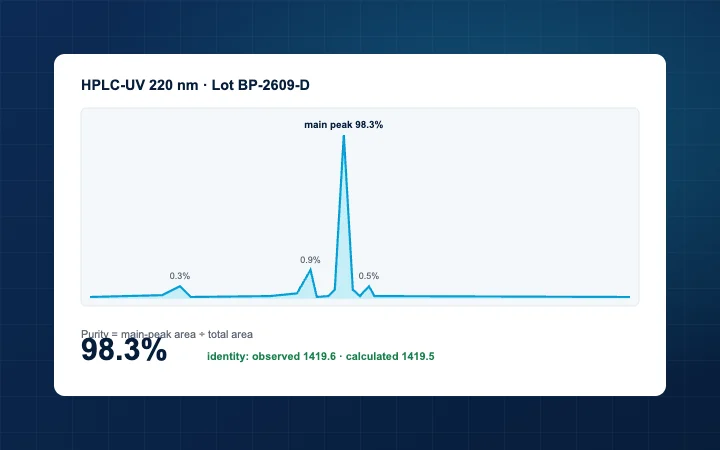
- Molecular formula and mass. Two compounds with the same name and different formulas are not the same compound, and the arithmetic in our sequence post lets you check a stated mass yourself.
Where an identifier is absent, say so rather than guess. Three compounds in this catalogue have no CAS published by PubChem, and their spec blocks are blank rather than filled with a plausible-looking number.
Why do suppliers not just standardise?
Partly inertia — research codes were established first and the literature uses them. Partly search: buyers type the research code, so that is what gets put in the title. And partly because for some compounds no INN exists, because they never entered formal development.
The workable standard is what a certificate should do anyway: lead with the name buyers search, and state the sequence description, CAS and PubChem identifier alongside it. Then the name is a label and the identifiers are the claim.
Frequently asked questions
If two suppliers list different molecular weights for the same name, who is right?
Check both against PubChem. One of them may be quoting the salt form rather than the free peptide, which our TFA and acetate post explains, or one may have the wrong compound entirely.
Why do some INNs end in -tide and others in -relin?
The stems signal class. -tide marks a peptide; -relin marks a releasing-hormone analogue, which is why sermorelin and tesamorelin share it. The system is deliberate and reading the stem tells you something real.
Is "Mod GRF 1-29" the same as sermorelin?
No, and this catches people out. Sermorelin is plain GHRH (1-29). Modified GRF (1-29) carries four substitutions that resist degradation. Same backbone, different molecule — our ipamorelin and sermorelin comparison sets out the family.
Which name should I use in a methods section?
The one that identifies the molecule unambiguously: the INN where it exists, otherwise the sequence description, plus the CAS or PubChem identifier and the supplier lot. Our methods post lists the full set.
References
- IUPAC-IUB Commission on Biochemical Nomenclature. Symbols for amino-acid derivatives and peptides: recommendations. Biochemical Journal 1972;126(4):773-780. doi.org/10.1042/bj1260773
- PubChem, National Center for Biotechnology Information — compound records and synonym lists. pubchem.ncbi.nlm.nih.gov
- Bachem. Quality Control of Amino Acids and Peptides: A Guide. www.bachem.com/knowledge-center/quality-control-of-amino-acids-peptides-a-guide
Every product mentioned is sold for laboratory research use only and is not for human or animal use. Nothing on this page describes or recommends use of the material sold here in humans or animals.