
Most receptor families in peptide research are named after their ligand and leave it there. The melanocortin family is more interesting than that, because five receptors share one recognition motif, sit in five largely unrelated tissues, and are activated by peptides cut from a single precursor protein. Understanding that layout is most of what you need to read the literature on any melanocortin analogue, PT-141 included.
One precursor, several signalling peptides
The native melanocortins all come from pro-opiomelanocortin, usually shortened to POMC. It is a precursor protein that is cut by prohormone convertases into a set of smaller peptides, and which peptides you get depends on which enzymes are present in that tissue.
The relevant products are α-MSH, β-MSH and γ-MSH — the melanocyte-stimulating hormones — along with ACTH. They are not variations on a theme in the loose sense. They are literally different fragments of the same parent chain, and their receptor preferences differ as a result.
This matters for a practical reason. When a paper says "melanocortin", it may mean the receptor family, the peptide family, or the whole signalling system. Reading which one is meant is the first step in not misreading the result.
Five receptors, five locations
| Receptor | Predominant tissue | Notes |
|---|---|---|
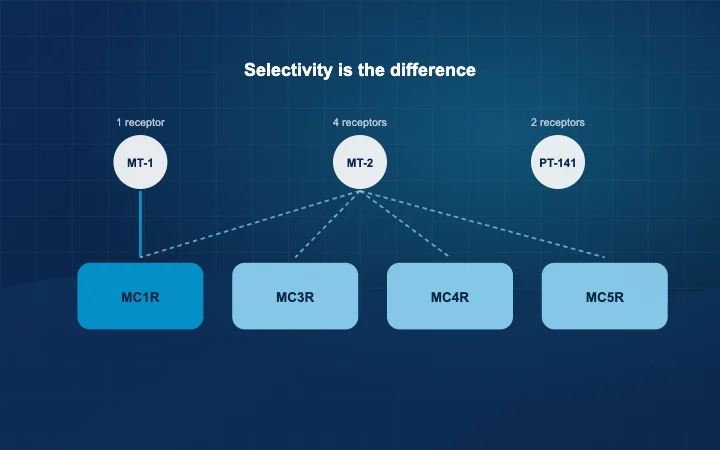
| MC1R | Melanocytes | The pigmentation receptor; the one the Melanotan series was built around |
| MC2R | Adrenal cortex | The ACTH receptor; does not respond to MSH peptides |
| MC3R | Central nervous system, periphery | Less well characterised than MC4R |
| MC4R | Central nervous system | The most studied of the five |
| MC5R | Exocrine tissue | Sebaceous and other secretory tissue |
MC2R is the outlier worth noting: it responds to ACTH and not to the MSH peptides, which is unusual in a family otherwise defined by a shared motif.
The spread across tissues is the whole reason selectivity dominates this literature. A compound that engages more than one subtype is engaging systems with nothing in common, and a result attributed to one receptor may not belong to it.
The His-Phe-Arg-Trp core
Running through the native ligands is a four-residue sequence: histidine, phenylalanine, arginine, tryptophan. It is the conserved recognition element, and essentially every synthetic melanocortin analogue is built to preserve it while changing what surrounds it.
That is the standard medicinal-chemistry move for a peptide family. Keep the part the receptor reads, alter the rest to improve stability, solubility or selectivity. Substitutions at the phenylalanine position, often to the D-isomer, recur throughout the series for exactly this reason: D-amino acids resist the proteases that would otherwise clear a linear peptide quickly.
Where PT-141 sits
PT-141, also catalogued as bremelanotide, is a cyclic melanocortin analogue structurally related to the Melanotan compounds. It is catalogued as a melanocortin receptor agonist.
Two structural points are worth holding onto when reading about it.
It is cyclic. The ring is what separates it from a plain linear analogue. A short linear peptide is an easy target for exopeptidases, which chew inward from the ends; a cyclic peptide has no ends to start on. Cyclisation is the reason compounds in this series are stable enough to work with at all.
Reported selectivity varies. Different assay systems, different cell lines and different readouts produce different subtype profiles. This is normal for the family rather than a sign that someone is wrong, and it is why a selectivity figure should always be read with its assay attached.
If you are comparing PT-141 against the Melanotan compounds in the catalogue, the family relationship is close, and Melanotan-1 and Melanotan-2 are the useful reference points.
Why any of this affects handling
Structure drives storage, which is the part that touches your bench rather than your reading.
A cyclic peptide is more robust than a linear one of the same length, but robust is relative. The ring survives proteases; it does not make the molecule indifferent to heat, light or repeated freeze-thaw. For the PT-141 liquid spray, supplied at 1.0 mg/mL in a 10 mL atomiser, that means refrigeration and protection from light from the day it arrives.
The advantage of a ready-made solution here is that the concentration is fixed at manufacture and certified, so it does not inherit the variability that comes from reconstituting a powder differently each time. If you want that argument in full, why some peptides ship as solutions covers it.
Reading the literature without overreading it
Three habits make melanocortin papers easier to assess.
Check which receptor. A finding at MC1R says nothing about MC4R. The family shares a motif, not a function.
Check the system. Recombinant cell lines, native tissue and whole-animal work do not always agree, and the disagreements are usually about access rather than about pharmacology.
Check what was actually measured. Receptor binding, second-messenger accumulation and a downstream readout are three different claims. They are often reported in the same paper and are not interchangeable.
Every product referenced here is supplied for laboratory research use only and is not for human or animal use.
References
- Gantz I, Fong TM. The melanocortin system. American Journal of Physiology - Endocrinology and Metabolism 2003;284(3):E468-E474.
- Cone RD. Studies on the physiological functions of the melanocortin system. Endocrine Reviews 2006;27(7):736-749.
- Hadley ME, Dorr RT. Melanocortin peptide therapeutics: historical milestones, clinical studies and commercialization. Peptides 2006;27(4):921-930.
- Bachem. Quality Control of Amino Acids and Peptides: A Guide. www.bachem.com/knowledge-center/quality-control-of-amino-acids-peptides-a-guide
Every product mentioned is sold for laboratory research use only and is not for human or animal use. Nothing on this page describes or recommends use of the material sold here in humans or animals.