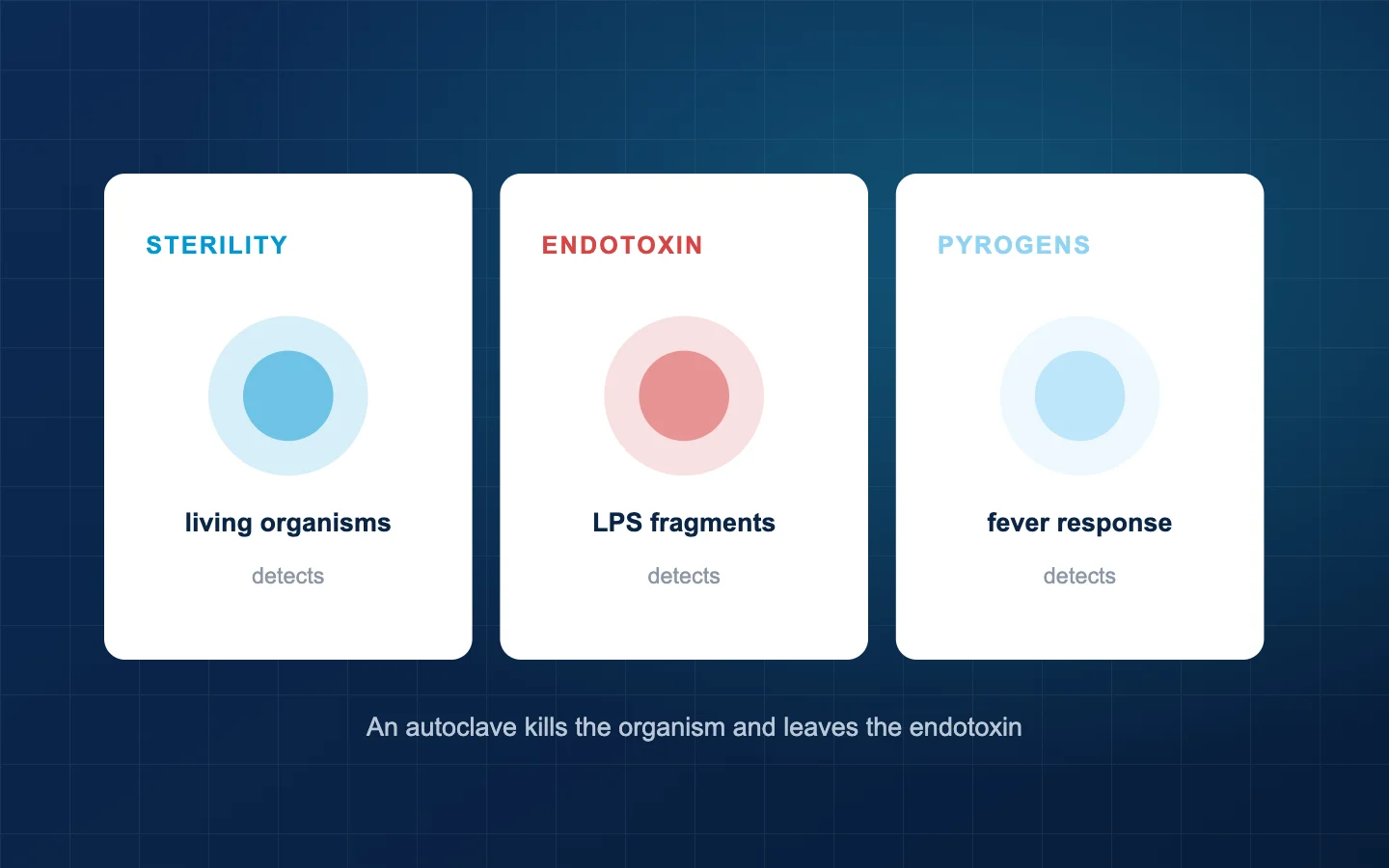
"Sterile" is doing a lot of work on peptide product pages, and it means less than most buyers assume. A vial can pass a sterility test and still carry enough bacterial endotoxin to wreck a cell experiment — not because the test was run badly, but because sterility does not ask that question. These are three separate assays answering three separate questions, and a certificate that reports one is not covering the others.
The three questions
Sterility asks: are there living, reproducing organisms in here? The test incubates the sample in growth media and watches for growth. No growth, sterile.
Endotoxin asks: are there bacterial cell-wall fragments in here? Specifically lipopolysaccharide from the outer membrane of Gram-negative bacteria. The standard method is the LAL assay, using a reagent derived from horseshoe crab blood that clots in the presence of LPS.
Pyrogenicity asks: would this induce a fever response? It is a broader biological question, and endotoxin is the most common but not the only cause.
| Sterility | Endotoxin | Pyrogen | |
|---|---|---|---|
| Detects | Living organisms | LPS fragments | Anything fever-inducing |
| Method | Culture, USP <71> | LAL, chromogenic or gel-clot | Historically rabbit; now largely cell-based or LAL |
| Result format | Pass / fail | A number, in EU/mg or EU/mL | Pass / fail |
| Survives autoclaving? | No — that is the point | Yes | Depends on the pyrogen |
| Matters most for | Multi-dose vials, storage | Cell culture, any biological readout | Injectable products |
Why can a sterile vial be full of endotoxin?
This is the crux, and it comes down to what heat does.
Autoclaving or filtration kills or removes bacteria. It does not destroy the lipopolysaccharide those bacteria leave behind. LPS is a remarkably heat-stable molecule — it takes far harsher conditions to degrade it than to kill the organism that made it. Depyrogenation typically means dry heat at temperatures and durations well beyond normal sterilisation.
So a process can take contaminated material, sterilise it thoroughly, and produce a vial that passes sterility with a high endotoxin burden. Sterile does not mean clean. It means nothing alive is in there now.
For a lyophilized peptide the practical route to low endotoxin is controlling it upstream — water quality, raw materials, the manufacturing environment — rather than removing it at the end.
Which one matters for your work?
For most readers of this site, endotoxin, by a distance.
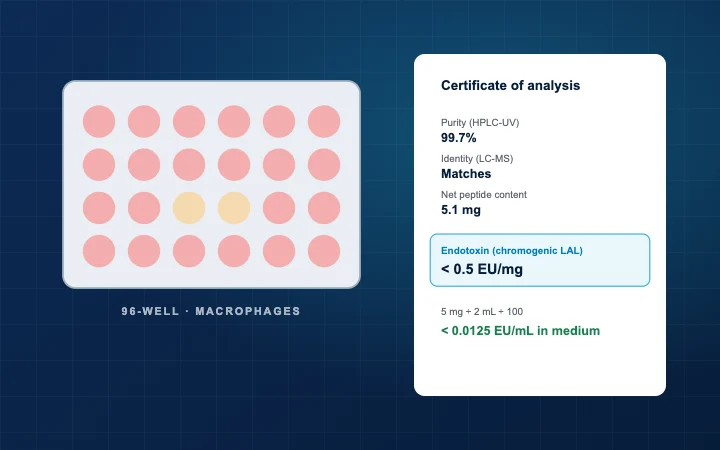
Endotoxin is not a mild contaminant in cell culture. It is a potent agonist at TLR4, and it activates inflammatory signalling at concentrations far below anything that would make a solution look wrong. If your readout involves immune cells, inflammatory markers, cytokine expression or NF-κB, an unmeasured endotoxin load is a confound that can generate an entire result. Our endotoxin post works through the figures and what they mean in a well.
Sterility matters in a different way: for a multi-dose vial you will puncture repeatedly over days. This is the whole reason bacteriostatic water carries a preservative — our diluent post covers when the preservative is worth having and when it interferes.
Pyrogenicity as a formal test belongs to injectable pharmaceutical products. It is not the relevant question for in-vitro research material, and a research certificate reporting it would be unusual.
What should a certificate show?
For research-grade peptide, three lines that together cover the ground:
- Sterility — a pass, with the method named.
- Endotoxin — a number with units, not a pass. "< 0.5 EU/mg" tells you something; "endotoxin: pass" tells you almost nothing, because the limit was chosen by the person reporting it.
- The method for each. LAL comes in variants and they are not interchangeable in sensitivity.
A number rather than a verdict is the theme. It is the same argument our purity post makes about purity figures, and the same reason our certificate library publishes the value rather than a tick.
Frequently asked questions
Can I filter endotoxin out of my solution?
Not with a standard 0.22 µm filter — LPS aggregates pass straight through, and filtering a peptide solution costs you material to the membrane anyway. Specialised endotoxin-removal resins exist but bring their own losses and validation burden.
Does low endotoxin mean the peptide is pure?
No. They are unrelated measurements. A peptide can be 99.8% pure with high endotoxin, or 95% pure with almost none. Our net content post makes the same point about purity and quantity.
What units should I expect?
EU/mg for a solid, since that scales with how much peptide you add. EU/mL applies to a solution at a stated concentration and has to be converted before you can compare it.
Is the horseshoe crab reagent still standard?
LAL remains widely used, and recombinant Factor C is an established alternative that avoids the animal-derived reagent. Either is acceptable provided the certificate says which was used.
References
- United States Pharmacopeia. General chapters on sterility testing and bacterial endotoxins. www.usp.org
- Niu CH, Chiu YY. FDA perspective on peptide formulation and stability issues. Journal of Pharmaceutical Sciences 1998;87(11):1331-1334. doi.org/10.1021/js9800782
- Bachem. Quality Control of Amino Acids and Peptides: A Guide. www.bachem.com/knowledge-center/quality-control-of-amino-acids-peptides-a-guide
Every product mentioned is sold for laboratory research use only and is not for human or animal use. Nothing on this page describes or recommends use of the material sold here in humans or animals.