
Nearly all published peptide handling advice assumes a chain long enough to adopt a shape. Keep it from unfolding, keep it from aggregating, keep it from sticking to itself. That advice is sound for a thirty-residue analogue and largely beside the point at three residues, where there is no shape to protect.
The short peptides in this catalogue — Pinealon, Epithalon, glutathione, the bioregulator sequences — behave differently enough to be worth treating as their own category.
What stops being a problem
Aggregation. Longer peptides aggregate when exposed hydrophobic faces find each other and associate, eventually coming out of solution. That needs a hydrophobic face, which needs enough residues to form one. A charged tripeptide has nothing to offer. Peptide aggregation explained covers the mechanism where it does apply.
Denaturation. There is no folded state, so there is nothing to denature. Heat that would wreck a structured peptide simply speeds up ordinary chemical reactions here.
Freeze-thaw damage. Largely a consequence of the first two. Without structure to disrupt or aggregation to nucleate, cycling is far less damaging — though it is still not free, because concentration at the ice boundary is a real effect.
Poor solubility. Short sequences rich in charged residues dissolve quickly and completely. The slow, cloudy reconstitution that plagues hydrophobic peptides is not a feature of this group.
That is four of the five things peptide handling guides warn about, and none of them applies.
What replaces them
Exopeptidase susceptibility. Exopeptidases work inward from the termini. A three-residue chain is almost entirely termini — there is no protected interior. In any system with enzymatic activity, short linear peptides are cleared quickly, which is part of why cyclisation and terminal modification recur throughout peptide chemistry.
In a sealed sterile bottle this is not a concern. It becomes one the moment the material meets anything biological.
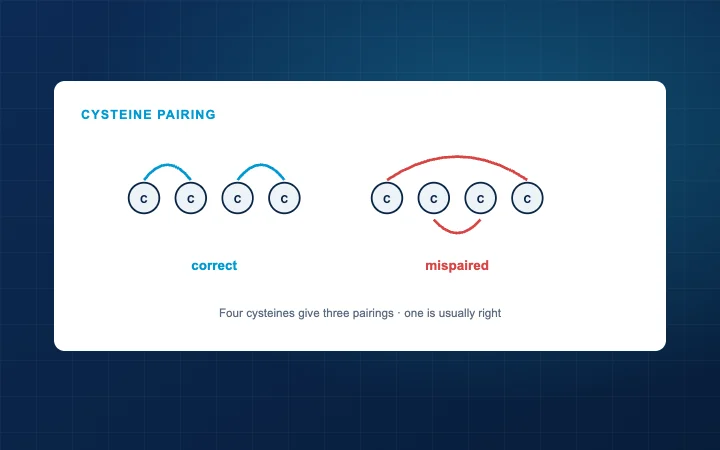
Side-chain reactivity. With no structure to hide behind, every side chain is fully exposed. A cysteine thiol at three residues is as accessible as chemistry allows, which is exactly the glutathione problem: why glutathione oxidises in solution.
Surface adsorption. Peptides stick to plastic and glass. For a long chain at working concentration, what adheres to the wall is a small fraction. For a short peptide in dilute solution, the same absolute quantity is a much larger share of what you have — and it is invisible, because nothing in the appearance of the solution changes.
This is a genuinely under-appreciated source of loss. Low-binding plasticware exists for this reason, and for dilute short-peptide work it is worth the cost rather than an affectation.
Why ready-made solutions suit this group
The trade-off described in why some peptides ship as solutions — shelf life given up for a fixed, certified concentration — lands differently for short peptides.
A structured thirty-residue peptide gains a great deal from being kept dry, because lyophilisation protects a shape as well as a chemistry. A charged tripeptide has no shape to protect, so the dry form is defending against ordinary hydrolysis and oxidation and nothing more.
The balance therefore tips further towards solution for this group than for the catalogue generally. It is why Pinealon works well as a metered solution while a large structured peptide would not.
Practical handling
Five things, specific to short peptides rather than inherited from general advice.
Use low-binding plasticware for dilute work. The single highest-value change, and the one most often skipped.
Do not over-vortex. Short peptides dissolve without help. Vigorous agitation adds air, and air is what oxidises exposed side chains.
Mind the pH for anything with a thiol. Slightly acidic keeps a thiol protonated and less reactive. Alkaline conditions do the opposite.
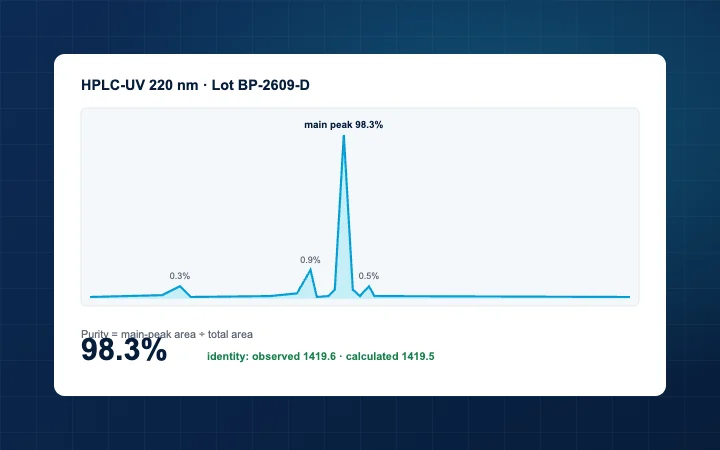
Check net peptide content, not just purity. Short charged sequences are hygroscopic and carry counter-ions. A vial can hold noticeably less compound than the label mass implies — net peptide content versus purity has the arithmetic.
Do not assume the long-chain rules transfer. They are not a stricter version of the same advice. They are advice about different failure modes.
Every product referenced here is supplied for laboratory research use only and is not for human or animal use.
References
- Manning MC, Chou DK, Murphy BM, Payne RW, Katayama DS. Stability of protein pharmaceuticals: an update. Pharmaceutical Research 2010;27(4):544-575. doi.org/10.1007/s11095-009-0045-6
- Goebel-Stengel M, Stengel A, Taché Y, Reeve JR. The importance of using the optimal plasticware and glassware in studies involving peptides. Analytical Biochemistry 2011;414(1):38-46.
- Bachem. Quality Control of Amino Acids and Peptides: A Guide. www.bachem.com/knowledge-center/quality-control-of-amino-acids-peptides-a-guide
Every product mentioned is sold for laboratory research use only and is not for human or animal use. Nothing on this page describes or recommends use of the material sold here in humans or animals.