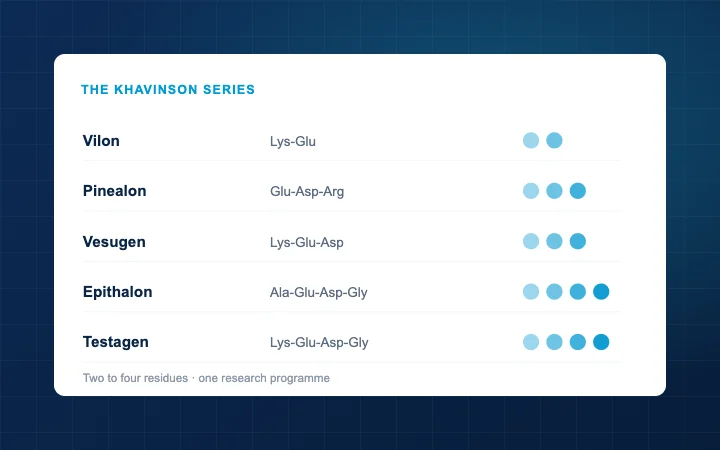

Most guidance on reading a peptide certificate is written with a twenty- or thirty-residue chain in mind. At three residues the analysis is genuinely different, and in a way that is counterintuitive: the short peptide is easier to make and harder to characterise.
This matters for a handful of products in this catalogue — glutathione, Pinealon, and the other short bioregulator sequences — where the certificate has to be read with different expectations from the one that came with a GLP-1 analogue.
Why synthesis is the easy part
Solid-phase peptide synthesis adds residues one at a time, and every coupling step is an opportunity for something to go wrong. Each step has a yield slightly below perfect, and those shortfalls compound.
At thirty residues that compounding dominates the outcome: deletion sequences, truncations and incomplete couplings accumulate, and the crude product is a mixture that needs real purification.
At three residues there are two couplings. The crude material is usually clean before anyone purifies it. So far, so good.
Why characterisation is the hard part
Reversed-phase HPLC — the workhorse of peptide purity analysis — separates molecules by hydrophobicity. A column retains what is greasy and lets what is polar pass quickly.
That is a fine mechanism when your product and its impurities differ substantially in character. It is a poor one when everything in the vial is small and polar, which is exactly the situation with a short, charged tripeptide.
Two practical consequences:
The product elutes early. Close to the solvent front, where the baseline is busiest and integration is least reliable.
Related impurities can co-elute. A tripeptide missing one residue is still small and still polar. It may travel at nearly the same rate as the product and hide under the same peak.
So a 99% figure from HPLC alone carries less information at three residues than the same figure at thirty. It is not wrong. It is answering a narrower question than it appears to.
What mass spectrometry contributes
MS takes on more of the load here, and for a reason that works in your favour at short length.
A deletion in a thirty-residue peptide changes the mass by one residue in thirty — a few per cent, detectable but not dramatic. The same deletion in a tripeptide changes it by a third. The mass difference is enormous in relative terms, and trivially resolved.
So on a short-peptide certificate, the MS panel is doing more work than the HPLC panel, which inverts the usual reading order. Check that the observed mass matches the theoretical mass, and check the charge states are consistent.
The blind spot neither catches
Sequence order.
Glu-Asp-Arg and Arg-Asp-Glu contain the same three residues. They have identical molecular mass, so MS cannot distinguish them. They are similar in polarity, so HPLC may not separate them either.
For a short peptide this is a real gap rather than a theoretical one, and it is why amino acid analysis or sequencing appears on a thorough certificate for these compounds. Amino acid analysis confirms composition — what is present and in what ratio — and sequencing confirms order.
If a short-peptide certificate shows only HPLC and MS, it has established composition and mass and has not established sequence. That may be perfectly acceptable for your purposes. It is worth knowing which question was answered.
The form question
For any peptide carrying a reactive side chain, purity and form are separate measurements.
Glutathione is the clearest case: its cysteine thiol oxidises, and the oxidised form is still glutathione by any composition-based assay. A certificate can report high purity while the reduced fraction has fallen substantially. Why glutathione oxidises in solution covers that in full.
The general rule: where a compound has more than one stable form, ask which one the certificate measured. "Purity" answers how much is the compound; it does not always answer which version of it.
What to look for, in order
For a tripeptide certificate specifically:
- Identity by MS — observed mass against theoretical, with consistent charge states
- Composition — amino acid analysis if present, which is what closes the sequence gap
- Purity by HPLC — with the gradient stated, so you can judge whether early elution was handled
- Form — for anything with a reactive side chain, which form was measured
- Water and counter-ion content — short peptides are hygroscopic, and net peptide content is the figure that tells you how much compound you actually have
That last point is easy to skip and shouldn't be. A hygroscopic short peptide can carry a substantial mass fraction as water and salt, and purity says nothing about it.
Every product referenced here is supplied for laboratory research use only and is not for human or animal use.
References
- Bachem. Quality Control of Amino Acids and Peptides: A Guide. www.bachem.com/knowledge-center/quality-control-of-amino-acids-peptides-a-guide
- United States Pharmacopeia. General Chapter <1503> Quality Attributes of Synthetic Peptide Drug Substances.
- Khavinson VK. Peptides and ageing. Neuroendocrinology Letters 2002;23 Suppl 3:11-144.
Every product mentioned is sold for laboratory research use only and is not for human or animal use. Nothing on this page describes or recommends use of the material sold here in humans or animals.