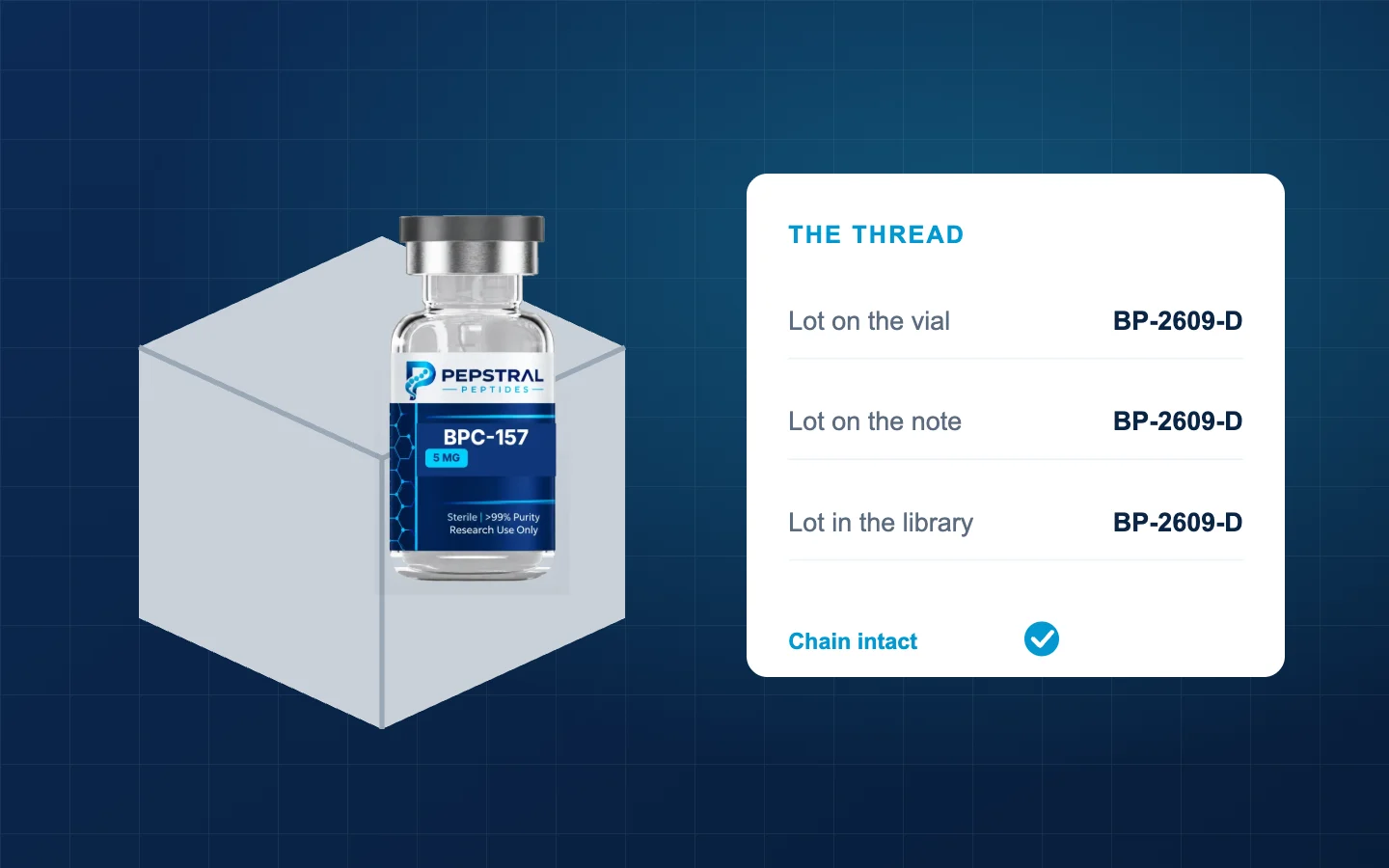
Most of what a peptide supplier publishes concerns the material: how it was made, how it was tested, what the certificate says. The step in between — someone picking a vial off a shelf and putting it in a box — gets no coverage at all, and it is where the chain from certificate to bench is either preserved or quietly broken. This post covers what should happen, what should arrive, and what to check.
Why is the lot number the thread that matters?
Everything traceable about a vial hangs off its lot number.
A lot is a specific manufacturing run. It has its own certificate, with its own purity figure, its own identity confirmation and its own endotoxin result. Those numbers describe that run and no other. A different lot of the same compound is a different material with a different certificate.
So the chain is: certificate → lot number → printed on the vial → matched by you on arrival. Break any link and the verification claim collapses. A vial with no lot, or a lot that does not appear in the supplier's library, cannot be verified no matter how good the analytical figures look in the abstract.
This is why our COA library is organised by lot rather than by compound, and why the vial label post treats the lot as one of the seven fields that must be present.
What should be in the package?
| Item | Why |
|---|---|
| The vial, crimped and sealed | The seal is what kept moisture out |
| Lot number on the label | The link to the certificate |
| Packing note listing what was picked | Lets you reconcile what arrived against what you ordered |
| Protective packing | Glass in transit |
| Any supplies ordered | Diluent, syringes |
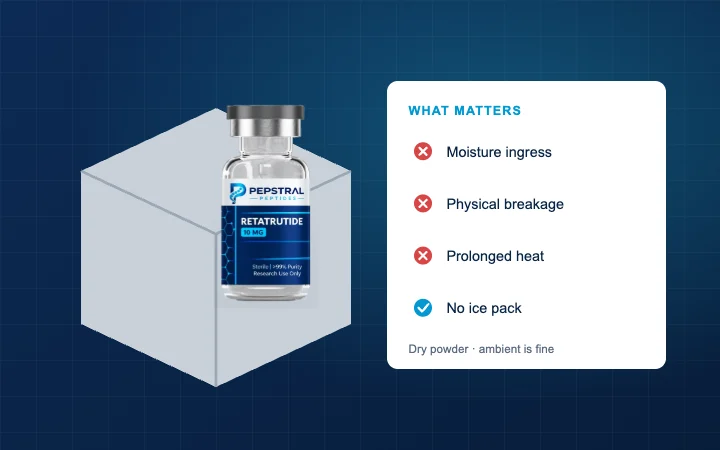
What should not be needed: a cold pack. Lai and Topp's work on solid-state stability is the reason — in the dry amorphous state, molecular mobility is drastically reduced and degradation rates fall by orders of magnitude. A lyophilized peptide tolerates ambient temperature for the days a parcel is in transit. Our cold-shipping post covers why a gel pack is spent within hours and addresses none of the risks that actually matter.
What should you check on arrival?
Do this before the vials go in the freezer, not after:
- Reconcile the packing note against what you ordered. Compound, dose, quantity.
- Check each lot number against the note and, if you want the full chain, against the supplier's certificate library.
- Inspect the crimp and stopper. A lifted or loose stopper means the seal failed, and Tang and Pikal's work on freeze-drying explains why that is the finding that matters — residual moisture is the variable governing solid-state stability, and a compromised seal is how moisture gets in.
- Look at the powder. Colour, clumping, any visible liquid. A shrunken or cracked cake is normal; discolouration and moisture are not. Our post on what a lyophilized vial should look like covers the appearances in detail.
- Check the glass for cracks, particularly around the neck.
- Write it down. Date received, condition, lot numbers.
That last step is the one people skip and later wish they had not. When a result looks odd three months on, the question is always whether the material was fine — and the answer exists only if somebody wrote it down on the day.
Then store it properly
Sealed vials to −20°C or below, protected from light. Do not open a cold vial in a warm room — cold glass condenses atmospheric moisture, which is precisely what the freeze-drying removed. Let it reach room temperature sealed first.
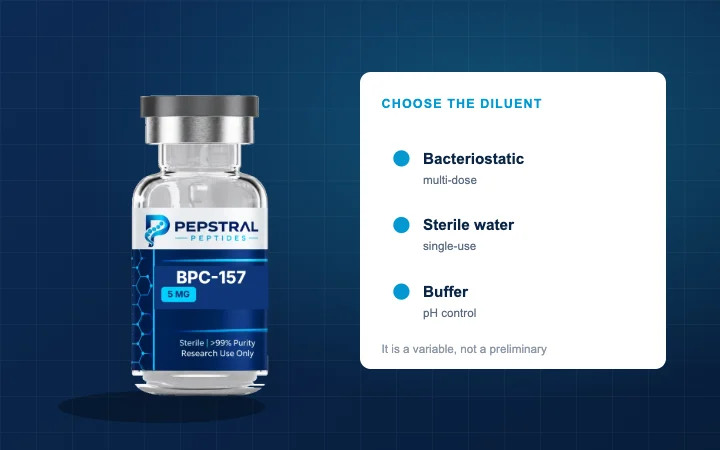
Once you do open and reconstitute, a different clock starts, covered in our solution stability post.
What should you do when something is wrong?
Photograph it before doing anything else — the vial, the label, the packaging, the damage. A photograph taken on arrival is evidence; a description written a week later is a recollection.
Then contact the supplier with the order number and the lot number. Those two identifiers let them find the run, check what else shipped from it, and tell you whether it is an isolated shipping event or something affecting a batch. A supplier who cannot do that lookup has a traceability problem, which is itself worth knowing.
What this looks like here
Orders placed before 2pm ET ship the same day. Every vial carries its lot; every lot has a certificate published in the library before the vial is listed, which is the ordering that makes "verify before you order" a literal description rather than a slogan.
One thing we will not do is imply more than we can evidence. The certificates in our library are currently generated placeholders pending real laboratory reports — that is stated in our editorial policy, and it is the honest position until the reports exist.
Frequently asked questions
What if the lot on the vial is not in the library?
Ask before using it. Either the library is behind or the vial is not what the paperwork says, and both are worth resolving before the material enters an experiment.
Should I refuse a package that arrived warm?
Almost certainly not. Inspect the stopper and the powder — those are the findings that matter. Our cold-shipping post covers why ambient transit is appropriate for dry powder.
Can I order multiple lots of the same compound?
You can, and for a long study it is worth asking whether your order will come from one lot. Running a series across two lots introduces a variable you did not intend.
How long should I keep the packing note?
As long as you have the vial. It is the cheapest part of the provenance record and the easiest to lose.
References
- Lai MC, Topp EM. Solid-state chemical stability of proteins and peptides. Journal of Pharmaceutical Sciences 1999;88(5):489-500. doi.org/10.1021/js980374e
- Tang X, Pikal MJ. Design of freeze-drying processes for pharmaceuticals: practical advice. Pharmaceutical Research 2004;21(2):191-200. doi.org/10.1023/b:pham.0000016234.73023.75
- Bachem. Quality Control of Amino Acids and Peptides: A Guide. www.bachem.com/knowledge-center/quality-control-of-amino-acids-peptides-a-guide
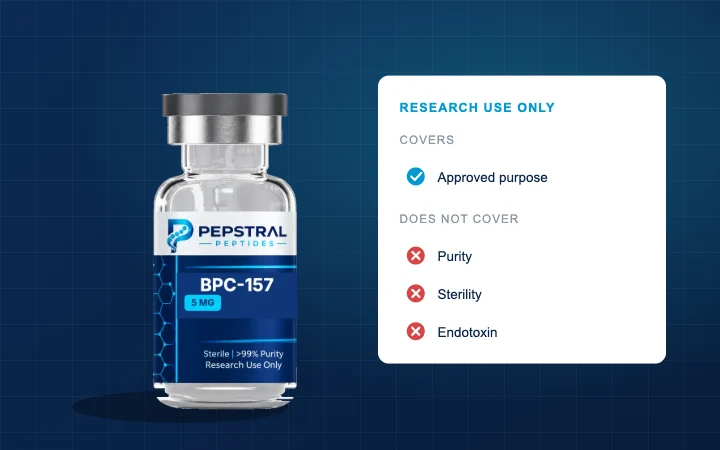
Every product mentioned is sold for laboratory research use only and is not for human or animal use. Nothing on this page describes or recommends use of the material sold here in humans or animals.