
Reconstitution solution is the catalogue's name for bacteriostatic water: sterile water for injection with 0.9% benzyl alcohol added as a preservative, supplied in a 30 mL multi-use vial. The preservative is the whole point. A vial of plain sterile water is meant to be opened once and used; a vial with 0.9% benzyl alcohol can be punctured and drawn from repeatedly because the alcohol stops bacteria growing in what is left. This post explains what is in the reconstitution solution sold here, how it differs from sterile water, saline and the benzyl alcohol people search for on its own, and when each is the right choice for a lyophilized peptide. The diluent post covers the choice from the peptide's side; this one covers the water.
What is in reconstitution solution?
Two things.
| Component | Amount | Role |
|---|---|---|
| Water for injection | To 100% | The solvent: sterile, endotoxin-controlled water with nothing dissolved in it |
| Benzyl alcohol | 0.9% w/v | Antimicrobial preservative, so the vial can be entered more than once |
That is the composition of Bacteriostatic Water for Injection in the United States Pharmacopeia, and it is why the two names are interchangeable. There is no salt, no buffer, no sugar. The solution is not isotonic and it has no pH control of its own; a reconstituted peptide's pH is set by the peptide and its counter-ion, which the TFA and acetate post explains.
What does the preservative actually do?
Benzyl alcohol at 0.9% is bacteriostatic: it stops bacteria multiplying in the vial rather than sterilising it. The practical consequence is that a multi-use vial stays usable across repeated entries. The pharmacopeial convention for a multi-use vial is 28 days after first puncture, and it applies to the water itself, not to the peptide dissolved in it, whose lifetime is set by chemistry and covered in the reconstituted-lifetime post.
The preservative carries one cost, which the cell-culture post works through in detail: 0.9% benzyl alcohol is toxic to mammalian cells at the concentration in the vial, and a stock made in it carries a little into every culture well. For most bench work the dilution from a concentrated stock makes that negligible; for a sensitive line, or a stock that will be dosed generously into a small well, sterile water is the cleaner choice.
How is it different from sterile water?
| Reconstitution solution (bacteriostatic water) | Sterile water | |
|---|---|---|
| Composition | Water + 0.9% benzyl alcohol | Water only |
| Vial use | Multiple entries, 28-day convention | Single use once opened |
| Preservative in the stock | Yes | No |
| Cell-culture stock | Acceptable at high dilution; avoid for sensitive lines | Preferred |
| Peptide solubility | Identical; the alcohol does not help or hinder | Identical |
| Freezing aliquots | Fine; the preservative is irrelevant once frozen | Fine |
| In the catalogue | 30 mL vial, in the kit | Not stocked; laboratory supply |
The rule of thumb: bacteriostatic water when the stock will live in the refrigerator and be drawn from over days; sterile water when the whole vial is reconstituted, aliquoted and frozen in one sitting, or when the solution is headed for cells. Many laboratories do both, using sterile water for the stock and bacteriostatic water for nothing at all; the product exists for the first pattern.
Is benzyl alcohol the same as bacteriostatic water?
No, and the search results that conflate them are wrong. Benzyl alcohol is the additive: an aromatic alcohol that is a solvent in its own right, sold as a reagent for other purposes. Bacteriostatic water is 99.1% water. Adding neat benzyl alcohol to a peptide vial is not reconstitution, would give a concentration a hundred times higher than the preservative level, and would denature most peptides. "Sterile benzyl alcohol" as a product is a reagent for compounding, not a diluent, and it is not something this catalogue sells or recommends for peptide work.
Is it the same as saline?
No. Saline is 0.9% sodium chloride in water, made isotonic for a different purpose. It contains no preservative unless labelled bacteriostatic saline, and its salt content changes the ionic strength of a peptide solution, which matters for the aggregation-prone sequences the aggregation post describes. Reconstitution solution has no salt at all. The two are not substitutes, and a methods section that says "reconstituted in saline" when the diluent was bacteriostatic water is describing a different solution.
Which diluent for which peptide?
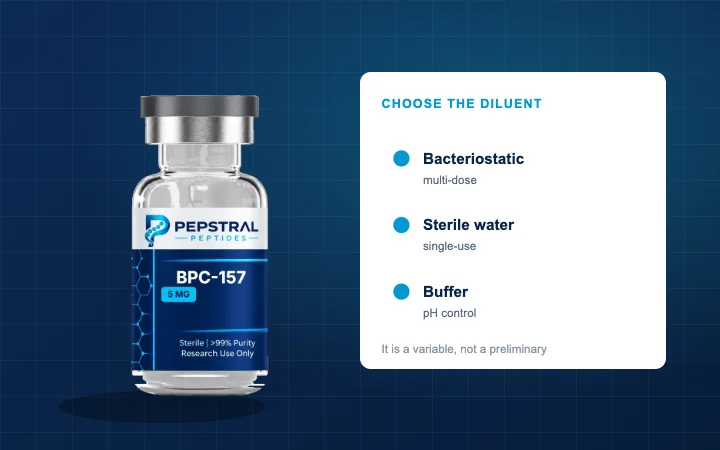
Water, with or without preservative, dissolves most of the catalogue readily: the Khavinson short peptides, BPC-157, the melanocortins, the GHRH analogues. Three groups need a moment's thought.
Acylated GLP-1 class peptides such as retatrutide dissolve slowly in water; the slow-dissolving post explains why and how to wait rather than shake. The diluent is still water.
GHK-Cu is the exception the diluent post names: the copper complex is pH-sensitive, and the preservative is not the concern there, the pH is.
Adamantane conjugates such as Adamax are less soluble in water than their parent peptides for the reasons in the adamantane post, which is why that compound is also offered as a ready-made solution.
For the volume to add, the concentration table lists every catalogue vial with the resulting concentration for common fill volumes, and the retatrutide table does the same for the five retatrutide sizes.
What is in the kit?
The reconstitution kit packs the 30 mL solution with the graduated syringes and alcohol prep pads used to transfer it, so a first order does not need a separate supply run. The packing post shows how it ships. The kit does not include sterile water; a laboratory that prefers preservative-free stocks sources that from its usual supplier.
How should the vial be stored?
Sealed, at room temperature and out of direct light, as the label states; refrigeration is not required and freezing is not appropriate for a multi-use vial, since a frozen and thawed vial has been through a cycle the preservative was never tested against. Once punctured, note the date on the vial and apply the 28-day convention. If the contents ever look cloudy or carry particles, discard the vial; the preservative prevents growth, it does not reverse contamination that has already happened.
Frequently asked questions
What is reconstitution solution used for?
Dissolving a lyophilized peptide back into a liquid stock. The powder in the vial is dry; the solution is the water it is dissolved in, with a preservative so the stock can be drawn from more than once.
Can I use sterile water instead of reconstitution solution?
Yes, and for cell-culture stocks it is the better choice. The peptide dissolves identically. What you give up is the preservative, so a sterile-water stock should be aliquoted and frozen rather than kept and re-entered.
Does the benzyl alcohol affect the peptide?
Not chemically at 0.9%; the cell-culture post covers the one published concern, which is about cells, not peptides. Store the reconstituted vial cold and dark regardless of the diluent.
Is reconstitution solution sterile?
Yes; it is prepared as a sterile product and sealed. It is not endotoxin-free in an absolute sense, no water is, and the non-pyrogenic post explains what that label does and does not promise.
How long does an opened vial last?
The multi-use convention is 28 days from first puncture, kept sealed and clean between uses. Mark the date on the vial when you open it.
References
- United States Pharmacopeia. Bacteriostatic Water for Injection and Sterile Water for Injection monographs; General Chapter <51> Antimicrobial Effectiveness Testing. www.usp.org
- Chang YS, Wu CL, Tseng SH, et al. In vitro benzyl alcohol cytotoxicity: implications for intravitreal use of triamcinolone acetonide. Experimental Eye Research 2008;86(6):942-950. doi.org/10.1016/j.exer.2008.03.011
- Bachem. Quality Control of Amino Acids and Peptides: A Guide. Reconstitution and solubility. www.bachem.com/knowledge-center/quality-control-of-amino-acids-peptides-a-guide
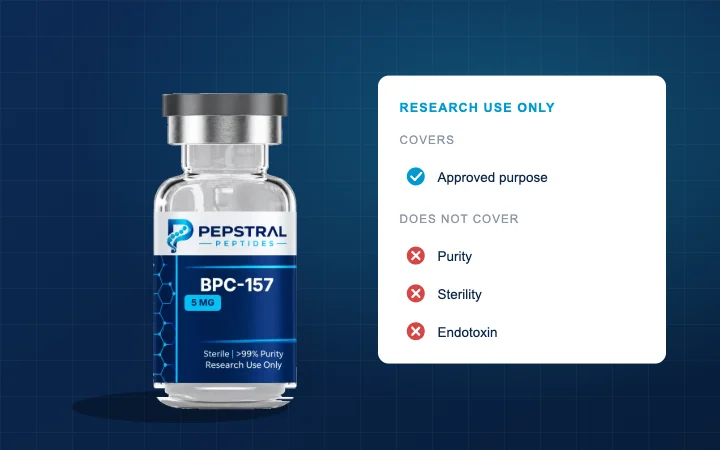
Every product mentioned is sold for laboratory research use only and is not for human or animal use. Nothing on this page describes or recommends use of the material sold here in humans or animals.