
"Non-pyrogenic" means the product was tested for fever-causing substances and found below a defined limit. In practice the substance is bacterial endotoxin, and the test is the Limulus amebocyte lysate assay or its recombinant equivalent. It is a claim about a measurement, not about how carefully something was made, and it is independent of sterility: a vial can be sterile and pyrogenic at the same time. This post explains what a pyrogen is, how the label is earned, why the usual ways of making something sterile do nothing about pyrogens, what the line means on the certificates published for this catalogue, and the difference between two words that search engines keep confusing.
What is a pyrogen?
Anything that produces fever when it reaches the bloodstream. The word covers a family, but one member dominates: endotoxin, the lipopolysaccharide that forms the outer membrane of Gram-negative bacteria. Endotoxin is released when those bacteria die, it is present wherever water and bacteria have met, it is heat-stable enough to survive an autoclave, and it triggers an inflammatory response at nanogram quantities. The endotoxin post covers the units and the arithmetic; the short version is that the potency is expressed in endotoxin units (EU) rather than mass because different bacteria's lipopolysaccharides differ in activity.
Non-endotoxin pyrogens exist too, from Gram-positive bacteria, fungi and some synthetic materials, and they are why the older rabbit test and the newer monocyte activation test survive alongside the endotoxin assay. For a synthetic peptide made by solid-phase chemistry and purified by chromatography, endotoxin is the realistic contaminant, and it is what the certificates test.
How is "non-pyrogenic" proven?
By one of three tests, each of which answers a slightly different question.
| Test | What it detects | How | Where it stands |
|---|---|---|---|
| Rabbit pyrogen test (USP <151>) | Any pyrogen | Inject rabbits, measure temperature rise | The original; largely replaced for endotoxin, still used for non-endotoxin pyrogens |
| Bacterial endotoxins test, LAL (USP <85>) | Endotoxin only | Horseshoe-crab blood lysate clots or changes colour in the presence of lipopolysaccharide | The standard; what "endotoxin < 0.05 EU/mL" on a certificate means |
| Recombinant factor C (rFC) | Endotoxin only | The single lysate enzyme that responds to endotoxin, made recombinantly, in a fluorescent assay | Accepted equivalent to LAL; no animal source; Ding and Ho 2010 review the history |
| Monocyte activation test | Any pyrogen | Human blood cells release cytokines in response to pyrogens | The in-vitro replacement for the rabbit test |
The certificates published for this catalogue report endotoxin by the bacterial endotoxins test with a limit of 0.05 EU/mL, and the sterility post explains why that line and the sterility line are two different tests answering two different questions.
Why can a sterile vial still be pyrogenic?
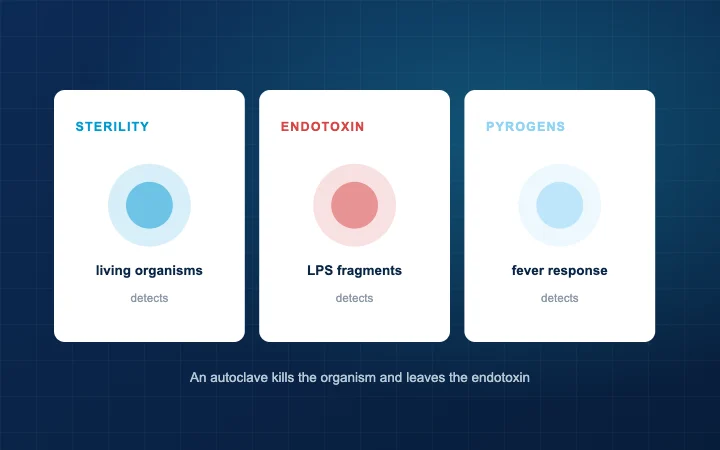
Because the things that make a product sterile do not touch endotoxin.
Autoclaving kills bacteria with steam at 121 °C. Endotoxin survives it; the dead bacteria leave their lipopolysaccharide behind, and a heavily contaminated solution that is then autoclaved is sterile and pyrogenic.
Sterile filtration through a 0.22 µm membrane removes bacteria by size. A lipopolysaccharide molecule is far smaller than the pore and passes straight through. Filtering a peptide solution before use makes it sterile; it does not make it non-pyrogenic.
Depyrogenation is a separate step with its own methods: dry heat at about 250 °C for 30 minutes for glassware, which destroys endotoxin rather than merely killing bacteria; ultrafiltration with a molecular-weight cut-off small enough to hold back endotoxin aggregates; or adsorption onto specific resins. None of these are things a laboratory does to a peptide vial after purchase. They are done to the water, the glass and the equipment before the product is filled, and the certificate's endotoxin line is the evidence they worked.
What does the line mean on a peptide certificate?
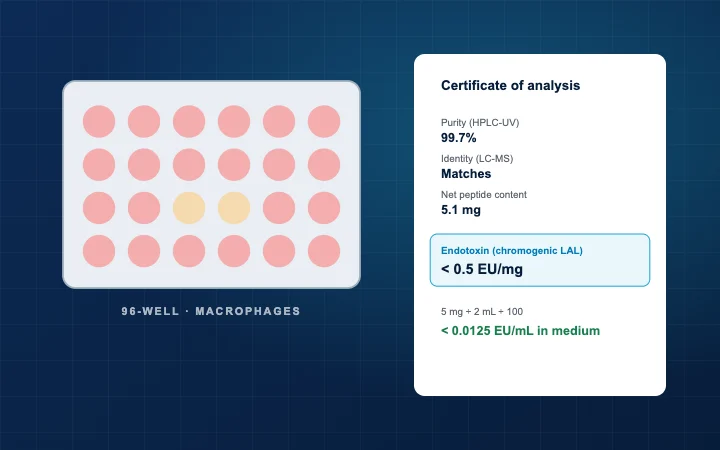
That a sample of the lot was tested by the bacterial endotoxins test and came in under the stated limit. For the current BPC-157, thymosin alpha-1, KPV and TB-500 certificates on the certificate page, that limit is 0.05 EU/mL of reconstituted sample. What the line does not say is "zero". No test reports zero; it reports below a limit, and the endotoxin post converts that limit into what a given vial could at most contribute to a culture well.
For the immune-signalling compounds in particular, thymosin alpha-1 and KPV among them, this line is the one that makes a result attributable. Endotoxin is itself a toll-like receptor 4 agonist and a potent inflammatory stimulus; a contaminated vial would produce exactly the response those compounds are studied for. Their posts, thymosin alpha-1 vs Thymalin and KPV, make the point from the compound's side.
Pyrogenic or pyogenic?
Two words one letter apart, and search engines conflate them.
| Word | Meaning | Example |
|---|---|---|
| Pyrogenic | Fever-causing | Endotoxin is pyrogenic; a non-pyrogenic vial has been tested for it |
| Pyogenic | Pus-forming | Staphylococcus aureus is a pyogenic bacterium |
A pyogenic bacterium can be a source of pyrogens, which is where the confusion starts, but the words describe different things: one an effect on body temperature, the other a kind of infection. A certificate uses only the first.
Does the water matter?
Yes, and it is where most endotoxin in a reconstituted vial would come from. Water for injection is made to an endotoxin limit, and the reconstitution solution in the catalogue is prepared as sterile, preservative-containing water for injection; the reconstitution solution post covers what is in it. Water from a laboratory tap, a deionising cartridge or a bottle that has been open for a month is sterile-looking and pyrogenic; reconstituting a certified peptide in it undoes the certificate.
Frequently asked questions
Does non-pyrogenic mean sterile?
No. They are separate tests for separate things. A product can be either, both or neither. Certificates in this catalogue report both lines separately on the layouts that include sterility.
Does non-pyrogenic mean endotoxin-free?
No. It means below a limit, which the certificate states. Absolute zero is not measurable and no honest certificate claims it.
Can I remove endotoxin from a peptide solution myself?
Not practically. Endotoxin-removal resins exist and can strip endotoxin from protein solutions, but they also bind some peptides, and validating the result needs the same assay the laboratory ran. Buying a lot with a certificate line and reconstituting it in water for injection is the realistic route.
Why is the limit expressed per millilitre rather than per milligram?
Because the test is run on a reconstituted sample at a known volume. The endotoxin post shows how to convert the per-millilitre figure to per-milligram or per-well for a given vial and fill volume.
Which is better, LAL or recombinant factor C?
They measure the same thing and are accepted as equivalent. rFC avoids the horseshoe-crab harvest and has no batch-to-batch lysate variation; LAL has decades of validation history. A certificate that names either is reporting a recognised bacterial endotoxins test.
References
- Ding JL, Ho B. Endotoxin detection: from Limulus amebocyte lysate to recombinant factor C. Subcellular Biochemistry 2010;53:187-208. doi.org/10.1007/978-90-481-9078-2_9
- Cooper JF. Quality-control analytical methods: endotoxins: essential testing for pyrogens in the compounding laboratory. International Journal of Pharmaceutical Compounding 2011;15(1):49-54. pubmed.ncbi.nlm.nih.gov/23696047
- United States Pharmacopeia. General Chapter <85> Bacterial Endotoxins Test; General Chapter <151> Pyrogen Test. www.usp.org
Every product mentioned is sold for laboratory research use only and is not for human or animal use. Nothing on this page describes or recommends use of the material sold here in humans or animals.