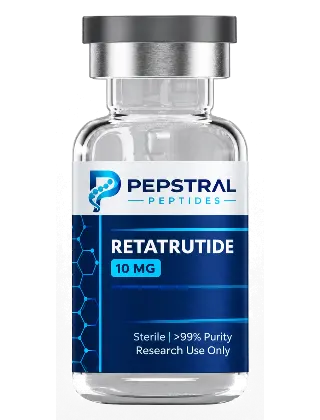
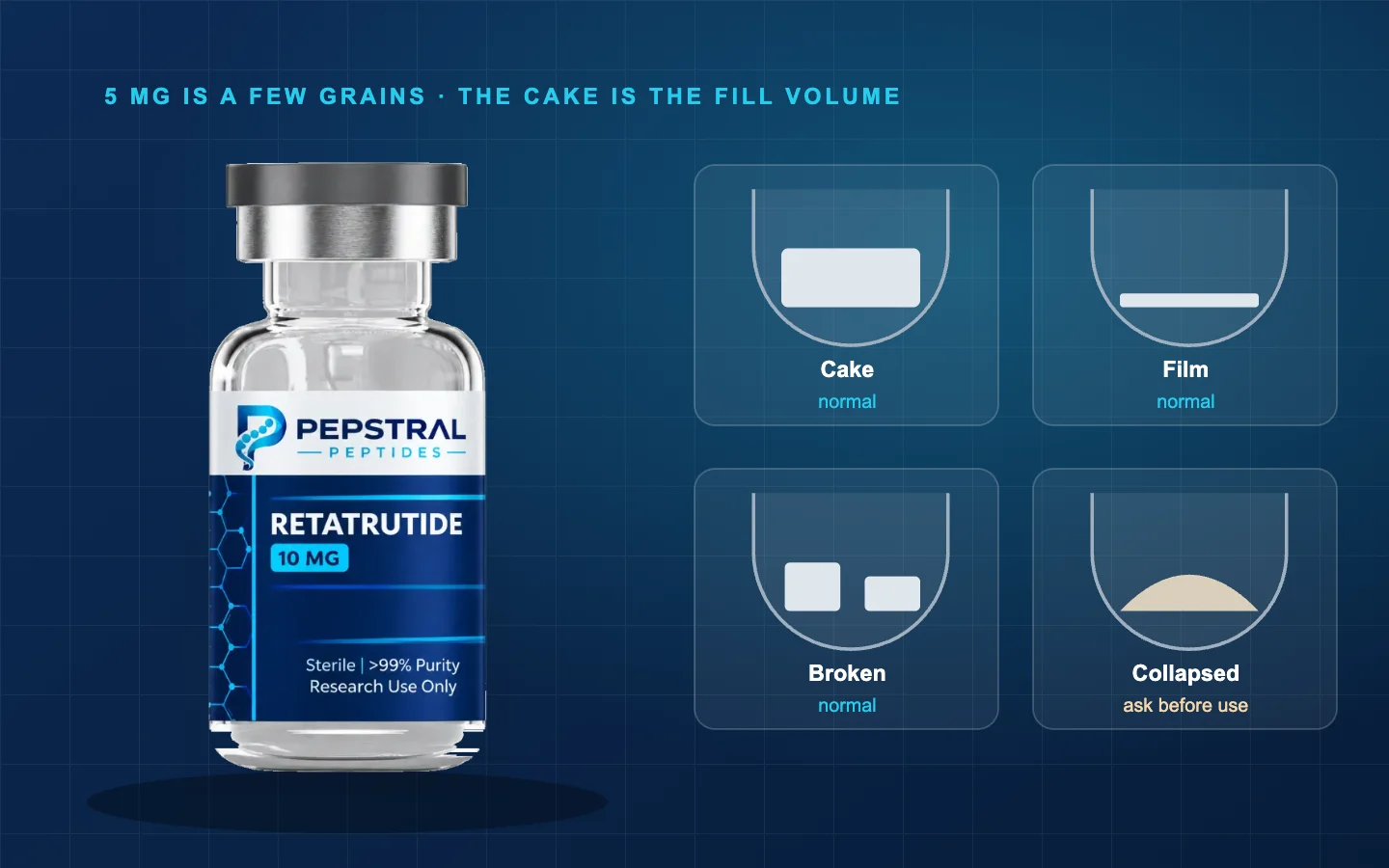
A 5 mg vial of lyophilized peptide contains 5 mg of powder plus a little counter-ion and water. Five milligrams is a few grains of table salt. Depending on how the vial was filled it can look like a small white cake at the bottom, a thin film on the glass, a few flakes, or nothing at all until you hold it against the light. All of those are normal. This post explains what freeze-drying leaves behind, what a good vial looks like, which appearances mean nothing and which mean something, and what to do before you open it.
What does freeze-drying actually leave in the vial?
Lyophilization removes water from a frozen solution by sublimation. The peptide is dissolved, the solution is filled into the vial, the vial is frozen, and under vacuum the ice sublimes straight to vapour without melting. What stays behind is everything that was dissolved, in the shape the frozen solution had. Tang and Pikal's review of freeze-drying design describes the result: a porous cake whose volume is set by the fill volume, not by the mass of solid in it.
That last point is the whole explanation. A vial filled with 0.5 mL of solution and dried gives a cake the size of 0.5 mL, mostly air, with 5 mg of solid spread through it. A vial filled with 0.1 mL gives a cake a fifth the size. Some suppliers fill dilute solutions and get a visible cake; some fill concentrated solutions and get a film or a few flakes. The peptide mass is identical.
What is a good vial supposed to look like?
| Appearance | What it means | Action |
|---|---|---|
| Small white or off-white cake at the bottom | Standard result from a larger fill volume | None |
| Thin film or crust on the bottom or wall | Standard result from a small fill volume | None |
| A few loose flakes or grains | Cake broke up in transit | None; tap to settle |
| Cake shrunk away from the glass | Slight collapse during drying | None; peptide unchanged |
| Cake cracked or in pieces | Mechanical, from handling or freezing | None |
| Cake stuck to the stopper or upper wall | Vial was inverted or shaken in transit | Tap down before opening |
| Nothing visible at arm's length | Small mass, small fill | Hold to the light; look for a film |
None of these change the peptide. Lyophilized peptide is dry and chemically inert enough that its physical form, cake or film or flakes, has no bearing on what dissolves when you add water. The storage guide explains why the dry state is so stable.
Which appearances are a problem?
| Appearance | What it suggests | Action |
|---|---|---|
| Yellow, brown or grey colour | Oxidation, contamination or a different compound | Do not use; contact the supplier with the lot number |
| Visible liquid, droplets or a gummy mass | Moisture got in: bad seal or cold vial opened warm | Do not use; the stability window has already started |
| Stopper loose, lifted or crimp damaged | Seal failure in transit | Do not use; photograph and report |
| Cake fully collapsed to a glassy puddle | Drying failure or moisture uptake | Ask the supplier; usable only if the certificate covers it |
| Powder that is a different colour from the last lot | Possible different compound or counter-ion | Check the lot certificate before use |
Moisture is the one that matters most and is least visible. Bachem's quality guide notes that hygroscopic peptides absorb water even under careful lyophilization, and a vial that has taken in water through a bad seal is a vial whose reconstituted-state clock started before you opened it.
Why do some lots look different from the last one?
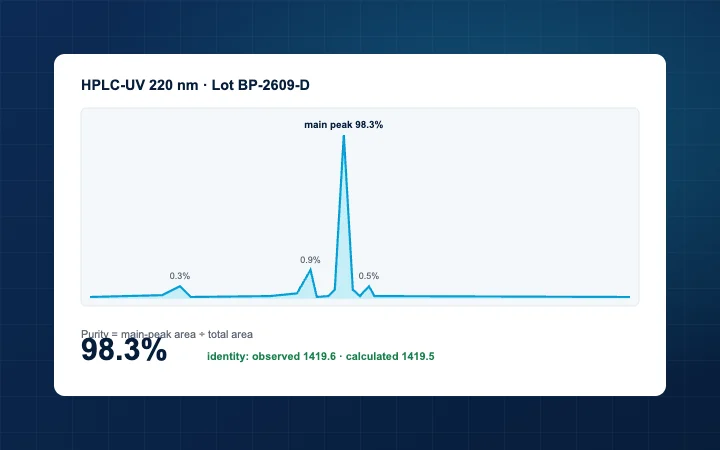
Because fill volume, freezing rate and drying cycle can change between lots, and each changes the cake's shape and texture. A supplier who switched from a 0.5 mL fill to a 0.2 mL fill will ship a lot that looks a third the size, with the same milligrams. The certificate, not the appearance, tells you what is in the vial. If two lots of the same compound look different, compare the two certificates: identity, purity and net content should match within normal variation. The certificate guide shows the lines to compare.
What should you do before opening a vial?
- Look. Check the crimp and stopper, the colour, and for any liquid.
- Tap. Hold the vial upright and tap it on the bench so powder on the stopper or wall drops to the bottom. Powder trapped under the stopper is lost when the needle goes in.
- Let it warm. A vial from the freezer opened straight away pulls moisture out of the air onto cold glass. Fifteen minutes at room temperature, still sealed, avoids that.
- Reconstitute against the glass. Run the water down the inside wall, not onto the cake, then swirl. The reconstitution guide gives volumes and the syringe arithmetic; the concentration table gives the numbers for every catalog vial.
- Check it dissolved. A clear solution with no particles is the expected result. A few minutes of gentle swirling is normal, longer for GLP-1 class peptides, which the post on slow-dissolving peptides explains.
Does a smaller cake mean less peptide?
No, and this is the question behind most "empty vial" support tickets. The cake is a record of the fill volume; the milligrams are a record of what was dissolved before drying. Only the certificate's net peptide content line tells you how much peptide is there, and only the label tells you which certificate to look at. A BPC-157 vial and an ipamorelin vial, both 5 mg, can look quite different depending on how each was filled, and both contain 5 mg.
Large-mass vials are the reverse case. A GHK-Cu 50 mg vial has a visible blue-violet cake, because the copper complex is coloured and there is ten times the mass. That colour is expected for that compound and would be a problem in any other.
Frequently asked questions
The cake broke into pieces in shipping. Is the peptide damaged?
No. Mechanical breakage of a dry cake does not change the peptide. Tap the pieces down and reconstitute as normal.
There is powder stuck under the stopper. What do I do?
Tap the vial firmly on the bench with the stopper up until the powder drops. If some remains, the first draw of water run down the wall will wash it into the solution; do not pry the stopper.
The vial arrived warm. Is it ruined?
Lyophilized peptide tolerates days at room temperature and short periods warmer than that. The storage guide gives the sealed-state windows. Warmth in transit is a concern for reconstituted solutions, not sealed dry vials.
Should I weigh the vial to check the contents?
You cannot weigh milligrams of powder accurately inside a glass vial on a laboratory balance, and the counter-ion and water make gross weight unreliable anyway. The certificate's net peptide content line, or an independent test, is how the amount is checked.
References
- Tang X, Pikal MJ. Design of freeze-drying processes for pharmaceuticals: practical advice. Pharmaceutical Research 2004;21(2):191-200. doi.org/10.1023/b:pham.0000016234.73023.75
- Bachem. Quality Control of Amino Acids and Peptides: A Guide. Net peptide content, counter-ions and moisture. www.bachem.com/knowledge-center/quality-control-of-amino-acids-peptides-a-guide
Every product mentioned is sold for laboratory research use only and is not for human or animal use. Nothing on this page describes or recommends use of the material sold here in humans or animals.