Most peptides in this catalogue are linear chains and their shape in solution is whatever the sequence makes it. A minority contain cysteine, and cysteine changes the problem: two of them can form a covalent bridge, and where that bridge forms determines the molecule's shape — and often whether it works at all. This post covers what disulfide bonds do, why making them correctly is a separate manufacturing step, and what cysteine means once the vial is on your bench.
What is a disulfide bond?
Cysteine's side chain ends in a thiol — a sulfur with a hydrogen. Two thiols can lose their hydrogens and bond sulfur-to-sulfur, forming a disulfide bridge. It is a genuine covalent bond, considerably stronger than the hydrogen bonds and hydrophobic contacts that otherwise hold a peptide's shape.
For a peptide with two cysteines at opposite ends, that bridge turns a floppy chain into a closed loop. The loop has a defined geometry, and for many bioactive peptides the geometry is the activity — insulin, oxytocin, vasopressin and the conotoxins all depend on specific disulfide arrangements.
The bond forms by oxidation, which is the key operational fact. Making one requires an oxidising environment; breaking one requires a reducing environment. Both are routine to arrange, which is why disulfides are chemically reversible in a way ordinary peptide bonds are not.
Why is folding a separate step?
Because with more than two cysteines, the right pairing is not the only possible one.
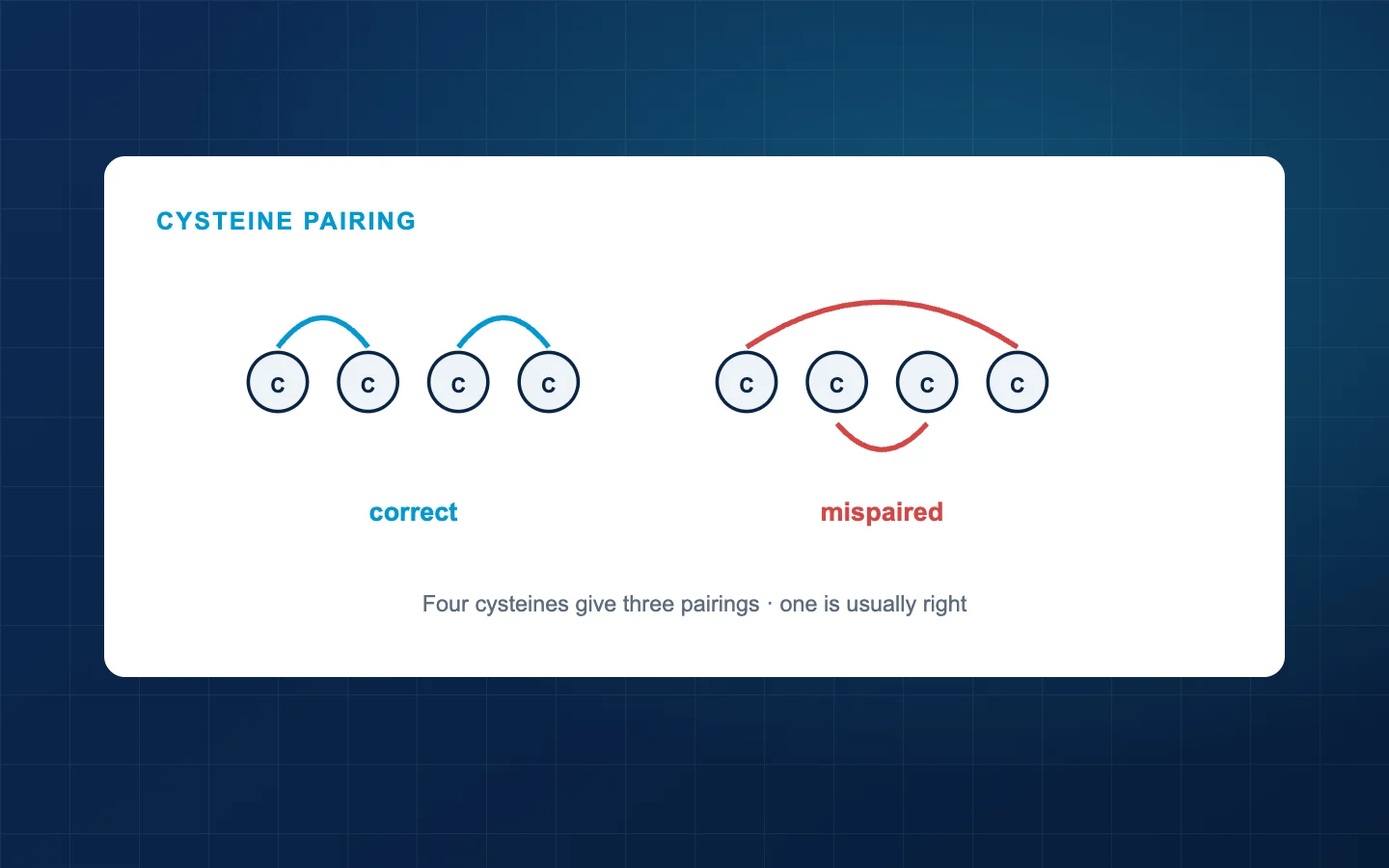
Four cysteines can pair three different ways: 1-2/3-4, 1-3/2-4, or 1-4/2-3. Only one of those is typically the native arrangement. Six cysteines give fifteen possible pairings. The synthesiser produces a linear chain with free thiols; letting it oxidise at random gives you a mixture, most of it misfolded.
So disulfide-rich peptides are made in two stages: build the chain, then fold it under controlled conditions that favour the correct arrangement. Patil and colleagues' work on photolysis-mediated folding, and Shekh and colleagues' on oxidative folding catalysts for conotoxins, are both attacking exactly this — getting the right pairing efficiently rather than hoping for it.
| Cysteines | Possible pairings | Practical consequence |
|---|---|---|
| 0 | — | Linear chain, no folding step |
| 2 | 1 | One loop, straightforward |
| 4 | 3 | Folding must be directed |
| 6 | 15 | Specialist process, higher cost |
The dimer problem
There is a second thing cysteines can do, and it catches people out: a thiol on one molecule can bond to a thiol on another molecule.
The result is a covalent dimer — two peptides joined. It has the same residues and the same purity by most measures, but it is twice the mass and a different species. On a chromatogram it separates; by mass spectrometry it is unmistakable, since the mass is roughly doubled.
This is different from the non-covalent association covered in our aggregation post. Aggregation involves no new bonds and can sometimes be reversed by dilution; a disulfide-linked dimer is covalently joined and will not come apart without a reducing agent.
What does this mean for handling?
Three things, and they apply to any peptide with a free cysteine.
Oxidation is not your friend here. A free thiol in solution, exposed to dissolved oxygen and trace metals, will oxidise. That can mean forming an unwanted internal bond, or dimerising, or going to a sulfinic or sulfonic acid that cannot be reduced back. Schöneich's work on methionine oxidation covers the adjacent chemistry for the other sulfur-containing residue.
Trace metals accelerate it. Copper is a well-known catalyst for thiol oxidation, which is a real consideration if you are working with GHK-Cu alongside a cysteine-containing peptide, or using a buffer with metal contamination. Our GHK-Cu post covers why the metal is not inert.
Prepare fresh where it matters. For a cysteine-containing peptide the working window is shorter than for a sequence without one, and unexplained haze deserves investigation rather than a shake.
Which compounds here are affected?
Only a minority. SS-31 contains no cysteine but does carry the aromatic-cationic motif that makes it distinctive. L-glutathione is the clearest case in the catalogue — it is a cysteine-containing tripeptide, supplied in the reduced form, and its whole function in biology is as a redox couple. Reduced glutathione oxidises to the disulfide dimer readily in air, which is why our product page says to prepare it fresh where the redox state matters.
Most of the catalogue — BPC-157, TB-500, the GLP-1 class, the bioregulators — has no cysteine and no disulfide chemistry to worry about. Checking is worth thirty seconds: our sequence post has the one-letter codes, and C is the one to look for.
Frequently asked questions
How do I know if my peptide has disulfide bonds?
The sequence tells you — count the cysteines. The certificate should also say, because a folded peptide's mass is 2 Da lower per disulfide than the reduced form, and a careful identity line reflects that.
Can I reduce a disulfide deliberately?
Yes — DTT or TCEP are standard. Whether you should depends on whether the bond is structural. Reducing a peptide whose activity depends on its loop destroys the activity.
Does oxygen in the vial matter?
For a lyophilized cysteine-containing peptide, headspace oxygen is a genuine if slow concern. The dry state slows everything, as our shipping post covers, but sealed and cold is the right storage either way.
Why is glutathione supplied reduced rather than oxidised?
Because most protocols specify GSH, the reduced form, and the oxidised dimer GSSG is a different compound with a different role. They are not interchangeable and a protocol will say which it needs.
References
- Patil NA, Karas JA, Turner BJ, Shabanpoor F. Rapid photolysis-mediated folding of disulfide-rich peptides. Chemistry — A European Journal 2019;25(38):8599-8603. doi.org/10.1002/chem.201901334
- Shekh S, et al. Oxidative folding catalysts of conotoxins derived from the venom duct transcriptome. Biochemistry 2023;62(18):2703-2713. doi.org/10.1021/acs.biochem.3c00320
- Schöneich C. Mechanisms of methionine oxidation in peptides. ACS Symposium Series 1997;675:79-89. doi.org/10.1021/bk-1997-0675.ch004
Every product mentioned is sold for laboratory research use only and is not for human or animal use. Nothing on this page describes or recommends use of the material sold here in humans or animals.