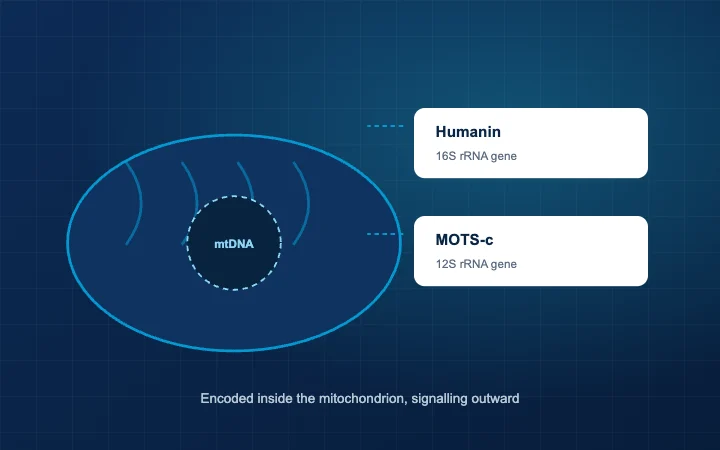

MOTS-c is a 16-residue peptide with an unusual origin: its sequence is encoded in a short open reading frame inside the mitochondrial 12S ribosomal RNA gene, which is why it is called a mitochondrial-derived peptide. The post on that family covers where these peptides come from and why the origin matters; the MOTS-c research guide covers the literature. This post does one job: it reads the certificate for the lot on sale, COA7589 for lot MOTS10-0803, and explains what each line establishes and what the sequence means for handling.
What is the sequence, and what in it matters?
MRWQEMGYIFYPRKLR. Written out: methionine, arginine, tryptophan, glutamine, glutamic acid, methionine, glycine, tyrosine, isoleucine, phenylalanine, tyrosine, proline, arginine, lysine, leucine, arginine.
Three features decide almost everything about how this peptide behaves on the bench.
| Feature | Residues | Consequence |
|---|---|---|
| Two methionines | positions 1 and 6 | Oxidise to methionine sulfoxide in air and in solution; each adds 16 to the mass and shifts the HPLC peak |
| One tryptophan, two tyrosines, one phenylalanine | 3, 8, 11, 10 | Strong absorbance at 280 nm, so A280 quantification works; tryptophan is light-sensitive |
| Three arginines and a lysine against one glutamate | Net charge about plus three at neutral pH; very soluble in water; sticks to glass and plastic more than a neutral peptide would |
The formula is C101H152N28O22S2, with the two sulfurs being the two methionines. The average mass is 2174.6.
What does the certificate for lot MOTS10-0803 report?
Issued by Bioviridian Inc. on 17 August 2026. Five tests.
| Test | Method | Result | What it establishes |
|---|---|---|---|
| Identity | LC-MS/MS | 2174.6 observed | The intact peptide has the predicted mass, and its fragment pattern is consistent with the sequence |
| Purity | RP-HPLC, 214 nm | 99.84% | 99.84% of the UV-absorbing material is the main peak, at a retention time of 10.02 minutes |
| Content | Gravimetric against label | 10.62 mg | Six percent over the 10 mg label |
| Endotoxin | LAL | < 0.05 EU/mL | Below the assay's reporting limit at the dilution tested |
| Heavy metals | ICP | < 0.01 ppm | Below the reporting limit |
Two of these lines deserve a closer look than usual for this particular sequence.
Identity by LC-MS/MS at 2174.6. Tandem mass spectrometry fragments the ion and reads the fragment ladder, so this is a sequence-level identity, not just a mass match. For a peptide with two methionines that is important for a second reason: oxidised MOTS-c would appear at 2190.6 or 2206.6. The certificate's mass is the unoxidised peptide, which tells you the lot was not oxidised at the time of testing. The LC-MS post explains what tandem MS adds over a single mass.
Purity at 214 nm, retention 10.02 minutes. A 16-residue peptide with four aromatic residues retains well on a reversed-phase column, so the main peak separates cleanly from deletion sequences and from the sulfoxide forms, which elute earlier. A 99.84% area figure on a well-retained peptide is a discriminating number in a way that the same figure on a dipeptide is not. The area-percent post covers what the percentage is and is not.
How many micromoles are in the vial?
The label's 10 mg at 2174.6 g/mol is 4.60 micromoles; the measured content, 10.62 mg, is 4.88. Lee and colleagues' 2015 cell work, which is where the sequence was first described, used micromolar concentrations in culture. At 1 micromolar in 200 microlitres per well, 4.60 micromoles is 23,000 wells. One vial is a research programme, not an experiment, and the vial-size post explains why that makes the 10 mg size the right one for most work.
The concentration table has the working dilutions for the 10 mg vial.
How should this sequence be handled?
More carefully than most of the catalogue, and for reasons that are in the sequence rather than in any special fragility of the compound.
- Oxidation. Two methionines. Methionine oxidises in dissolved oxygen, faster with light and with trace metals. Reconstitute with degassed water or buffer if the assay is sensitive to a mass shift, aliquot immediately, and freeze. Do not keep a working stock at 4 °C for weeks. The oxidation-prone residues post sets out the chemistry.
- Light. Tryptophan photo-oxidises. Keep the lyophilized vial in its box and solutions in amber or foil-wrapped tubes.
- Adsorption. Net positive charge and aromatic residues together make this a peptide that binds to surfaces. Use low-binding tubes and pipette tips at the nanomolar end, as the adsorption post recommends, and never store a dilute working solution for reuse.
- Freeze-thaw. Aliquot once, thaw once. A sixteen-residue peptide survives a few cycles, but each is a chance for oxidation and adsorption, not for anything the certificate measured.
- Quantification. The aromatic content means A280 works for checking a stock, as the A280 post explains, which is a useful independent check on a solution that has been stored.
- Diluent. Water or buffer. Reconstitution solution, with its benzyl alcohol preservative, is for multi-entry vials; the diluent post covers when it is and is not appropriate for cell work.
What does the certificate not tell you?
Its purity is a value at the issue date, 17 August 2026, for material stored as the laboratory received it. It is not a guarantee against what happens to a methionine-containing peptide left in solution on a bench. The issued-date post is about exactly this distinction, and the stability study post is how to measure your own storage conditions rather than assume them.
Frequently asked questions
Is MOTS-c encoded in the nuclear genome?
No. The open reading frame is within the mitochondrial 12S rRNA gene, MT-RNR1, which is on the mitochondrial genome. That is the defining feature of a mitochondrial-derived peptide, as described in Lee et al. 2015.
How do you know the lot was not oxidised?
The LC-MS/MS identity reports 2174.6, the unoxidised mass. Methionine sulfoxide would add 16 per methionine. The certificate shows the intact peptide at the time of testing; what happens after the vial is opened is in the handling.
Why does this peptide retain so long on HPLC?
Four aromatic residues and a leucine and isoleucine make it hydrophobic enough to hold on a C18 column until well into the gradient, 10.02 minutes on this lot's run. That is what makes the purity figure discriminating.
Can A280 be used for a stock?
Yes. Tryptophan and two tyrosines give it a usable extinction coefficient. The A280 post has the method and the caveats.
What is MOTS-c sold for?
Laboratory research. Every product on this site is for in-vitro research use only and is not for human or animal use. The 2015 Cell Metabolism paper is a mouse and cell study, and its title is cited here as a title, not as a claim.
References
- Lee C, Zeng J, Drew BG, et al. The mitochondrial-derived peptide MOTS-c promotes metabolic homeostasis and reduces obesity and insulin resistance. Cell Metabolism 2015;21(3):443-454. doi.org/10.1016/j.cmet.2015.02.009
- PubChem, National Library of Medicine. MOTS-c, CID 146675088, C101H152N28O22S2, CAS 1627580-64-6. Read 2 October 2026. pubchem.ncbi.nlm.nih.gov/compound/146675088
- Bioviridian Inc. Certificate of analysis COA7589, lot MOTS10-0803, issued 17 August 2026. Verification code on the certificate. bioviridians.com/coa-search.html
Every product mentioned is sold for laboratory research use only and is not for human or animal use. Nothing on this page describes or recommends use of the material sold here in humans or animals.