Almost every peptide in this catalogue is either a synthetic analogue of a hormone or a fragment of a larger protein encoded in the cell nucleus. Mitochondrial-derived peptides are neither. They are encoded inside the mitochondrion's own genome — the small circular DNA that mitochondria carry as a remnant of their bacterial ancestry. That origin is not trivia; it is the entire basis for treating them as a class, and it shapes what researchers use them to ask.
Where do they actually come from?
Mitochondria have their own DNA, about 16,500 base pairs, encoding a handful of genes needed for oxidative phosphorylation plus the RNAs to translate them. For decades that was understood as the complete inventory.
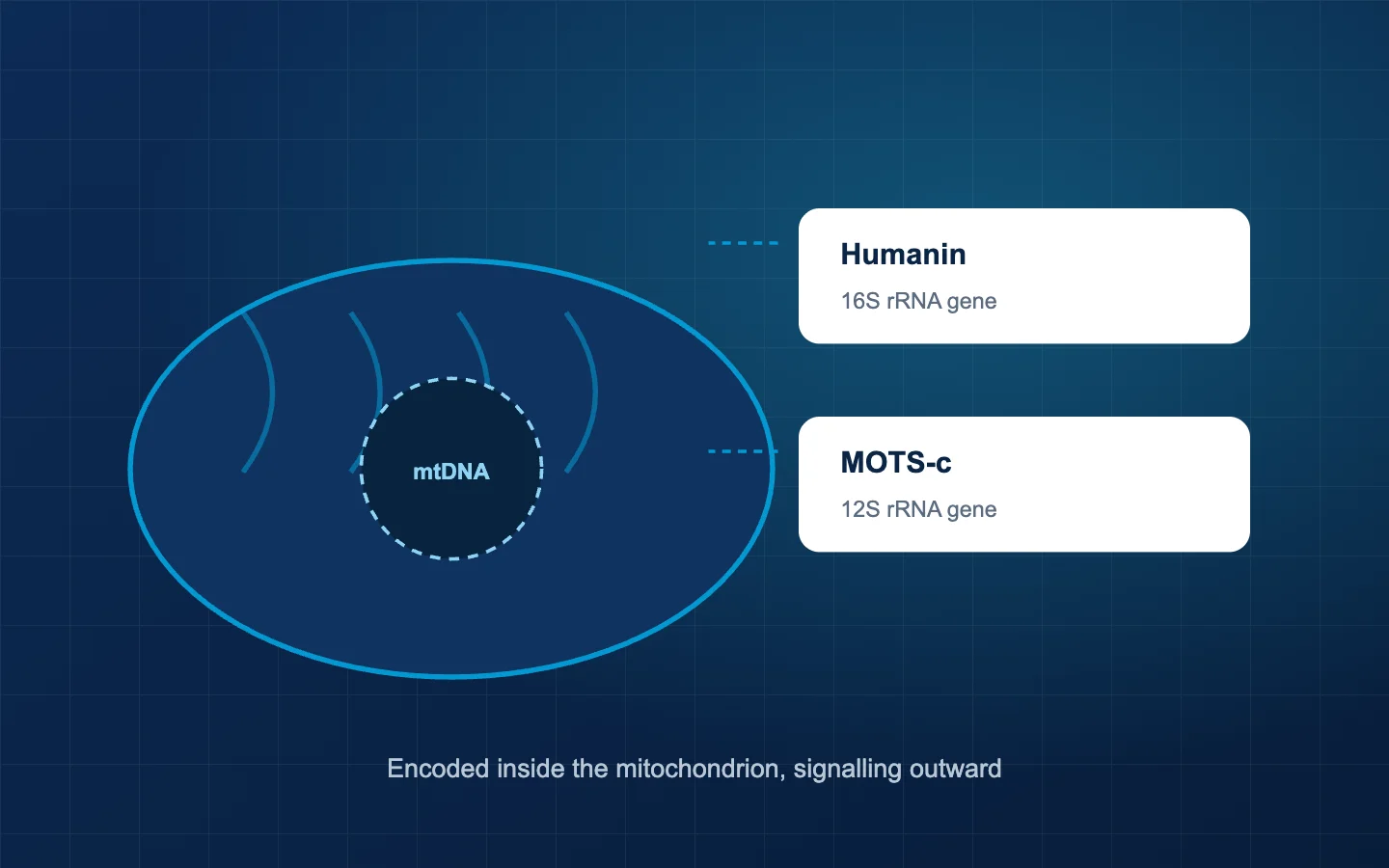
Then short open reading frames were found within those genes — sequences nested inside the ribosomal RNA genes that encode small peptides in their own right.
- Humanin, a 24-residue peptide, comes from within the 16S rRNA gene. It was the first identified and gave the class its footing.
- MOTS-c, a 16-residue peptide, comes from within the 12S rRNA gene.
Two different genes, two different peptides, two different signalling stories. They are not isoforms of each other, and results for one do not read across to the other.
Why does the origin matter?
Because it inverts the usual direction of information. The standard picture is the nucleus instructing the mitochondrion — the nuclear genome encodes most mitochondrial proteins and ships them in. Peptides encoded by the mitochondrion and acting on the rest of the cell run the other way, which the literature calls retrograde signalling, and the peptides themselves mitokines.
That framing is why they attract interest in metabolic and ageing research: a molecule whose expression tracks mitochondrial state, and which then signals outward, is a candidate messenger for how cellular energy status reaches the rest of the system. Ayubi and colleagues' review looks at exactly this in the context of exercise, where mitochondrial demand changes sharply.
Thakur and colleagues' 2025 review covers the neurodegeneration literature, where the cytoprotective observations have drawn the most attention.
| Humanin | MOTS-c | |
|---|---|---|
| Encoded in | 16S rRNA gene | 12S rRNA gene |
| Length | 24 residues | 16 residues |
| Molecular weight | 2,687.2 g/mol | See product page |
| Described signalling | gp130 receptor complex | AMPK and metabolic pathways |
| Studied for | Cytoprotection, apoptosis models | Metabolic regulation, exercise response |
Which of these are genuinely mitochondrial-derived?
Pepstral lists MOTS-c and humanin as genuine mitochondrial-derived peptides.
SS-31 is shelved nearby and is not one. It is a synthetic tetrapeptide designed to concentrate in mitochondria by binding cardiolipin in the inner membrane. Same organelle, completely different provenance — it is a molecule humans designed, not one the mitochondrion encodes. Grouping it with MDPs in a methods section would be an error, and our SS-31 product page describes it on its own terms.
NAD+ sits in the same category too and is a dinucleotide cofactor, not a peptide at all. The longevity category page is explicit that this shelf spans genuinely different chemistry.
How should this shape a study design?
Three consequences worth planning around:
- Expression is condition-dependent. These peptides are studied partly because their levels change with metabolic state. A model that holds cells in one condition may not show the biology the literature describes.
- They are not interchangeable. Humanin signals through a gp130-containing receptor complex; MOTS-c is described through AMPK-linked metabolic pathways. A combination experiment needs each alone as a control or the result cannot be attributed.
- Endogenous background exists. Unlike a synthetic analogue with no natural counterpart, your system is already making these. Whether that matters depends on the readout, but it belongs in the design.
Frequently asked questions
Are there more mitochondrial-derived peptides than these two?
Yes — the SHLP family (small humanin-like peptides) has also been described from the same region. Humanin and MOTS-c are the two with enough literature to be worth stocking.
Why is humanin so much heavier than MOTS-c?
Twenty-four residues against sixteen. At roughly 112 Da per residue that difference accounts for most of the gap; PubChem lists humanin at 2,687.2 g/mol. Our molarity post covers why that matters when comparing them at equal mass.
Is the mitochondrial genetic code different?
It is, slightly — mitochondria use a few codon assignments that differ from the standard nuclear code. It does not change how you handle the synthetic peptide, but it is part of why these sequences went unnoticed for so long.
Do these need special storage?
They are handled like the other lyophilized peptides here: sealed and frozen, protected from light, reconstituted into a recorded window. Humanin contains methionine, so oxidation is a live route for it — our stability post covers what that means once it is in solution.
References
- Thakur R, Sharma A, Kumar M, et al. Mitochondrial-derived peptides: implication in the therapy of neurodegenerative diseases. Molecular Neurobiology 2025. doi.org/10.1007/s12035-025-05198-5
- Ayubi N, et al. Mitochondrial-derived peptides (MDPs) activated by physical exercise as therapeutic targets. Physiology International 2026. doi.org/10.1556/2060.2026.00863
- PubChem CID 16131438 — humanin: molecular formula C119H204N34O32S2, molecular weight 2687.2. pubchem.ncbi.nlm.nih.gov/compound/16131438
Every product mentioned is sold for laboratory research use only and is not for human or animal use. Nothing on this page describes or recommends use of the material sold here in humans or animals.