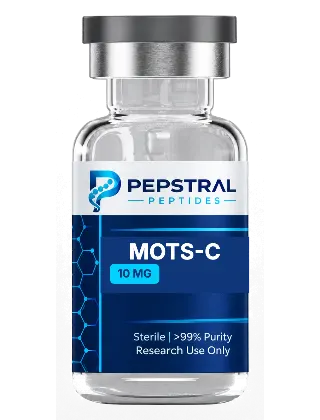
What is MOTS-c, and what is it studied for?
MOTS-c is a 16-amino-acid peptide encoded by a short open reading frame within the mitochondrial 12S ribosomal RNA gene, one of a small family of mitochondrial-derived peptides. It is studied as a signal from the mitochondria to the rest of the cell: it activates AMPK, shifts metabolism under stress, and has been linked to exercise response and insulin sensitivity in rodent models.
What is the structure of MOTS-c?
Sequence MRWQEMGYIFYPRKLR, translated from mitochondrial DNA. Supplied lyophilized as the acetate salt; identity by LC-MS against the calculated mass, purity by HPLC-UV.
How is MOTS-c thought to work?
MOTS-c inhibits the folate cycle and de novo purine synthesis, which raises AICAR and activates AMPK, the central energy sensor. Under metabolic stress it translocates to the nucleus and regulates gene expression through stress-response transcription factors. Circulating levels rise with exercise and fall with age in the studies that have measured them.
Which research areas use MOTS-c?
| Area | Typical models and endpoints |
|---|---|
| AMPK activation | Phosphorylation readouts and downstream glucose-uptake assays in muscle cells. |
| Skeletal muscle and exercise | Rodent models of exercise capacity and metabolic adaptation. |
| Insulin sensitivity | Diet-induced insulin-resistance models. |
| Mitochondrial signalling | Nuclear translocation and gene-expression profiling under stress. |
What does the published literature show?
Lee, Cohen and colleagues described MOTS-c in Cell Metabolism in 2015, including its AMPK activation and metabolic effects in mice. Later work from the same group reported exercise-responsive regulation in humans and nuclear translocation under stress. A small early-phase clinical programme by a biotechnology company exists. Research use of the material sold here is in-vitro and preclinical.
How is MOTS-c handled in the laboratory?
Dissolves readily. Standard reconstitution; refrigerate at 2 to 8°C; 28-day window. Contains methionine, so protect from light and minimise headspace. The reconstitution guide covers volumes and syringe units; the storage guide covers stability by compound class.
What does the current certificate show?
Lot MC-2609-E tested at 99.1% purity by HPLC-UV, identity confirmed by LC-MS, endotoxin below 0.5 EU/mg. The certificate is in the COA library and the lot number on the vial matches it. Sold as 10 mg net peptide per vial at $100, for laboratory research only.
Frequently asked questions
What makes MOTS-c different from other peptides here?
It is encoded by mitochondrial DNA, so it is used to study signalling from mitochondria to the nucleus rather than a cell-surface receptor.
What purity does lot MC-2609-E show?
99.1% by HPLC-UV, identity confirmed by LC-MS, endotoxin below 0.5 EU/mg.
Is MOTS-c in a bundle?
Yes. The Longevity stack pairs it with GHK-Cu and NAD+ at a 10% saving.
References
- Lee C et al. The mitochondrial-derived peptide MOTS-c promotes metabolic homeostasis and reduces obesity and insulin resistance. Cell Metab. 2015.
- Reynolds JC et al. MOTS-c is an exercise-induced mitochondrial-encoded regulator of age-dependent physical decline and muscle homeostasis. Nat Commun. 2021.
- Kim KH et al. The mitochondrial-encoded peptide MOTS-c translocates to the nucleus to regulate nuclear gene expression in response to metabolic stress. Cell Metab. 2018.
Clinical results cited above describe regulated trials of pharmaceutical products and are given as context for research interest only. Nothing on this page describes or recommends use of the material sold here in humans or animals.