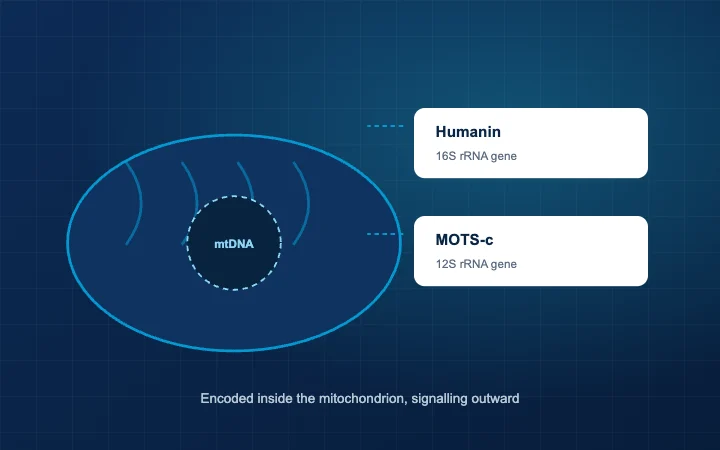

Humanin is a 24-residue peptide with the same kind of origin as MOTS-c: its sequence sits in a short open reading frame inside a mitochondrial ribosomal RNA gene, in this case the 16S rRNA, MT-RNR2. The mitochondrial-derived peptides post explains that family and the complication that nuclear pseudogenes carry similar sequences. This post reads the certificate for the lot on sale, COA7583 for lot HUM10-0803, and works through what the sequence means at the bench, because this is one of the more demanding peptides in the catalogue to handle well.
What is the sequence, and what in it matters?
MAPRGFSCLLLLTSEIDLPVKRRA. Methionine, alanine, proline, arginine, glycine, phenylalanine, serine, cysteine, then four leucines in a row, threonine, serine, glutamate, isoleucine, aspartate, leucine, proline, valine, lysine, arginine, arginine, alanine.
| Feature | Residues | Consequence |
|---|---|---|
| One cysteine | position 8 | Free thiol; two molecules can oxidise to a disulfide-linked dimer at 5,372 daltons, which is why the certificate's single mass matters |
| One methionine | position 1 | Oxidises to the sulfoxide, adding 16 |
| Four consecutive leucines plus isoleucine, valine and phenylalanine | 9 to 12 and elsewhere | A hydrophobic core: slow to dissolve, prone to aggregate, retains over ten minutes on the column, binds plastic |
| Three arginines and a lysine against two acidic residues | Net charge about plus two at neutral pH | |
| One phenylalanine, no tyrosine or tryptophan | Almost no absorbance at 280 nm; purity at 214 nm, no A280 quantification |
The formula is C119H204N34O32S2; the two sulfurs are the methionine and the cysteine. Average mass 2687.2.
What does lot HUM10-0803 report?
Issued by Bioviridian Inc. on 17 August 2026. Five tests.
| Test | Method | Result | What it establishes |
|---|---|---|---|
| Identity | LC-MS/MS | 2687.2 observed | The intact monomer, not the dimer, not the sulfoxide; fragment ladder consistent with the sequence |
| Purity | RP-HPLC, 214 nm | 99.79% | Main peak at 10.55 minutes is 99.79% of the UV-absorbing area |
| Content | Gravimetric against label | 10.60 mg | Six percent over the 10 mg label |
| Endotoxin | LAL | < 0.05 EU/mL | Below the reporting limit |
| Heavy metals | ICP | < 0.01 ppm | Below the reporting limit |
The identity line does more work here than on most certificates. A free-cysteine peptide can arrive partly as a disulfide dimer, which would show as a species at twice the mass, and a methionine peptide can arrive partly oxidised, which would show at plus 16. The certificate's 2687.2 is the intact, reduced, unoxidised monomer at the time of testing. The LC-MS post explains the tolerance.
The retention time, 10.55 minutes, is among the longest in the catalogue and is the hydrophobic core showing itself. A peptide that retains this well separates cleanly from its deletion sequences, which is what makes 99.79% a discriminating figure; the area-percent post sets out why.
How many micromoles is 10 mg?
The label's 10 mg at 2687.2 g/mol is 3.72 micromoles; the measured 10.60 mg is 3.94. The cell literature works at nanomolar to low micromolar concentrations, so one vial is thousands of wells. The concentration table and the molarity post have the arithmetic. At the listed price of $150 the vial is about $40 per micromole.
How is it handled?
In order of how often each one goes wrong.
- Dissolution. The leucine run makes this peptide slow to wet. Add the diluent down the side of the vial, let it stand, swirl gently; do not vortex, which foams a hydrophobic peptide and drives aggregation. If it will not clear, a small proportion of a water-miscible co-solvent before dilution into buffer is the standard remedy, recorded in the notes. The aggregation post explains the mechanism.
- Dimerisation. The cysteine thiol oxidises to a disulfide in air, linking two molecules. Degas the diluent, keep solutions cold, and for assays where the monomer matters, include a reducing agent in the buffer or re-check a stored stock by mass before trusting it.
- Methionine oxidation. Same precautions as above; the oxidation-prone residues post covers both residues.
- Adsorption. Hydrophobic and cationic: low-binding tubes and tips at every dilution, and no stored dilute working solutions. The adsorption post has the mechanism.
- Freeze-thaw. Aliquot once, thaw once. Each cycle is a chance for both aggregation and oxidation.
- Storage. Lyophilized at minus 20 °C, boxed. Solutions frozen in aliquots.
- Diluent. Water or buffer; reconstitution solution only for a preserved multi-entry stock, per the diluent post.
What does the literature contain?
The 2001 paper by Hashimoto and colleagues described the peptide from a screen of a cDNA library in a cultured-cell system, and gave it its name. Subsequent work, in cells and in rodents, has studied analogues as well as the native sequence; a serine-to-glycine substitution at position 14 is the most used analogue in that literature and is a different compound from the one sold here. No human trial of humanin is registered; a search of ClinicalTrials.gov on 2 October 2026 found none. The mitochondrial-derived peptides post and the trial-data post are the right frame for reading that literature without over-reading it.
Frequently asked questions
Is the catalogue humanin the native sequence or an analogue?
The native 24-residue sequence, MAPRGFSCLLLLTSEIDLPVKRRA, with a mass of 2687.2 on the certificate. The S14G analogue used in much of the literature would differ by 30 daltons.
Why does the certificate's single mass matter more here than for most peptides?
Because the free cysteine can dimerise and the methionine can oxidise, and both would show as different masses. 2687.2 is the intact reduced monomer at the time of testing.
Can it be quantified by A280?
Not usefully. One phenylalanine and no tyrosine or tryptophan give almost no absorbance at 280 nm. Use the content figure and mass.
Why is it slow to dissolve?
Four leucines in a row plus isoleucine, valine and phenylalanine make a hydrophobic core. Wet gently, do not vortex, and allow time.
What is humanin sold for?
Laboratory research. Every product on this site is for in-vitro research use only and not for human or animal use.
References
- Hashimoto Y, Niikura T, Tajima H, et al. A rescue factor abolishing neuronal cell death by a wide spectrum of familial Alzheimer's disease genes and Abeta. Proceedings of the National Academy of Sciences 2001;98(11):6336-6341. doi.org/10.1073/pnas.101133498
- PubChem, National Library of Medicine. Humanin, CID 16131438, C119H204N34O32S2, CAS 330936-69-1. Read 2 October 2026. pubchem.ncbi.nlm.nih.gov/compound/16131438
- Bioviridian Inc. Certificate of analysis COA7583, lot HUM10-0803, issued 17 August 2026. Verification code on the certificate. bioviridians.com/coa-search.html
Every product mentioned is sold for laboratory research use only and is not for human or animal use. Nothing on this page describes or recommends use of the material sold here in humans or animals.