
A peptide's molecular weight is not looked up. It is calculated, and the calculation is addition. That matters more than it sounds, because once you can do it you can check a label, check a certificate, and recognise the three or four situations where the number on the vial is correct and your arithmetic is not.
This post does the calculation, then runs it against this catalogue as a test. Eleven compounds come out exactly right. Four do not, and the four are the interesting part.
The calculation
A peptide is a chain of amino acids joined by amide bonds. Forming each bond expels one water molecule. So if you take the free amino acids and subtract the water lost at every join, you get the chain. The bookkeeping is easier in the other direction: chemists use residue masses, which are the amino acid masses already reduced by one water, and then add a single water back at the end to account for the two unreacted ends, the amine at one and the carboxyl at the other.
Molecular weight = sum of residue masses + 18.02
That is the whole method. Glycine's residue mass is 57.05, glutamic acid's is 129.12, proline's is 97.12. A chain of those three in any order weighs 57.05 + 129.12 + 97.12 + 18.02 = 301.31.
The number of water molecules is always one, whatever the chain length, which is the step people most often get wrong. A fifteen-residue peptide has fourteen bonds and has lost fourteen waters, but you are not subtracting them; the residue masses have already done it. You add one water, once.
Does it work?
A method is worth what it predicts. This site publishes a molecular formula and a molecular weight for every catalogue compound, each read from a public chemical database, and it publishes sequences on the reference table and the compound guides. Those are two independent facts, so the sequence can be used to predict the formula and the prediction can be checked.
Here is that check. The calculated column is derived only from the sequence; the published column comes from the compound record.
| Compound | Residues | Calculated average | Calculated monoisotopic | Published | Formula |
|---|---|---|---|---|---|
| BPC-157 | 15 | 1419.55 | 1418.7041 | 1419.5 | C62H98N16O22, exact match |
| DSIP | 9 | 848.82 | 848.3300 | 848.8 | C35H48N10O15, exact match |
| Semax | 7 | 813.93 | 813.3479 | 813.9 | C37H51N9O10S, exact match |
| Selank | 7 | 751.88 | 751.4341 | 751.9 | C33H57N11O9, exact match |
| Prostamax | 4 | 487.51 | 487.2278 | 487.5 | C20H33N5O9, exact match |
| Testagen | 4 | 447.45 | 447.1965 | 447.45 | C17H29N5O9, exact match |
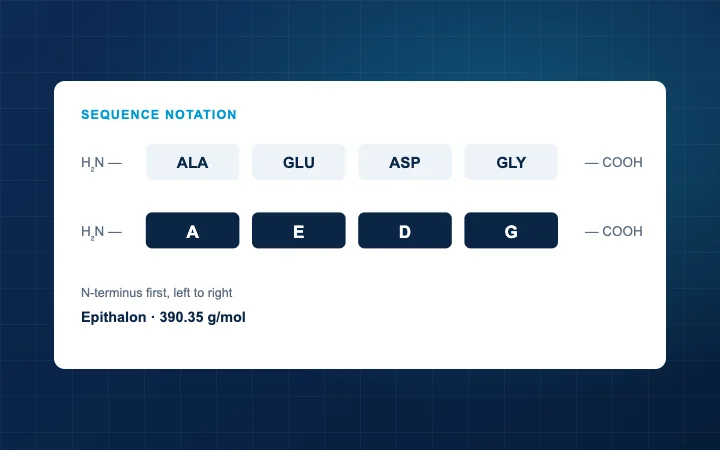
| Epithalon | 4 | 390.35 | 390.1387 | 390.35 | C14H22N4O9, exact match |
| Pinealon | 3 | 418.41 | 418.1812 | 418.40 | C15H26N6O8, exact match |
| Vesugen | 3 | 390.39 | 390.1751 | 390.39 | C15H26N4O8, exact match |
| KPV | 3 | 342.44 | 342.2267 | 342.43 | C16H30N4O4, exact match |
| Glutathione | 3 | 307.32 | 307.0838 | 307.33 | C10H17N3O6S, exact match |
Eleven for eleven on the formula, atom for atom, and the mass agrees to within 0.05 Da everywhere, which is rounding in the published figure rather than disagreement. Nothing about that is remarkable; it is what the arithmetic is. It is worth doing because it establishes that when the method does disagree with a published number, the disagreement is information.
The four that disagree
SNAP-8: two modified ends
SNAP-8 is the eight-residue chain Glu-Glu-Met-Gln-Arg-Arg-Ala-Asp. Summed, that is 1034.11, with the formula C39H67N15O16S. The published figure is 1075.2, formula C41H70N16O16S. The gap is 41.09 Da.
Subtract the formulas and the difference is exactly C2H3N. Two common end modifications produce that composition together and nothing else does. Acetylating the N-terminus adds an acetyl group, C2H2O. Converting the C-terminal acid to an amide swaps an oxygen for a nitrogen and a hydrogen. Add both and you have added C2 H2 O1 and then exchanged O1 for N1H1: net C2H3N, net +41.05 Da. 1034.11 + 41.05 = 1075.16, which rounds to the published 1075.2.
The compound's other name says so out loud. It is sold as acetyl octapeptide-3, and the "acetyl" is the first half of that arithmetic. A bare sequence does not tell you about the ends, and the ends are where most peptide modification happens. The SNAP-8 guide covers what the acetylation is for.
GHK-Cu: an atom that is not an amino acid
The tripeptide Gly-His-Lys sums to 340.38. The published formula for GHK-Cu is C14H21CuN6O4 at 400.9. The free tripeptide's formula is C14H24N6O4, so the published formula has three fewer hydrogens and one more copper.
Run that arithmetic: 340.38 − 3 × 1.008 + 63.546 = 400.90. It reproduces the published mass to two decimal places. The copper is not an impurity or a label; it is a constituent atom, the peptide is a ligand holding it, and the number of hydrogens it displaces is a property of how it is held. The GHK-Cu guide covers the complex itself. For the purposes of this post the lesson is narrower: a sequence only predicts a mass when the molecule is nothing but that sequence.
PT-141 and melanotan-2: a motif is not a chain
Both compounds are discussed on this site in terms of the His-Phe-Arg-Trp motif, the four residues that the melanocortin receptors read. Summed as a standalone tetrapeptide that is 644.73. The published masses are 1025.2 and 1024.2.
Those are not errors in either direction. His-Phe-Arg-Trp is a pharmacophore, the part of a larger molecule that does the binding, and both compounds are cyclic peptides built around it with additional residues and a ring closure. The melanocortin receptor post explains why that motif is the one that recurs. If a "sequence" you have been given is four residues long and the mass is a thousand, you have been given the active site, not the molecule.
Average or monoisotopic?
The table reports both, and they are not the same number. Carbon in nature is about 98.9% carbon-12 and 1.1% carbon-13. An average mass uses the natural mixture, so it is what a bulk weighing reflects: you dissolve 10 mg and the molecules in that powder are the mixture. A monoisotopic mass uses only the lightest isotope of each element, which is what a mass spectrometer sees as the first and usually tallest peak of the isotope cluster.
The gap grows with size. Glutathione is 307.32 average and 307.08 monoisotopic, a quarter of a Dalton. BPC-157 is 1419.55 and 1418.70, nearly a full Dalton.
This is the single most common way the calculation appears to fail. A certificate reports an observed mass from an LC-MS run, you compare it to an average mass from a calculator, the two differ by a fraction of a Dalton, and it looks like a finding. It is a units mismatch. Compare monoisotopic to monoisotopic. The LC-MS post sets out what the instrument actually reports.
The 0.04 Dalton problem
Look again at two rows in the table.
| Sequence | Residues | Average | Monoisotopic | |
|---|---|---|---|---|
| Epithalon | Ala-Glu-Asp-Gly | 4 | 390.35 | 390.1387 |
| Vesugen | Lys-Glu-Asp | 3 | 390.39 | 390.1751 |
Two different compounds in this catalogue, different sequences, different residue counts, and their average masses are 0.04 Da apart. Rounded to whole numbers they are both 390.
A measurement that reports only a mass therefore cannot distinguish them. Separating them monoisotopically needs a resolving power over about ten thousand, which a good instrument has and a basic one does not, and separating them by sequence needs an instrument that breaks the molecule into fragments and reads the ladder. That is the practical difference between the MALDI-MS identity method on this catalogue's earlier certificates and the LC-MS/MS method on the later ones, a change the certificate dataset dates to August 2026 and the sequence-verification post explains.
So the pair is not a curiosity. It is a live example, inside one catalogue, of two compounds that a weight alone confuses and a sequence read tells apart.
What the calculation does not tell you
It gives you the free peptide. It does not give you what is in the vial.
A lyophilized peptide is usually a salt, most often acetate or trifluoroacetate, and the counter-ions add mass that your sequence sum knows nothing about. A vial labelled 10 mg contains 10 mg of peptide by the certificate's content assay, and the powder on the stopper weighs more than that. The salt-form post covers the difference and the content-versus-purity post covers why the certificate's content line is the number to put in a calculation.
It also tells you nothing about structure. Disulfide bonds cost two hydrogens each, cyclisation costs a water, and neither changes the sequence you were given. If a calculated mass is 2 Da above a published one, a disulfide is the first thing to suspect; the disulfide post explains why.
Frequently asked questions
What do I add for the ends of the chain, one water per bond or one in total?
One in total, 18.02. Residue masses already have the water of each peptide bond removed, so the only water left to account for is the pair of unreacted ends. Chain length does not change it.
Why does my calculator disagree with the certificate by about 0.2 Da?
Almost always because one of the two numbers is an average mass and the other is monoisotopic. An LC-MS observed mass is usually monoisotopic. Recalculate on the same basis before treating it as a discrepancy.
Which number should I use to work out a molar concentration?
The average mass, and the certificate's measured content rather than the label. Weighing and dissolving samples the natural isotope mixture, which is what an average mass describes. The molarity post works through the conversion.
Does the calculated mass include the acetate or TFA salt?
No. It is the free peptide. Salt content is additional mass in the powder and is not reported on these certificates, which is covered in the post on what a certificate does not test for.
My sequence sum is 2 Da higher than the published mass. What did I miss?
A disulfide bond is the usual answer. Each one forms by removing two hydrogens, so a peptide with one intramolecular disulfide weighs 2.02 Da less than the same chain with free cysteines.
Can I check these numbers myself?
Yes, and that is the point of publishing both columns. Take the sequence from the compound page, add the residue masses, add 18.02, and compare it with the formula and mass in the reference table. Eleven of this catalogue's compounds should agree to a rounding error.
References
- Pepstral compound reference data, src/compound-data.json: molecular formulas and masses for 50 catalogue compounds, each carrying the PubChem CID or CAS number it was read from. The eleven formulas in the check table were recomputed from the sequence on 5 October 2026 and agree atom for atom. pepstral.com/research-peptide-reference-table.html
- PubChem, National Library of Medicine. Compound records used for the published formulas: BPC-157 CID 9941957; DSIP CID 68816; Semax CID 9811102; Selank CID 11765600; epithalon CID 219042; vesugen CID 87571363; pinealon CID 10273502; KPV CID 125672; prostamax CID 9848296; glutathione CID 124886; acetyl octapeptide-3 CID 76283482. pubchem.ncbi.nlm.nih.gov
- Commission on Isotopic Abundances and Atomic Weights (IUPAC). Standard atomic weights, used for the average-mass arithmetic. ciaaw.org/atomic-weights.htm
- Wang M, Huang J, Meija J, Berglund M. Atomic weights of the elements 2023. Pure and Applied Chemistry. doi.org/10.1515/pac-2024-0013
Every product mentioned is sold for laboratory research use only and is not for human or animal use. Nothing on this page describes or recommends use of the material sold here in humans or animals.