What is Ipamorelin, and what is it studied for?
Ipamorelin is a synthetic pentapeptide and a selective agonist of the ghrelin receptor, also called the growth-hormone secretagogue receptor (GHS-R1a). It is studied because it stimulates growth-hormone release from the pituitary without the increases in cortisol, ACTH and prolactin that earlier secretagogues such as GHRP-2 and GHRP-6 produce, making it a cleaner tool for isolating the GH response.
What is the structure of Ipamorelin?
Sequence Aib-His-D-2-Nal-D-Phe-Lys-NH2, a five-residue amidated peptide with two D-amino acids and an aminoisobutyric acid that give it enzymatic stability. Supplied lyophilized as the acetate salt; identity by LC-MS, purity by HPLC-UV on every lot.
How is Ipamorelin thought to work?
Ghrelin receptor activation on pituitary somatotrophs triggers growth-hormone release and suppresses somatostatin; the receptor is also expressed in the hypothalamus and gut. Ipamorelin's selectivity is its defining property: in the original characterisation it raised GH without the ACTH or cortisol response seen with GHRP-6 at equivalent doses.
Which research areas use Ipamorelin?
| Area | Typical models and endpoints |
|---|---|
| Ghrelin receptor selectivity | Comparison against GHRP-2, GHRP-6 and hexarelin for off-target hormone release. |
| Pituitary GH release | Dose-response in pituitary cell models and rodents. |
| Gastric motility | Ghrelin-receptor-mediated effects on gastric emptying in postoperative models. |
| Baseline for combinations | Reference arm for blends with GHRH analogues. |
What does the published literature show?
Raun and colleagues described Ipamorelin in 1998 as the first selective growth-hormone secretagogue, with GH release comparable to GHRP-6 and no significant effect on cortisol or prolactin. Later work explored gastric motility. A clinical programme for postoperative ileus was discontinued, which is part of the public record; there is no approved product.
How is Ipamorelin handled in the laboratory?
Dissolves readily. Standard reconstitution; 2 to 8°C after mixing; 28-day window. 5 mg in 2 mL gives 2.5 mg/mL. The reconstitution guide covers volumes and syringe units; the storage guide covers stability by compound class.
What does the current certificate show?
Lot IP-2609-C tested at 99.5% purity by HPLC-UV, identity confirmed by LC-MS, endotoxin below 0.5 EU/mg. The certificate is in the COA library and the lot number on the vial matches it. Sold as 5 mg net peptide per vial at $40, for laboratory research only.
Frequently asked questions
What makes Ipamorelin selective?
It activates the ghrelin receptor without meaningfully raising ACTH, cortisol or prolactin in pituitary models, unlike earlier GHRPs.
What purity does lot IP-2609-C show?
99.5% by HPLC-UV, identity confirmed by LC-MS, endotoxin below 0.5 EU/mg.
How many draws in a 5 mg vial?
At 250 mcg per draw, 20 draws. The reconstitution guide covers other volumes.
References
- Raun K et al. Ipamorelin, the first selective growth hormone secretagogue. Eur J Endocrinol. 1998.
- Beck DE et al. Ipamorelin, a selective growth hormone secretagogue receptor agonist, for postoperative ileus: a phase 2 study. Am J Surg. 2014.
Clinical results cited above describe regulated trials of pharmaceutical products and are given as context for research interest only. Nothing on this page describes or recommends use of the material sold here in humans or animals.
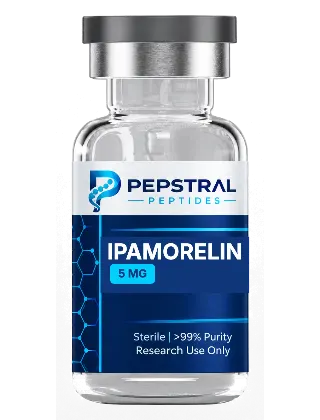 Ipamorelin 5 mg
$40 per vial
Lot IP-2609-C · 99.5% HPLC · certificate published
View productRelated
- CJC-1295 + Ipamorelin research guide · CJC-1295 + Ipamorelin 5/5 mg
- Tesamorelin research guide · Tesamorelin 10 mg
- What is a GPCR, and why do most of these peptides target one?
- Designing a dose-response experiment with research peptides
- Net peptide content and purity are two different numbers
- Glossary of certificate terms