
CJC-1295 without DAC is modified GRF (1-29): the first 29 residues of growth hormone releasing hormone, the same fragment sold as sermorelin, with four residues swapped to resist enzymatic cleavage and oxidation. The swaps are D-alanine at position 2, glutamine at 8, alanine at 15 and leucine at 27. They add exactly 10 mass units, which is why the certificate reads 3367.9 where sermorelin reads 3357.9, and that arithmetic is the cleanest way to confirm which of the three GHRH analogues is actually in a vial. This post walks through each substitution, the mass proof, the current certificate for the CJC-1295 without DAC in the catalogue, the molar figures for a 10 mg vial, and how it relates to the DAC form and the two blends built on it. The DAC post covers the naming confusion; this one covers the molecule.
What is GRF (1-29)?
Growth hormone releasing hormone is a 44-residue peptide, and its first 29 residues carry the full receptor activity. That fragment, GRF (1-29), is sermorelin: an unmodified, native-sequence peptide with a mass of 3357.9. It works, and it is cleared in minutes, because the native sequence has several sites that plasma enzymes cut and one residue that oxidises. Modified GRF (1-29) keeps the fragment and patches the sites.
What do the four substitutions do?
| Position | Native residue (sermorelin) | Modified GRF (1-29) | Why | Mass change |
|---|---|---|---|---|
| 2 | L-alanine | D-alanine | Dipeptidyl peptidase IV cuts after position 2; the D-isomer is not recognised | 0 |
| 8 | Asparagine | Glutamine | Asparagine deamidates and is a cleavage site; glutamine is stable | +14.0 |
| 15 | Glycine | Alanine | Stabilises the helix that the receptor binds | +14.0 |
| 27 | Methionine | Leucine | Methionine oxidises in solution; leucine cannot | −18.0 |
| Net | +10.0 |
Sermorelin 3357.9 + 10.0 = 3367.9, the mass on the certificate. Position 2 is a stereochemical change with no mass change, which is the one substitution a mass spectrum cannot see directly; the other three it can. The half-life post explains the general logic of blocking cleavage sites, and the glutathione post the reason a methionine is worth replacing.
How does the certificate tell the three forms apart?
By mass, unambiguously.
| Compound | Mass | Difference from modified GRF | What accounts for it |
|---|---|---|---|
| Sermorelin, GRF (1-29) | 3357.9 | −10.0 | The four substitutions absent |
| CJC-1295 without DAC, modified GRF (1-29) | 3367.9 | 0 | |
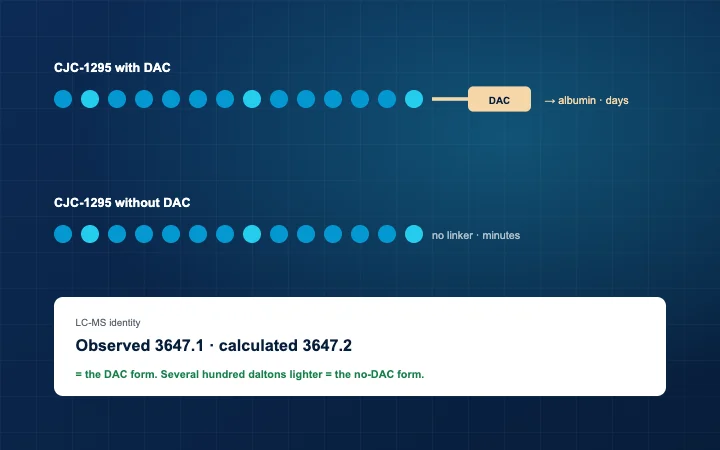
| CJC-1295 with DAC | 3647.2 | +279.3 | The maleimidopropionyl-lysine linker that binds albumin |
A certificate reporting 3367.9 is the no-DAC form. One reporting 3647 is the DAC form, whatever the label says; one reporting 3358 is sermorelin. The DAC post describes what happens in a design when the forms are confused, and the LC-MS post why a 10-unit difference is well within any instrument's resolution.
The current lot on file is CJC10-0803, certificate COA7601, issued by Bioviridian Inc. on 17 August 2026 against a 10 mg sample, published unaltered on the certificate page.
| Certificate line | Result | What it tells you |
|---|---|---|
| Identity, LC-MS/MS | CJC-1295 no DAC, observed mass 3367.9 | Modified GRF (1-29); neither sermorelin nor the DAC form |
| Content, HPLC quantitation | 10.38 mg | Overage against the 10 mg label |
| Purity, RP-HPLC at 214 nm | 99.76% | One main peak; the chromatogram post covers the trace |
| Endotoxin | < 0.05 EU/mL | Suitable for cell work |
| Heavy metals | Conforms | August 2026 layout |
How many molecules are in 10 mg?
| Vial | Moles | In 1 mL | In 2 mL | In 5 mL |
|---|---|---|---|---|
| 10 mg | 10 mg ÷ 3367.9 g/mol = 2.97 µmol | 2.97 mM | 1.48 mM | 0.59 mM |
GHRH receptor assays run in the nanomolar range, so a 10 nM working concentration from a 1.48 mM stock is a dilution of about 1 in 150,000, made in two steps through an intermediate in medium with carrier protein. The molarity post covers the arithmetic, and the vial-size post why 10 mg of a 3.4 kDa peptide lasts a long time at those concentrations.
Why is it paired with ipamorelin and GHRP-6, and never with sermorelin?
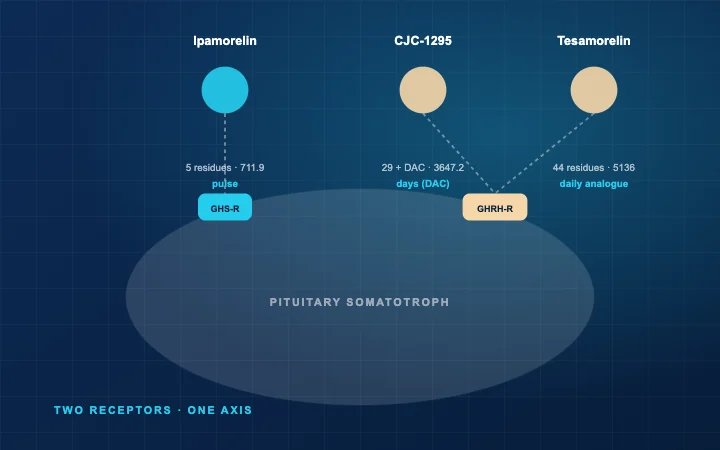
Because a pairing is only informative across two receptors. Modified GRF (1-29) acts at the GHRH receptor. Ipamorelin and GHRP-6 act at GHS-R1a, the ghrelin receptor, on the same pituitary cells. The CJC-1295 and ipamorelin blend and the CJC-1295 and GHRP-6 blend each put one input on each receptor in a lot-matched vial, which is what a study of how the two inputs combine needs; the GHRP-6 post covers the second blend's certificate. Pairing modified GRF with sermorelin would put two ligands on one receptor, which answers nothing a single ligand could not. Tesamorelin, the third GHRH analogue in the catalogue, is a different case again, a 44-residue analogue with an N-terminal hexenoyl group, compared in the three-compound post.
What does the published literature actually describe?
The DAC form, mostly. Teichman and Ionescu, the two standard references, studied CJC-1295 with the albumin-binding linker, in people, and their findings about prolonged stimulation are findings about that molecule's days-long half-life. Modified GRF (1-29) shares the receptor pharmacology and none of the persistence; in a culture system with no albumin to bind, the difference vanishes and the no-DAC form is the appropriate reagent. The trial-data post explains why neither paper is a result about a plate.
How does a 29-residue peptide behave at the bench?
It dissolves readily in water or reconstitution solution. At 29 residues with a helical region it can adsorb to plastic in dilute solution, so working dilutions belong in medium with serum or albumin, or in low-binding tubes. Aliquot the stock once and freeze; the reconstituted-lifetime post gives the windows. The leucine at 27 means there is no methionine to oxidise, which is one fewer thing to protect against than with sermorelin.
Frequently asked questions
Is CJC-1295 without DAC the same as modified GRF (1-29)?
Yes. Two names for one molecule: sermorelin's 29 residues with the four substitutions above. The certificate mass, 3367.9, identifies it.
Is it the same as sermorelin?
No. Sermorelin is the unmodified fragment, 10 mass units lighter, with the native cleavage and oxidation sites intact. The ipamorelin vs sermorelin page covers sermorelin on its own.
Why does the certificate say "no DAC" rather than "modified GRF"?
Because that is the name the supplier uses and the laboratory tests against. The mass is what settles the identity, and 3367.9 is modified GRF (1-29).
Can a certificate confirm the D-alanine at position 2?
Not by mass; D- and L-alanine weigh the same. The other three substitutions are visible by mass, and a lot that shows them is very unlikely to have been made without the fourth, since all four are part of one published design. The one-percent post covers what the standard tests do not resolve.
What should the methods section record?
"Modified GRF (1-29) (CJC-1295 without DAC)", the supplier, lot CJC10-0803, certificate COA7601, the observed mass, and the stock concentration in molar terms. The methods-section post has the template.
References
- Ionescu M, Frohman LA. Pulsatile secretion of growth hormone (GH) persists during continuous stimulation by CJC-1295, a long-acting GH-releasing hormone analog. Journal of Clinical Endocrinology and Metabolism 2006;91(12):4792-4797. doi.org/10.1210/jc.2006-1702
- Teichman SL, Neale A, Lawrence B, et al. Prolonged stimulation of growth hormone (GH) and insulin-like growth factor I secretion by CJC-1295, a long-acting analog of GH-releasing hormone, in healthy adults. Journal of Clinical Endocrinology and Metabolism 2006;91(3):799-805. doi.org/10.1210/jc.2005-1536
- PubChem, National Library of Medicine. Sermorelin (GRF 1-29), CID 16132413, C149H246N44O42S, 3357.9 g/mol; CJC-1295 (DAC form), CID 91971820, 3647.2 g/mol. Read 28 September 2026. pubchem.ncbi.nlm.nih.gov/compound/16132413
Every product mentioned is sold for laboratory research use only and is not for human or animal use. Nothing on this page describes or recommends use of the material sold here in humans or animals.