
GHRP-6 is a synthetic hexapeptide, His-D-Trp-Ala-Trp-D-Phe-Lys-NH2, with a mass of 873.0. It was the first of the growth hormone releasing peptides, described by Bowers and colleagues in 1984 twelve years before its receptor was identified, and that receptor turned out to be the one that binds ghrelin. The catalogue does not sell it alone; it supplies it paired with CJC-1295 without DAC in a lot-matched 5 mg + 5 mg blend. This post explains what GHRP-6 is, how it differs from ipamorelin, the secretagogue the catalogue does sell alone, why the blend pairs it with a GHRH analogue, and what the current blend certificate reports for each component.
What is GHRP-6?
A six-residue peptide designed rather than discovered. Bowers' group had been making analogues of met-enkephalin and found, in 1984, that one hexapeptide released growth hormone from pituitary cells in vitro and in vivo while having no opioid activity. It contained two D-amino acids, which resist proteolysis, and an amidated C-terminus. Nobody knew what it bound to. The compound was a tool in search of a receptor for over a decade.
Howard and colleagues found the receptor in 1996 by expression cloning: a G protein-coupled receptor in pituitary and hypothalamus, named GHS-R1a for growth hormone secretagogue receptor. Three years later the same receptor was shown to bind a natural ligand, ghrelin, which is why GHRP-6 is now described as a ghrelin receptor agonist. The GPCR post covers what that receptor class is, and the receptor table lists GHS-R1a as the target for both GHRP-6 and ipamorelin.
| GHRP-6 | Ipamorelin | |
|---|---|---|
| Sequence | His-D-Trp-Ala-Trp-D-Phe-Lys-NH2 | Aib-His-D-2-Nal-D-Phe-Lys-NH2 |
| Residues | 6 | 5 |
| Mass | 873.0 (certificate: 873.1) | 711.9 (certificate: 711.8) |
| First described | Bowers 1984 | Raun 1998 |
| Receptor | GHS-R1a | GHS-R1a |
| Original characterisation | Released GH; later work reported effects on other pituitary hormones and on feeding in models | Reported as selective for GH release over ACTH and cortisol in Raun's assays |
| Unnatural residues | Two D-amino acids | Aib, D-2-naphthylalanine, D-Phe |
| Sold alone in the catalogue | No | Yes, 5 mg and 10 mg |
How does GHRP-6 differ from ipamorelin?
They act at the same receptor, and the difference the literature records is in what else they do. Raun's 1998 paper, which introduced ipamorelin, compared it against GHRP-6 and reported that ipamorelin released growth hormone in their models without the ACTH and cortisol release that GHRP-6 produced, which is the basis of the "first selective secretagogue" title. GHRP-6, in later work, was also associated with effects on feeding in animal models, consistent with its receptor being the ghrelin receptor.
For a research design that means the two are not interchangeable controls. A study of GHS-R1a signalling in a pituitary cell line can use either; a study that wants to isolate the growth hormone response from other pituitary responses has a reason to choose ipamorelin, and a study of the ghrelin receptor's other functions has a reason to choose GHRP-6. The ipamorelin comparison post covers the wider set of growth hormone axis compounds, and the trial-data post explains why "selective in Raun's assays" is the exact scope of the claim.
Why pair GHRP-6 with CJC-1295 without DAC?
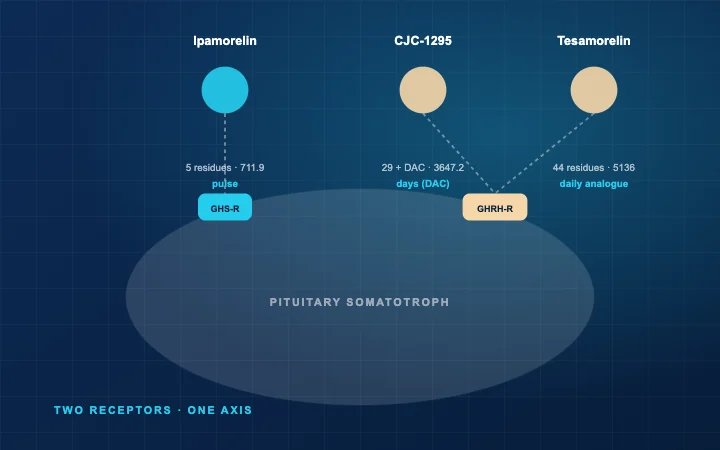
Because they act on different receptors in the same axis. CJC-1295 without DAC is a modified GRF(1-29), a 29-residue analogue of growth hormone releasing hormone that acts at the GHRH receptor; GHRP-6 acts at GHS-R1a. In a pituitary model the two receptors are on the same cells, and a study of how the two inputs combine needs both compounds, lot-matched, in a known ratio. That is what the blend is for, and it is the same logic behind the CJC-1295 and ipamorelin blend, with a different secretagogue.
Two points about the CJC component. It is the no-DAC form, which the DAC post explains: the version without the albumin-binding group, which is cleared in minutes rather than days and is the appropriate form for a cell-culture study where the drug-affinity complex would have nothing to bind. And it is 3367.9 g/mol against GHRP-6's 873.0, so a 5 mg + 5 mg blend is not equimolar: it is 1.48 µmol of CJC-1295 to 5.73 µmol of GHRP-6, close to a 1 to 4 molar ratio. The blends post covers why that arithmetic decides whether a blend fits a design.
What does the blend certificate report?
Lot CJCGHRP5-0528, certificate COA4860, was issued by Bioviridian Inc. on 17 June 2026 against a 10 mg sample and is published unaltered on the certificate page. A blend certificate has to report each component separately for identity and content, and this one does.
| Certificate line | Result | What it tells you |
|---|---|---|
| Identity, MALDI-MS | Two masses: 3367.9 and 873.1 | Both components present; the first is CJC-1295 no DAC, the second GHRP-6 |
| Content, HPLC quantitation | 5.23 mg and 5.11 mg | Each component quantified against the 5 mg label; both slightly over |
| Purity, RP-HPLC at 214 nm | 99.9% | One figure for the chromatogram, see below |
| Endotoxin | < 0.05 EU/mL | Suitable for cell work |
| Heavy metals | Conforms | On the June 2026 layout |
| Sterility | Conforms | On the June 2026 layout |
The purity line needs a sentence. A single purity figure for a two-component blend describes the chromatogram: 99.9% of the absorbing material is one of the two expected peaks. It does not say how pure each component was before mixing, and it cannot distinguish an impurity related to one peptide from an impurity related to the other. The blend certificate post explains this limit in detail; the short version is that the identity masses and the two content figures are the lines that establish the blend is what it says, and the purity figure is a statement about the mixture.
How does the blend compare with the ipamorelin blend?
| CJC-1295 + GHRP-6 | CJC-1295 + ipamorelin | |
|---|---|---|
| Secretagogue | GHRP-6, 873.0 | Ipamorelin, 711.9 |
| Sizes | 5 mg + 5 mg | 5 mg + 5 mg, 10 mg + 10 mg |
| Molar ratio at 5 + 5 | About 1 : 3.9 | About 1 : 4.7 |
| Current certificate | COA4860, June 2026, MALDI-MS, with sterility | COA7607 and COA7631, August 2026, LC-MS/MS |
| Choose when | The design wants the ghrelin receptor's fuller pharmacology | The design wants a secretagogue characterised as GH-selective |
Both blends use the same CJC-1295 no-DAC component at the same mass. The choice between them is the choice between the two secretagogues described above.
Frequently asked questions
Is GHRP-6 sold on its own?
Not in this catalogue. It is supplied in the CJC-1295 + GHRP-6 blend. Ipamorelin is the secretagogue sold alone.
Is GHRP-6 the same as GHRP-2 or hexarelin?
No. All three are hexapeptides that act at GHS-R1a, from the same design lineage, with different sequences and different masses. The catalogue supplies GHRP-6 only, within the blend, and the certificate mass of 873.1 identifies it.
Why does the certificate report one purity for two compounds?
Because the purity test is a chromatogram of the mixture. The blend certificate post explains what that figure can and cannot say. The two identity masses and two content figures are the component-specific lines.
Does the blend certificate use LC-MS/MS?
The current one, from June 2026, uses MALDI-MS. The ipamorelin blend's August 2026 certificates use LC-MS/MS. Either confirms the two masses; the LC-MS post covers the difference.
What should the methods section record?
Both components by name and mass, the molar ratio, the supplier, lot CJCGHRP5-0528, certificate COA4860, and the stock concentration of each component. The methods-section post has the template.
References
- Bowers CY, Momany FA, Reynolds GA, Hong A. On the in vitro and in vivo activity of a new synthetic hexapeptide that acts on the pituitary to specifically release growth hormone. Endocrinology 1984;114(5):1537-1545. doi.org/10.1210/endo-114-5-1537
- Howard AD, Feighner SD, Cully DF, et al. A receptor in pituitary and hypothalamus that functions in growth hormone release. Science 1996;273(5277):974-977. doi.org/10.1126/science.273.5277.974
- Raun K, Hansen BS, Johansen NL, et al. Ipamorelin, the first selective growth hormone secretagogue. European Journal of Endocrinology 1998;139(5):552-561. doi.org/10.1530/eje.0.1390552
- Bioviridian Inc. Certificate of analysis COA4860, CJC-1295 (no DAC) + GHRP-6 5 mg + 5 mg, lot CJCGHRP5-0528, issued 17 June 2026. coa.html
Every product mentioned is sold for laboratory research use only and is not for human or animal use. Nothing on this page describes or recommends use of the material sold here in humans or animals.