
IGF-1 LR3 is insulin-like growth factor 1 with two deliberate changes: the glutamate at position 3 is replaced by arginine, and 13 extra residues are added at the N-terminus. Both changes lower its affinity for the IGF binding proteins that normally sequester IGF-1, so in a culture system containing those proteins more of the analogue stays free to reach the receptor. That is the whole reason it exists. This post explains what the modifications do, why the vial is 1 mg rather than 5 or 10, how to turn 1 mg into a molar figure, and what the current lot certificate reports for the IGF-1 LR3 in the catalogue.
What does "Long R3" actually mean?
The name is a description. Long refers to the N-terminal extension, thirteen residues that native IGF-1 does not carry, left over from the fusion-protein expression system the analogue was first produced in. R3 refers to the substitution at position 3 of the IGF-1 sequence, where glutamate (E) becomes arginine (R). Francis and colleagues, who characterised a series of these analogues in 1992, found that the position-3 substitution is what breaks the interaction with the binding proteins, and that the extension on its own contributes little to potency.
| Native IGF-1 | IGF-1 LR3 | |
|---|---|---|
| Residues | 70 | 83 (70 + 13 N-terminal) |
| Position 3 | Glutamate | Arginine |
| Approximate mass | 7.6 kDa | 9.1 kDa (certificate: 9117.6) |
| IGF binding protein affinity | High | Markedly reduced |
| IGF-1 receptor affinity | Reference | Similar |
| Apparent potency in serum-containing systems | Reference | Higher, because more is free |
The last row is the one to read carefully. LR3 is not a stronger agonist at the receptor. In a system with no binding proteins, the two behave alike. Its advantage appears only where binding proteins are present, and the advantage is a larger free fraction, not a different receptor pharmacology. A methods section that says "more potent" without saying "in the presence of IGFBPs" is saying less than it thinks.
Why is it sold as 1 mg when other compounds come in 5 or 10 mg?
Because it is used at far lower mass concentrations. IGF-1 and its analogues act in cell culture at nanograms per millilitre, and 1 mg makes litres of working medium at those levels. A larger vial would sit in the freezer for years and be discarded before it was used, and every freeze-thaw cycle in that time would cost activity.
There is a second reason. IGF-1 LR3 is produced recombinantly, not by solid-phase synthesis, and the synthesis post explains why the two routes price differently. Recombinant proteins cost more per milligram to make and to purify to the level the certificate reports, which is another reason the vial is small.
How do you convert 1 mg to a molar amount?
Divide the mass by the molar mass. Using the certificate's observed mass of 9117.6:
| Vial | Moles | Reconstituted in 1 mL | Reconstituted in 5 mL |
|---|---|---|---|
| 1 mg | 1 mg ÷ 9117.6 g/mol = 0.110 µmol (110 nmol) | 110 µM | 22 µM |
From a 110 µM stock, a working concentration of 10 ng/mL is a dilution of about 1 in 100,000. Nobody does that in one step; make an intermediate at 1 to 10 µg/mL in medium containing carrier protein, then dilute again. The molarity post covers the arithmetic in general, and the reason to record the molar figure rather than the mass is that 1 mg of a 9 kDa protein and 1 mg of a 700 Da peptide differ thirteen-fold in the number of molecules.
Does a small protein need different handling from a short peptide?
Yes, in three ways.
Adsorption. At 83 residues with a defined tertiary fold, IGF-1 LR3 sticks to untreated polystyrene and polypropylene more readily than a short linear peptide does. Below about 10 µg/mL, a significant fraction of the protein can be lost to the walls of the tube. Dilute working solutions belong in low-binding tubes or in medium that already contains albumin.
Freeze-thaw. Proteins unfold and aggregate across repeated freezing and thawing in a way that short peptides mostly do not. Aliquot the reconstituted stock once, at the concentration you will draw from, and freeze the aliquots. The reconstituted-lifetime post gives the general rules; for a protein, lean towards the shorter end of every window it quotes.
Diluent. The diluent post applies, with one addition: for a protein stock that will be diluted into cell-culture medium, the bacteriostatic preservative in reconstitution solution is worth avoiding, since 0.9% benzyl alcohol carried into a culture well is a variable you did not intend. Sterile water or a buffer, aliquoted and frozen, is the cleaner choice for this compound.
What does the current certificate report?
The current lot on file is IGF1-0803, certificate COA7588, issued by Bioviridian Inc. on 17 August 2026 against a 1 mg sample of white lyophilized powder. The PDF is published unaltered on the certificate page, and each line means the following.
| Certificate line | Result | What it tells you |
|---|---|---|
| Identity, LC-MS/MS | IGF-1 LR3, observed mass 9117.6 | The molecule in the vial has the mass of the 83-residue analogue, not native IGF-1 (about 7.6 kDa) |
| Content, HPLC quantitation | 1.12 mg | The vial holds slightly more than the label; the overage is normal fill practice |
| Purity, RP-HPLC at 214 nm | 99.55% | Of the peptide-absorbing material, 0.45% is something other than the main peak |
| Endotoxin | < 0.05 EU/mL | Suitable for cell work without an endotoxin correction, see the endotoxin post |
| Heavy metals | Conforms | Tested on this certificate; earlier layouts did not include it |
Two things the certificate does not say. It does not report bioactivity, so receptor binding or a proliferation response is yours to measure. And it does not report the free-fraction behaviour that the LR3 modifications exist for; that is a property of the sequence, confirmed by the mass, not something the laboratory tests.
For a recombinant protein, the identity line carries more weight than it does for a short synthetic peptide. A 9.1 kDa mass observed by LC-MS/MS is very hard to arrive at by accident, and it rules out the most common substitution in this category, which is native IGF-1 sold under the analogue's name. The LC-MS post explains what that method can and cannot settle.
How does IGF-1 LR3 fit alongside the growth hormone axis compounds?
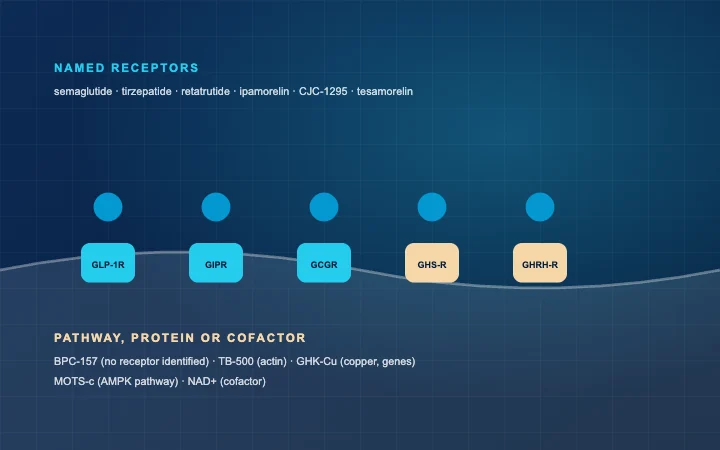
It sits downstream of them. The GHRH analogues and secretagogues in the catalogue, ipamorelin and the CJC-1295 and ipamorelin blend among them, act on pituitary receptors; IGF-1 is the hepatic and tissue product further along the same axis. In a cell-culture model that means they are rarely used in the same well. A pituitary cell line responds to a secretagogue; a fibroblast or myoblast line responds to IGF-1. Choosing which compound to use is choosing which part of the axis the model represents, and the receptor table lists the target for each.
Frequently asked questions
Is IGF-1 LR3 the same as IGF-1?
No. It is an analogue with 13 extra N-terminal residues and an arginine at position 3. The changes reduce binding-protein affinity while leaving receptor affinity similar. The certificate mass, 9117.6 against about 7.6 kDa for native IGF-1, is the quickest way to tell which you have.
Why does the certificate use LC-MS/MS rather than MALDI for this compound?
Both can confirm a mass in this range. The August 2026 certificates in this catalogue use LC-MS/MS across the board; the earlier April certificates used MALDI-MS. Either method answers the identity question; the chromatogram post covers what the accompanying HPLC trace adds.
Can I store the reconstituted stock in the refrigerator?
For days, not weeks. A protein stock at room temperature or 4 °C loses activity faster than a lyophilized powder and faster than most short peptides in the same conditions. Aliquot and freeze; thaw each aliquot once.
Does the 1 mg vial contain a carrier protein?
The certificate reports 1.12 mg of IGF-1 LR3 and lists no excipient. Treat the vial as carrier-free, which is why dilute working solutions need albumin or a low-binding surface added on your side.
What should the methods section record?
The analogue name in full (IGF-1 LR3, or Long-R3 IGF-1), the supplier, the lot number and certificate code, the observed mass, the diluent, the stock concentration in molar terms, and the carrier protein used in working dilutions. The methods-section post has the template.
References
- Francis GL, Ross M, Ballard FJ, et al. Novel recombinant fusion protein analogues of insulin-like growth factor (IGF)-I indicate the relative importance of IGF-binding protein and receptor binding for enhanced biological potency. Journal of Molecular Endocrinology 1992;8(3):213-223. doi.org/10.1677/jme.0.0080213
- Bioviridian Inc. Certificate of analysis COA7588, IGF-1 LR3 1 mg, lot IGF1-0803, issued 17 August 2026. Published unaltered on the Pepstral certificate page. coa.html
Every product mentioned is sold for laboratory research use only and is not for human or animal use. Nothing on this page describes or recommends use of the material sold here in humans or animals.