
DMSO occupies an odd place in peptide work. It is the solvent people reach for when something will not dissolve, it is genuinely the right answer for a minority of compounds, and it is also a pharmacologically active substance that changes cells on its own. Using it well means being clear about which of those three facts applies to your experiment.
Start with the question that decides everything: does this peptide need it at all?
Most of these compounds do not need it
Solubility is predictable from composition. Mean hydropathy, averaged over a sequence, says whether the molecule's composition leans toward water or away from it, and every catalogue compound on this site with a published sequence comes out negative, meaning hydrophilic. The full table is in will this peptide dissolve, and the figures run from about −0.4 to −3.8 with nothing in positive territory.
For a hydrophilic peptide carrying a real net charge, an aqueous diluent is not a compromise. It is the correct solvent, and adding DMSO to it adds a variable to the experiment while solving nothing. The diluent post covers the aqueous options.
Two situations are different. A peptide with a hydrophobic composition, which this catalogue does not contain but the wider field does, may genuinely resist water. And a peptide that is hydrophilic but needed at a very high stock concentration can hit a practical ceiling in water that it does not hit in DMSO. The second case is the common real reason for a DMSO stock: not that the peptide cannot dissolve in water, but that you want a stock concentrated enough to dilute a thousandfold.
That distinction matters because it tells you what the DMSO is for. It is a vehicle for a concentrated stock, not the solvent the peptide meets in the well.
Working the arithmetic backwards
The mistake that puts experiments above tolerance is working forwards: make a convenient stock, then work out what dilution gives the concentration you want, then discover how much DMSO came along.
Run it the other way. Two numbers are fixed by the biology, and they determine the third.
- The final concentration in the well, set by the experiment.
- The maximum DMSO percentage the cells tolerate, set by the cell line.
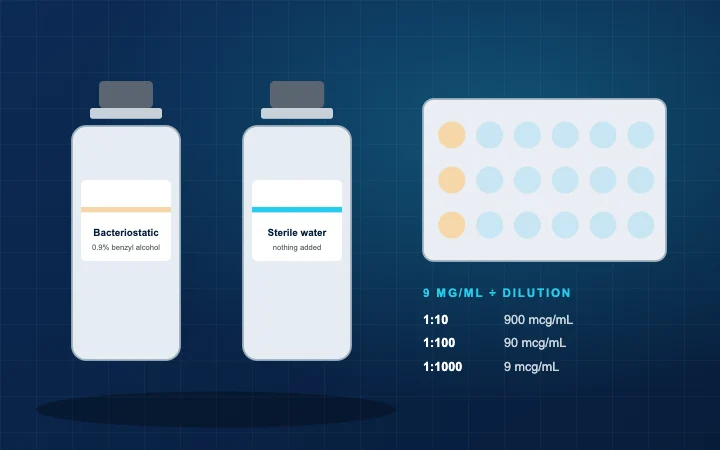
Those two fix the minimum stock concentration. If the well needs 10 µM of a 1,000 Da peptide and the DMSO ceiling is 0.1% by volume, then the stock can be diluted no less than 1,000-fold, so it must be at least 10 mM. A 1 mM stock cannot be used at that ceiling, because reaching 10 µM from it needs a 100-fold dilution and that carries 1% DMSO into the well, ten times over.
Written as a single relation: the stock must be at least the final concentration divided by the dilution the DMSO ceiling permits. Everything else in the protocol follows from that one line, and it is worth computing before any solvent is opened.
A practical consequence is that serial dilution needs care. Diluting the DMSO stock in medium in several steps is fine, and each step reduces the DMSO along with the peptide. Diluting in DMSO and then making one jump into medium is what concentrates the solvent load into the final step.
What concentration cells tolerate
The honest answer is that it depends on the cell line, the exposure time and the endpoint, and that it has to be established rather than assumed.
The commonly cited working figures in mammalian cell culture put the ceiling below about 0.5% by volume, with 0.1% a widely used practical limit. Those are reasonable starting points and they are not guarantees. Two bodies of work are worth knowing about before treating any number as safe. One reports toxicity at concentrations below those generally assumed harmless. The other reports that DMSO produces substantial changes in cellular processes and in the epigenetic landscape in vitro, which is to say it is not inert even where it is not killing cells.
What follows practically is that a tolerance figure is a parameter of your system, not a constant. Establishing it is a short experiment: a dilution series of vehicle alone, run on your cells, for your exposure time, read with your assay. The post on designing a concentration-response experiment covers the shape of that.
Sensitivity also varies with what you are measuring. A viability endpoint tolerates more DMSO than a differentiation endpoint or a transcriptional readout, because the solvent can change gene expression well below the concentration at which it changes survival. If your endpoint is subtle, your ceiling is lower.
The vehicle control
This is the part of the design that cannot be skipped, and the part most often done wrong.
A vehicle control is medium containing exactly the DMSO concentration the treated wells contain, and nothing else. It is not the same as an untreated control, and having an untreated control does not substitute for it.
The reason is simple. If treated wells carry 0.1% DMSO and the comparison is against medium alone, then any difference you measure is the peptide's effect plus the solvent's effect, and nothing in the data separates them. The vehicle control is what makes the subtraction possible.
Three rules keep it honest.
Match the highest DMSO concentration in the series. If a concentration-response series is built by diluting one stock, the DMSO percentage falls along with the peptide, and the lowest-peptide wells carry the least solvent. The vehicle control should match the highest, which is the worst case.
Better, equalise the vehicle across the series. Add DMSO back to the lower-concentration wells so that every well in the experiment carries the same percentage. Then one vehicle control serves the whole series and the only variable across it is the peptide. This is more work and it is the stronger design.
Run it on the same plate. A vehicle control from a different plate or a different day carries plate and day effects along with the solvent.
Stability in the stock
Two things change when a peptide sits in DMSO rather than water.
DMSO is hygroscopic and takes water from the air readily. A stock that was anhydrous when made is not after a few open-and-close cycles on the bench, and the water it has absorbed is a reactant for most peptide degradation routes, as which residues degrade first sets out. Small single-use aliquots, kept closed, address this; aliquoting and freeze-thaw covers the practice.
DMSO also freezes at around 19 °C, so a stock in a freezer is a solid and will need thawing. That is not harmful in itself but it means a frozen DMSO aliquot is not a quick grab, and it is another reason to size aliquots to single uses rather than refreezing a tube repeatedly.
Methionine, cysteine and tryptophan deserve a specific note. DMSO is a mild oxidising environment and those three residues are the oxidation-prone ones, so a long-stored DMSO stock of a sulfur-containing peptide is a reasonable place to look if a result drifts. Three compounds in this catalogue contain methionine or cysteine, and the molecular formula identifies them without needing the sequence: an S in the formula means one or the other. The oxidation post has the detail.
Frequently asked questions
Do the peptides on this catalogue need DMSO?
Generally no. Every one with a published sequence is hydrophilic by mean hydropathy and most carry a real net charge, so an aqueous diluent is the correct choice. A DMSO stock is for reaching a high stock concentration, not for getting these compounds into solution.
What DMSO percentage is safe in cell culture?
Commonly cited working limits sit below about 0.5% by volume, with 0.1% a widely used ceiling, and both are starting points rather than guarantees. Published work reports effects on cellular processes below concentrations often assumed safe, so the figure for your cells and your endpoint has to be established.
How concentrated does my stock need to be?
Divide the final concentration you need by the dilution your DMSO ceiling permits. At a 0.1% ceiling you can dilute 1,000-fold, so a 10 µM final concentration needs a stock of at least 10 mM.
Is an untreated control enough?
No. Without a vehicle control carrying the same DMSO, any effect you measure is the peptide plus the solvent and the data cannot separate them.
Should every well carry the same DMSO percentage?
Ideally yes. Adding vehicle back so the percentage is constant across a concentration series means the only variable is the peptide, and one vehicle control then serves the whole plate.
Does DMSO damage peptides in storage?
It can, indirectly and directly. It absorbs water from the air, and water drives most degradation routes. It is also a mild oxidising environment, which matters for peptides containing methionine, cysteine or tryptophan. Single-use aliquots kept closed are the practical answer.
References
- Kyte J, Doolittle RF. A simple method for displaying the hydropathic character of a protein. Journal of Molecular Biology 1982;157(1):105-132. The hydropathy basis for the claim that this catalogue's sequences are hydrophilic. doi.org/10.1016/0022-2836(82)90515-0
- Galvao J, Davis B, Tilley M, Normando E, Duchen MR, Cordeiro MF. Unexpected low-dose toxicity of the universal solvent DMSO. FASEB Journal 2014;28(3):1317-1330. doi.org/10.1096/fj.13-235440
- Verheijen M, Lienhard M, Schrooders Y, et al. DMSO induces drastic changes in human cellular processes and epigenetic landscape in vitro. Scientific Reports 2019;9:4641. doi.org/10.1038/s41598-019-40660-0
- Pepstral compound reference data: mean hydropathy computed 5 October 2026 for the fifteen catalogue sequences published on this site, all of which are negative. pepstral.com/research-peptide-reference-table.html
Every product mentioned is sold for laboratory research use only and is not for human or animal use. Nothing on this page describes or recommends use of the material sold here in humans or animals.