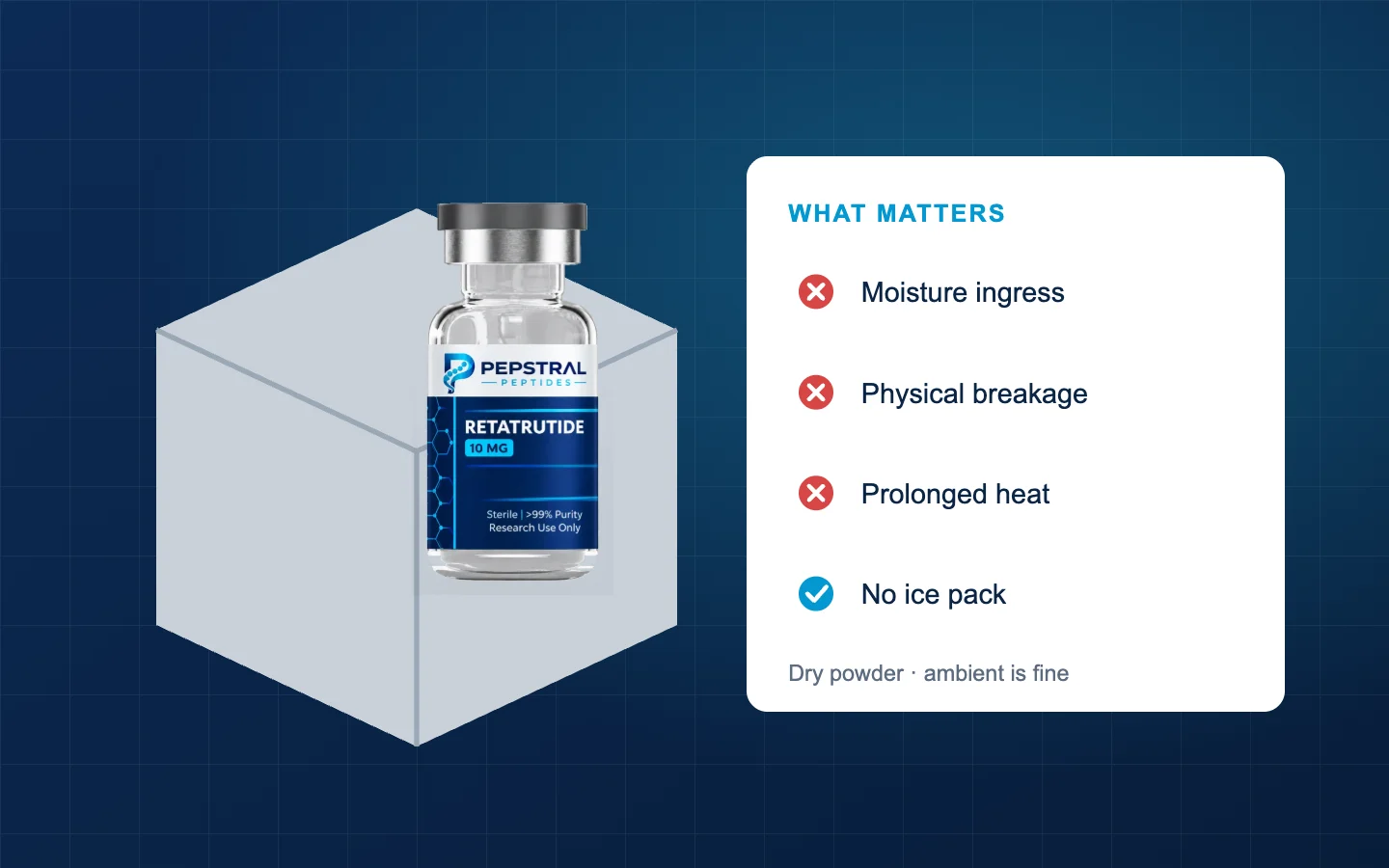
Lyophilized research peptides are shipped at ambient temperature by essentially every supplier, and buyers regularly ask whether that is a corner being cut. It is not. The reason peptides are freeze-dried in the first place is that the dry state is dramatically more stable than solution, and a few days in a parcel is well within what that state tolerates. This post explains the chemistry behind that, what genuinely does threaten a vial in transit, and the cases where cold shipping is the right call rather than theatre.
Why is dry powder so much more stable?
Almost every route that degrades a peptide needs water — as a reactant, as a medium, or as the thing that gives the molecule enough mobility to react at all. Deamidation of asparagine is a hydrolytic reaction. Backbone cleavage is hydrolysis by definition. Even oxidation is accelerated in solution, where dissolved oxygen and trace metals are mobile.
Lai and Topp's review of solid-state chemical stability makes the mechanism explicit: in the amorphous solid produced by freeze-drying, molecular mobility is drastically reduced, and reaction rates fall by orders of magnitude compared with the same peptide in aqueous solution. The molecules are effectively frozen in place, not because they are cold, but because they are dry.
Tang and Pikal's work on freeze-drying process design adds the practical corollary: what matters most for solid-state stability is residual moisture, not temperature. A properly dried cake with low residual water is robust. A poorly dried one, or one that has picked up moisture through a compromised seal, is not — and no amount of refrigeration fixes it.
That is the whole argument in one line: the enemy is water, not warmth.
So what actually threatens a vial in transit?
| Risk | How it happens | What it looks like on arrival |
|---|---|---|
| Moisture ingress | Compromised crimp or stopper, or a vial opened and resealed | Clumped, sticky or discoloured powder; visible droplets |
| Physical breakage | Inadequate padding, crushed parcel | Cracked glass, loose or lifted stopper |
| Prolonged extreme heat | Days in a hot vehicle or a mailbox in summer | Usually nothing visible — the risk is cumulative |
| Freezing of a liquid diluent | Bacteriostatic water shipped in winter | Cracked diluent vial, not the peptide |
Note which of those an ice pack addresses. A cold pack in a padded envelope is exhausted within hours and does nothing about the top two, which are the ones that actually ruin vials. A well-packed parcel beats a badly packed one with a melted gel pack in it every time.
When is cold shipping genuinely warranted?
Three cases, and they are real:
Solutions rather than powders. Anything shipped already reconstituted is subject to every route in the solution-stability post, and those are strongly temperature-driven. A liquid product should travel cold.
Compounds with known thermal lability. Some materials are genuinely more fragile than the typical short peptide. NAD+ is the clearest example in this catalogue — it is a dinucleotide rather than a peptide, more sensitive to moisture and to repeated temperature cycling, and our NAD+ handling post treats it separately for that reason.
Extreme or extended transit. A week in a delivery network during a heatwave is a different proposition from two days in autumn. Where transit will be long or conditions extreme, insulated packaging is a reasonable precaution.
For a lyophilized short peptide arriving in a few days, the evidence does not support it, and paying for it buys reassurance rather than protection.
What should you do when a package arrives?
- Look before you open the box fully. Note any crushing, and whether the vials are still seated in their packaging.
- Inspect each vial. Check the crimp is tight, the stopper is flush, the glass is intact, and the powder is the colour you expect. Discolouration, visible moisture and a lifted stopper are the findings that matter.
- Do not open a cold vial in a warm room. If the parcel arrived in winter, let the sealed vial reach room temperature first. Cold glass condenses atmospheric moisture, and you would be introducing exactly the thing the freeze-drying removed.
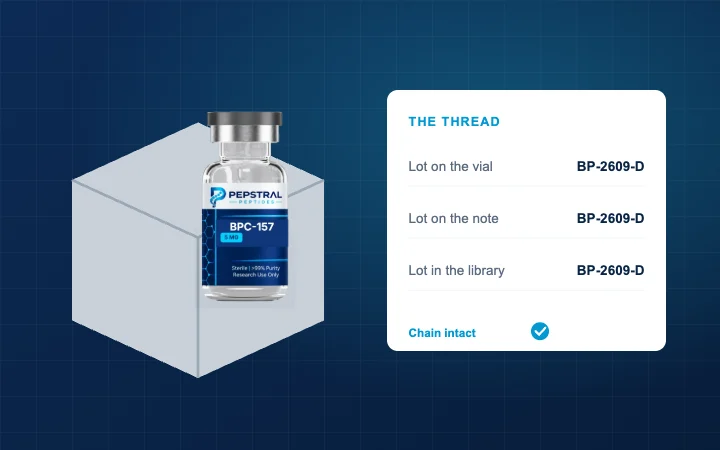
- Record the condition on arrival against the lot number, with the date. If a question arises later about the material, this is the record that answers it.
- Store it dry and cold. Sealed vials at −20°C for long-term holding, protected from light.
Our post on what a lyophilized vial should look like covers the appearances that are normal — shrunken cakes, thin films, flakes — versus the ones that are not.
Does same-day shipping change any of this?
It shortens the exposure window, which is a genuine if modest benefit, and it mostly matters for the cases above rather than for ordinary lyophilized powder. Pepstral ships same day on orders placed before 2pm ET, which means most parcels spend two to three days in the network rather than five or six. For a dry peptide that difference is not the deciding factor in whether the material is good; it is a service standard, and we would rather describe it as one.
Frequently asked questions
My package sat in a hot mailbox all day. Is the peptide ruined?
Almost certainly not. Lyophilized peptide tolerates ambient and above for the durations involved in shipping. Inspect the vial for moisture and stopper integrity, which are the findings that would actually concern us, and record what you saw. If the result you are running is sensitive and you want certainty, an independent HPLC test is roughly the price of a vial — our testing post covers how.
Why do some suppliers advertise cold-chain shipping then?
Because it reads as care, and it is cheap to add. That is not the same as it being necessary. Where a supplier ships solutions, or genuinely heat-labile material, it is warranted. Applied blanket to lyophilized powder it is marketing, and it distracts from the packaging and sealing that actually protect the vial.
Should I ask for an ice pack in summer?
If it gives you confidence, there is no harm in it. Just know that the gel pack is spent long before delivery, and that a compromised stopper on a cold vial is a worse outcome than a warm vial with an intact one.
Does the certificate cover transit?
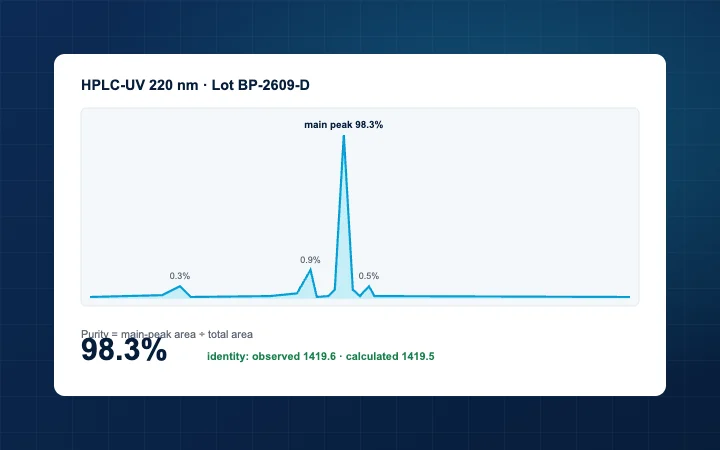
No. A certificate reports the lot as released from testing. What happens in the delivery network is outside it, which is why the arrival inspection above is worth the sixty seconds it takes.
References
- Lai MC, Topp EM. Solid-state chemical stability of proteins and peptides. Journal of Pharmaceutical Sciences 1999;88(5):489-500. doi.org/10.1021/js980374e
- Tang X, Pikal MJ. Design of freeze-drying processes for pharmaceuticals: practical advice. Pharmaceutical Research 2004;21(2):191-200. doi.org/10.1023/b:pham.0000016234.73023.75
- Manning MC, Chou DK, Murphy BM, Payne RW, Katayama DS. Stability of protein pharmaceuticals: an update. Pharmaceutical Research 2010;27(4):544-575. doi.org/10.1007/s11095-009-0045-6
Every product mentioned is sold for laboratory research use only and is not for human or animal use. Nothing on this page describes or recommends use of the material sold here in humans or animals.