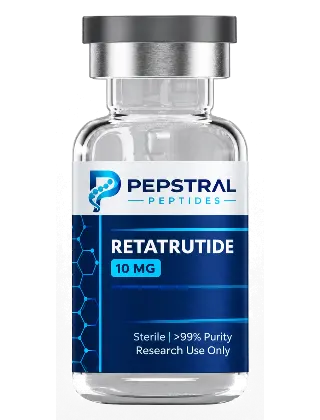
What is the CJC-1295 and Ipamorelin blend, and why are they paired?
This blend combines CJC-1295 without DAC, a 29-amino-acid analogue of growth-hormone-releasing hormone, with Ipamorelin, a pentapeptide agonist of the ghrelin receptor, co-lyophilized at 5 mg each. They act on two different receptors that converge on the same pituitary output, which is why they are paired in research on pulsatile growth-hormone release.
What is the structure of CJC-1295 + Ipamorelin?
CJC-1295 no-DAC (also called modified GRF 1-29) carries four amino-acid substitutions that protect the GHRH sequence from enzymatic cleavage without the drug-affinity-complex modification that would extend its half-life to days. Ipamorelin is Aib-His-D-2-Nal-D-Phe-Lys-NH2. Each is confirmed separately by LC-MS on the blend certificate.
How is CJC-1295 + Ipamorelin thought to work?
GHRH receptor activation on pituitary somatotrophs stimulates growth-hormone synthesis and release; ghrelin receptor activation amplifies the release and suppresses somatostatin tone. Together they are used to model the natural pulsatile pattern. The no-DAC form is chosen because it preserves the short half-life of native GHRH, so timing in pulse studies is preserved.
Which research areas use CJC-1295 + Ipamorelin?
| Area | Typical models and endpoints |
|---|---|
| Pulsatile GH release | Pituitary cell and rodent models measuring pulse amplitude and frequency. |
| Receptor co-activation | GHRH receptor and ghrelin receptor signalling in combination. |
| IGF-1 axis | Downstream hepatic IGF-1 response. |
| Comparison with Tesamorelin | Blend versus a single stabilised GHRH analogue. |
What does the published literature show?
CJC-1295 with DAC was characterised in clinical pharmacology studies by Teichman and colleagues in 2006, which established its GH- and IGF-1-raising activity and long half-life; the no-DAC form is used precisely to avoid that duration. Ipamorelin was characterised by Raun and colleagues in 1998 as a selective secretagogue without the cortisol and prolactin effects of earlier GHRPs. The blend itself has no dedicated published literature.
How is CJC-1295 + Ipamorelin handled in the laboratory?
Dissolves readily. Refrigerate at 2 to 8°C after reconstitution, 28-day window. The blend contains methionine-free sequences, so oxidation risk is lower than for some GH-axis peptides, but light protection is still good practice. The reconstitution guide covers volumes and syringe units; the storage guide covers stability by compound class.
What does the current certificate show?
Lot BL-2608-E tested at 99.0% purity by HPLC-UV, identity confirmed by LC-MS, endotoxin below 0.5 EU/mg. The certificate is in the COA library and the lot number on the vial matches it. Sold as 5/5 mg net peptide per vial at $90, for laboratory research only.
Frequently asked questions
Why no-DAC?
The DAC modification extends half-life to days and flattens pulsatility. Without it the analogue mirrors native GHRH timing.
What does lot BL-2608-E report?
Both peptides at 99.0% or above by HPLC-UV, identity by LC-MS for each, endotoxin below 0.5 EU/mg.
Is Ipamorelin available alone?
Yes, as a 5 mg vial, and the GH axis set bundle pairs this blend with Tesamorelin.
References
- Teichman SL et al. Prolonged stimulation of growth hormone (GH) and insulin-like growth factor I secretion by CJC-1295, a long-acting analog of GH-releasing hormone, in healthy adults. J Clin Endocrinol Metab. 2006.
- Raun K et al. Ipamorelin, the first selective growth hormone secretagogue. Eur J Endocrinol. 1998.
Clinical results cited above describe regulated trials of pharmaceutical products and are given as context for research interest only. Nothing on this page describes or recommends use of the material sold here in humans or animals.
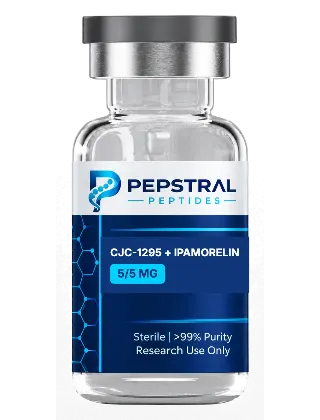 CJC-1295 + Ipamorelin 5/5 mg
$90 per vial
Lot BL-2608-E · 99.0% HPLC · certificate published
View productRelated
- Ipamorelin research guide · Ipamorelin 5 mg
- Tesamorelin research guide · Tesamorelin 10 mg
- Research peptide reference table: length, formula and molecular weight for 12 compounds
- Which receptor does each research peptide act on? A target table for the catalog
- Peptide blends vs single compounds: which fits the study design?
- Glossary of certificate terms