What is Tesamorelin, and what is it studied for?
Tesamorelin is a 44-amino-acid analogue of growth-hormone-releasing hormone with a trans-3-hexenoic acid group at the N-terminus that protects it from enzymatic breakdown. It is studied for its action at the GHRH receptor, the downstream growth-hormone and IGF-1 axis, and its effect on visceral adipose tissue, where it has the most developed literature of any GHRH analogue.
What is the structure of Tesamorelin?
The full 1-44 GHRH sequence, amidated, with the hexenoyl modification that extends half-life while preserving native receptor selectivity. Supplied lyophilized; identity by LC-MS against the calculated mass, purity by HPLC-UV.
How is Tesamorelin thought to work?
GHRH receptor activation on pituitary somatotrophs increases growth-hormone synthesis and pulsatile release, which raises hepatic IGF-1. Because it acts upstream of the pituitary rather than replacing growth hormone, the physiological feedback loops remain intact, which is the property that distinguishes GHRH analogues from exogenous GH in research design.
Which research areas use Tesamorelin?
| Area | Typical models and endpoints |
|---|---|
| GHRH receptor pharmacology | Binding and activation compared with native GHRH and with CJC-1295. |
| GH and IGF-1 axis | Pulse profile and hepatic IGF-1 response in rodent and pituitary models. |
| Visceral adipose tissue | Lipolysis and adipose remodelling endpoints. |
| Comparative studies | Stabilised GHRH analogue against a GHRH plus secretagogue blend. |
What does the published literature show?
Falutz and colleagues reported in the New England Journal of Medicine in 2007 that tesamorelin reduced visceral adipose tissue in HIV-associated lipodystrophy over 26 weeks, and it was subsequently approved for that indication. Those are clinical results in a specific population and are cited only as the context for research interest; they do not describe research use of the material sold here.
How is Tesamorelin handled in the laboratory?
Dissolves readily. The sequence contains methionine, which oxidises; minimise headspace, protect from light, refrigerate at 2 to 8°C and use within the 28-day window. The reconstitution guide covers volumes and syringe units; the storage guide covers stability by compound class.
What does the current certificate show?
Lot TS-2608-D tested at 99.2% purity by HPLC-UV, identity confirmed by LC-MS, endotoxin below 0.5 EU/mg. The certificate is in the COA library and the lot number on the vial matches it. Sold as 10 mg net peptide per vial at $120, for laboratory research only.
Frequently asked questions
How does Tesamorelin differ from CJC-1295?
Both are GHRH analogues. Tesamorelin uses an N-terminal hexenoyl group for stability; CJC-1295 uses amino-acid substitutions. Tesamorelin has the larger clinical literature.
What does lot TS-2608-D report?
99.2% purity by HPLC-UV, identity by LC-MS, endotoxin below 0.5 EU/mg.
Is it in a bundle?
Yes. The GH axis set pairs it with the CJC-1295 and Ipamorelin blend at a 10% saving.
References
- Falutz J et al. Metabolic effects of a growth hormone-releasing factor in patients with HIV. N Engl J Med. 2007.
- Stanley TL et al. Effects of tesamorelin on non-alcoholic fatty liver disease in HIV: a randomised, double-blind, multicentre trial. Lancet HIV. 2019.
Clinical results cited above describe regulated trials of pharmaceutical products and are given as context for research interest only. Nothing on this page describes or recommends use of the material sold here in humans or animals.
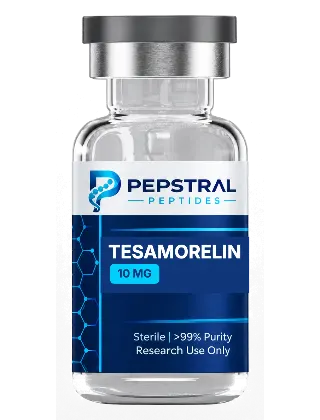 Tesamorelin 10 mg
$120 per vial
Lot TS-2608-D · 99.2% HPLC · certificate published
View product