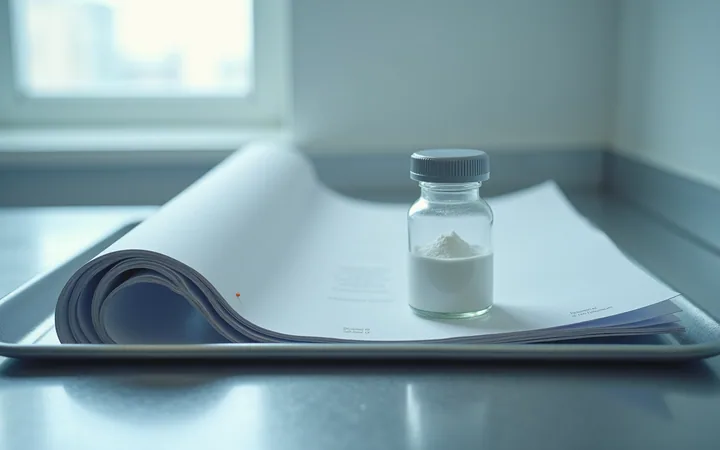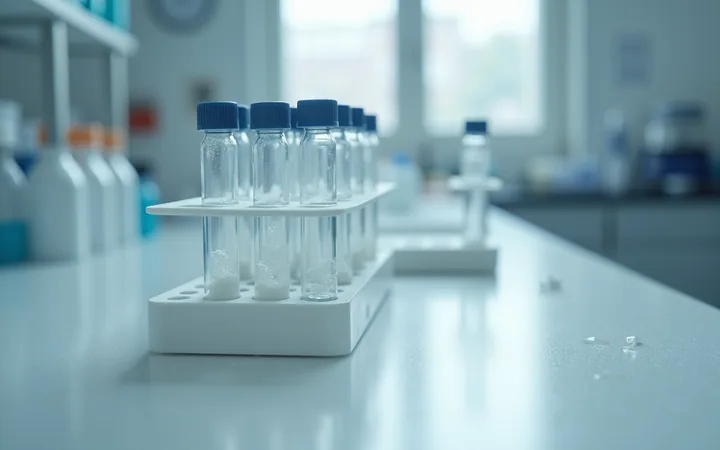

Every vial on this catalogue arrives as a dry solid, and the usual one-line explanation is that freeze-drying removes the water so the peptide lasts longer. That is true and it skips the part that matters. Freeze-drying is three distinct operations with three different purposes, and the thing in the vial, the cake, is a structure produced deliberately rather than a residue left behind.
Knowing which stage does what is the difference between reading the powder's appearance as evidence and reading it as decoration.
Why not simply dry it?
Water can be removed from a solution by warming it, and for a peptide that is a bad idea twice over. Heat drives the degradation reactions the molecule is capable of, which the post on which residues degrade first maps. And as a solution concentrates, every dissolved thing in it concentrates too, so the peptide spends the last part of the process in a progressively more hostile environment at exactly the moment it is hottest.
Lyophilization avoids both by changing the route. Freeze the solution solid, then lower the pressure far enough that ice passes directly to vapour without ever becoming liquid. That is sublimation. The water leaves, the temperature stays low, and nothing is ever concentrated into a hot syrup.
Stage one: freezing
The solution is cooled until it is fully solid. What forms is not a uniform block. Ice crystallises out as pure water, which pushes everything else, the peptide, any buffer salts, any excipient, into the shrinking spaces between the crystals. By the time freezing finishes, the vial contains ice crystals threaded through a concentrated amorphous phase holding the solute.
This stage decides the structure of the final cake, before a single molecule of water has been removed. Fast cooling makes many small crystals, which leaves a fine-pored cake that dries slowly. Slow cooling makes fewer, larger crystals, which leaves a coarse open cake that dries quickly. Neither is simply better, and the choice is a real formulation decision rather than a detail.
Stage two: primary drying
Pressure drops and gentle heat is applied, and the ice sublimes away. As it goes it leaves voids exactly where the crystals were.
That is the origin of the cake. The porous solid in the vial is the negative image of the ice, and its pores are the channels the crystals occupied. It is also the direct reason lyophilized peptide dissolves as fast as it does: solvent wicks through the whole structure at once and meets the peptide everywhere simultaneously, instead of having to dissolve inward from the surface of a dense lump. The reconstitution post covers what happens next.
Primary drying has one hard limit. The concentrated amorphous phase holding the peptide has a collapse temperature, and above it that phase softens enough to flow. If the product warms past it while ice is still leaving, the structure slumps into the voids as they open. This is where a cake is lost, and losing it is a process failure with visible consequences, discussed below.
Stage three: secondary drying
When the ice has gone the vial is not dry. Water is still bound to the solid, hydrogen-bonded to the molecule and dissolved in the amorphous phase, and no amount of sublimation removes it because it is not ice. Secondary drying raises the temperature with the vacuum still on and desorbs that bound water.
This is the stage that determines how long the vial lasts, and it is the least visible. A cake that looks perfect can still hold several percent water if secondary drying was cut short, because the appearance was fixed in stage two and this stage does not change it. Residual water is both a reactant for most degradation routes and a plasticiser that lowers the glass transition temperature of the solid, so a wet cake degrades faster and is also more likely to collapse in storage. Where a lyophilized expiry date comes from is the related reading, and the reason the measurement is not on these certificates is covered in the post on residual moisture.
Finally the vials are backfilled, commonly with an inert gas, and stoppered under that atmosphere. The stopper and seal post covers what the closure then has to do.
Reading the cake
Across this catalogue's 114 certificates, 103 record the sample as a white lyophilized powder; the rest are coloured or, in one case, a solution, which the certificate dataset itemises. That description is the laboratory recording what arrived, and it is worth knowing how much weight it carries.
| What you see | What it suggests | What it does not prove |
|---|---|---|
| An even porous cake filling part of the vial | The cycle held structure through primary drying | That secondary drying finished, or that the water is gone |
| A thin film or a scatter at the base | A small mass of peptide, which is normal at these fill weights | Anything about quality; a 5 mg fill is a very small amount of solid |
| A cake shrunken away from the glass, or glassy and melted-looking | Collapse: the product warmed past its collapse temperature | That the peptide is chemically degraded |
| Visible liquid or a sticky mass | Water is present, from an incomplete cycle or a breached closure | Which of those two causes it was |
| A cake that has broken loose and moved | Transit, not a process fault | Anything at all about the material |
Two of those rows need expanding.
A thin film or almost nothing visible is the single most common surprise, and it is arithmetic rather than a defect: 5 mg of a low-density porous solid in a vial sized for a few millilitres occupies very little space. Why the vial looks empty is a whole post on that point.
Collapse is a genuine finding and still not a verdict on the molecule. A collapsed cake has lost its pore structure, so it dissolves more slowly and holds water more readily, and it is more likely to be chemically unstable in storage for that second reason. But the peptide in it is usually still the right molecule at the right purity, which is why a certificate's identity and purity lines can be clean on material whose cake is visibly wrong. Appearance and assay are answering different questions.
What this catalogue does not claim
The cycle used to lyophilize this material is the manufacturer's, and we do not hold its parameters: no shelf temperatures, no chamber pressures, no drying times. Nothing in this post should be read as a description of it. What the certificates record is the state of the material when it reached the laboratory, and what the reconstitution guides describe is how it behaves when solvent is added.
Frequently asked questions
Is freeze-dried the same as lyophilized?
Yes. They are two names for the same process, and both appear on certificates and labels. "Lyophilized" is the usual term in a laboratory context and "freeze-dried" the usual one outside it.
Why is the powder so light and fluffy?
Because most of its volume used to be ice and is now empty space. The cake is a porous skeleton with the water removed from between its walls, which is why a few milligrams can look like a loose film rather than a dense grain.
Does a collapsed cake mean the peptide is bad?
Not by itself. Collapse is a loss of physical structure, so the material dissolves more slowly and holds water more readily, which does matter for storage. The molecule's identity and purity are separate questions and are what the certificate addresses.
Why does lyophilized peptide dissolve so quickly?
Because solvent reaches all of it at once through the pores left by the ice, rather than having to work inward from the outside of a solid lump. Compounds carrying a fatty-acid chain are the exception and genuinely take longer, which why GLP-1 peptides dissolve slowly explains.
Can I tell from looking whether the water was fully removed?
No, and this is the main limit of appearance as evidence. Residual moisture is fixed in the last stage of drying, after the cake's appearance has already been set, so the two are not linked. Only a moisture assay answers it.
Is the vial under vacuum?
Usually not. Vials are commonly backfilled with an inert gas before stoppering rather than sealed under full vacuum, so the pressure inside is below atmospheric but the vial is not evacuated. That partial vacuum is why some vials draw solvent in slightly when they are first opened.
References
- Tang X, Pikal MJ. Design of freeze-drying processes for pharmaceuticals: practical advice. Pharmaceutical Research 2004;21(2):191-200. The stage-by-stage process description and the role of collapse temperature. doi.org/10.1023/b:pham.0000016234.73023.75
- Carpenter JF, Chang BS, Garzon-Rodriguez W, Randolph TW. Rational design of stable lyophilized protein formulations: theory and practice. Pharmaceutical Biotechnology 2002;13:109-133. pubmed.ncbi.nlm.nih.gov/12596620
- Franks F. Freeze-drying of bioproducts: putting principles into practice. European Journal of Pharmaceutics and Biopharmaceutics 1998;45(3):221-229. doi.org/10.1016/S0939-6411(98)00004-6
- Pepstral certificate library: 114 certificates issued by Bioviridian Inc. Sample descriptions, read 5 October 2026, record the physical appearance of the material as received; 103 of the 114 read as a white lyophilized powder. pepstral.com/coa.html
Every product mentioned is sold for laboratory research use only and is not for human or animal use. Nothing on this page describes or recommends use of the material sold here in humans or animals.