
A GLOW certificate reports three molecular weights — 403.2, 1419.5 and 4964.2 Da. Each one identifies a component, so the certificate tells you the formulation without the label having to: GHK-Cu, BPC-157 and TB-500.
That is the useful thing about a multi-component certificate. Trade names for blends are arbitrary and tell you nothing; the masses are checkable facts. This post covers how to decode them, what the copper figure proves, what a single purity number can and cannot describe, and how a three-component blend behaves.
Decoding the three masses
| Mass reported | Component | Cross-check |
|---|---|---|
| 403.2 | GHK-Cu | Free GHK is ~340 Da; the difference is the copper ion |
| 1419.5 | BPC-157 | Matches lots BP5/BP10/BP15-0803 exactly |
| 4964.2 | TB-500 | Matches lot TB10-0803 exactly |
Two of those are straightforward identity confirmations — the same masses the single-compound certificates report, which is the cross-check described in reading a two-component blend certificate.
The first one carries extra information.
Why 403 rather than 340 matters
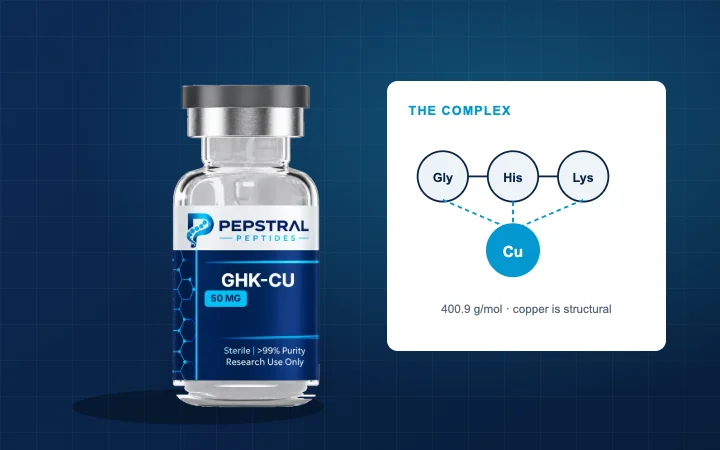
GHK is glycyl-histidyl-lysine, a tripeptide first described by Pickart and Thaler in 1973 as a factor in human serum. As a bare peptide it weighs approximately 340 Da.
GHK-Cu is the copper(II) complex — the peptide coordinating a copper ion through its histidine imidazole, the N-terminal amine and backbone nitrogen. Copper has an atomic mass of about 63.5, and the complex comes in near 403.
So the mass on the certificate is doing real work: 403.2 confirms the copper is present and coordinated. A certificate reporting ~340 for the same line would be describing uncomplexed GHK, which is a different substance with different chemistry and different handling.
This is unusual among peptides. Almost every other entry in a catalogue is an organic molecule whose mass confirms a sequence. Here the mass confirms a metal complex, and the metal is the point — what is GHK-Cu covers the coordination chemistry and why the complex behaves differently from the free tripeptide.
A practical consequence: GHK-Cu solutions are blue. Copper(II) complexes absorb in the red part of the spectrum. If a reconstituted GLOW solution has a blue tint, that is the copper, and it is expected rather than a contamination signal.
What the certificate reports
| Field | Lot GLOW70-0803 |
|---|---|
| Molecular weights | 403.2, 1419.5, 4964.2 |
| Purity (RP-HPLC, 214 nm) | 99.80% |
| Identity | LC-MS/MS |
| Endotoxin | <0.05 EU/mL |
What a single purity figure cannot tell you
99.80% describes all three peaks together as a fraction of total absorbance at 214 nm. It does not give you the ratio.
The reason is worth understanding rather than just accepting. Absorbance at 214 nm comes mostly from the peptide bond. A 43-residue protein has 42 peptide bonds; a tripeptide has two. TB-500 absorbs an order of magnitude more strongly per molecule than GHK-Cu does. Peak areas therefore say very little about relative quantity, and a blend where one component looks small on the chromatogram may not be small in the vial.
HPLC purity as area percent covers the absorbance issue; net peptide content vs purity covers why the content line, not the purity line, is where quantity lives.
There is a second limitation specific to copper complexes: GHK-Cu's detection behaviour differs from an ordinary peptide's because the metal alters its spectral properties. Treating all three peaks as comparable is a mistake.
What blending does and does not change
Nothing chemically. Three powders, one vial. No conjugation, no complexation between components, no reaction.
| Question | Behaviour |
|---|---|
| Reconstitution | Governed by the slowest component; all three are water-soluble |
| Colour | Blue tint from the copper complex — expected |
| Stability | Each component degrades independently, on its own timescale |
| Ratio | Fixed at manufacture; cannot be varied afterwards |
| Attribution | Impossible — no observation can be assigned to one component |
That last row is the real cost. A three-component blend cannot support any experiment where you need to know which compound produced an effect. Peptide blends vs single compounds covers the trade-off; the short version is that blends are a convenience format, not an experimental one.
One genuine chemical consideration: copper is redox-active. Copper(II) can participate in oxidation chemistry, and in a shared solution that is worth knowing about when the other components contain oxidisable residues — TB-500 has a methionine at position 6. This is a reason to keep reconstituted blend solutions cold, dark and short-lived rather than a reason to avoid the format. Oxidation-prone residues in peptides covers the chemistry, and how long does reconstituted peptide last the timescales.
GLOW and KLOW
The two blends differ by one component:
| GLOW | KLOW | |
|---|---|---|
| GHK-Cu (403.2) | ✓ | ✓ |
| BPC-157 (1419.5) | ✓ | ✓ |
| TB-500 (4964.2) | ✓ | ✓ |
| KPV (342.4) | — | ✓ |
What is in a KLOW blend covers the fourth component and why a 342.4 figure is easy to confuse with GHK's 340.
Regulatory position
None of the three components is an approved drug in any major jurisdiction. BPC-157 sits in FDA 503A Category 2; TB-500 is prohibited in sport under WADA's S2 class; GHK-Cu appears in cosmetic contexts under separate regulatory regimes that do not extend to a research blend. All are supplied for laboratory research only — what "research use only" means.
Frequently asked questions
What does GLOW stand for?
It is a trade name, not an abbreviation with a defined expansion. The certificate's molecular weights are the reliable description of what is in the vial.
Why is my reconstituted solution blue?
Copper(II) in the GHK-Cu complex. Expected, and a reasonable informal indication that the copper is still coordinated.
Can I tell the ratio from the purity figure?
No. Purity is one area percent for the whole chromatogram, and the three components absorb very differently at 214 nm. Net content per component is the line that describes quantity.
Is GHK-Cu the same as GHK?
No. GHK is the bare tripeptide at about 340 Da; GHK-Cu is its copper complex at about 403. The certificate mass distinguishes them.
Does the copper interfere with the other two peptides?
Copper is redox-active, which is a reason to keep reconstituted solutions cold, dark and short-lived. It is not a reason to avoid the blend format.
Can I separate the components after reconstitution?
Not without preparative chromatography. A blend is effectively permanent once it is in the vial.
References
- Pickart L, Margolina A. Regenerative and Protective Actions of the GHK-Cu Peptide in the Light of the New Gene Data. International Journal of Molecular Sciences 2018;19(7):1987. doi.org/10.3390/ijms19071987
- Pickart L, Thaler MM. Tripeptide in human serum which prolongs survival of normal liver cells and stimulates growth in neoplastic liver. Nature New Biology 1973;243(124):85-7. doi.org/10.1038/newbio243085a0
- Goldstein AL, Hannappel E, Kleinman HK. Thymosin beta4: actin-sequestering protein moonlights to repair injured tissues. Trends in Molecular Medicine 2005;11(9):421-9. doi.org/10.1016/j.molmed.2005.07.004
Every product mentioned is sold for laboratory research use only and is not for human or animal use. Nothing on this page describes or recommends use of the material sold here in humans or animals.