
Certificates · 29 September 2026
What a peptide certificate of analysis does not test for
A certificate reports its stated scope and nothing more. Water content, residual solvents, counter-ion and sterility are often outside it.
Read the post →
A certificate reports its stated scope and nothing more. Water content, residual solvents, counter-ion and sterility are often outside it.
Read the post →
Yes, for a vial used in one session. The two differ by 0.9% benzyl alcohol, and that difference decides how long an opened vial is usable.
Read the post →
A280 only sees tryptophan, tyrosine and cystine. Most of this catalogue has none of them, so the reading is zero. What to use instead.
Read the post →
The right pH depends on the peptide's charge and what you are measuring. How to choose one, which buffers suit peptides, and which to avoid.
Read the post →
Methionine, cysteine and tryptophan do nearly all the oxidising. What each becomes, and why oxidation shows as +16 and an earlier HPLC peak.
Read the post →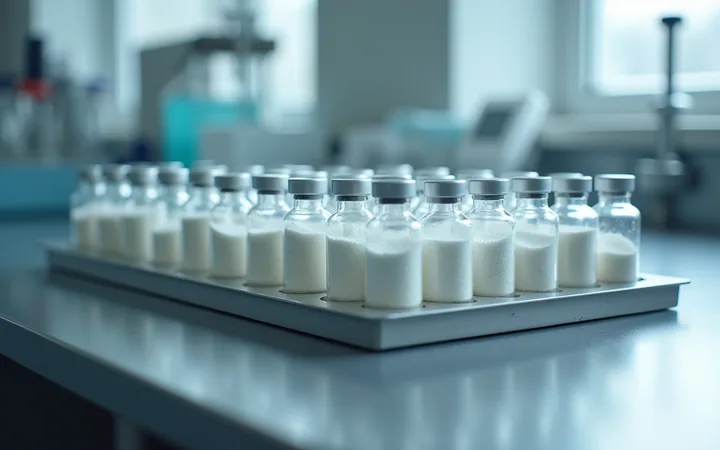
Two certificates for one compound will not match. How much is the material, how much is the laboratory, and which number belongs in a calculation.
Read the post →
A stability study asks how much peptide survives defined conditions, and what the rest became. How to design one, and what forced degradation is for.
Read the post →
0.22 micron is the standard sterilising pore size. Which membrane to choose, how much peptide the filter takes, and when filtering is the wrong call.
Read the post →
Non-pyrogenic is an endotoxin limit, not sterility. What EU/mL means, how the LAL assay proves it, and the figure from a published Pepstral lot.
Read the post →
Reconstitution solution is bacteriostatic water: sterile water with 0.9% benzyl alcohol. What it is for, and when sterile water is the better choice.
Read the post →
SNAP-8 is acetyl octapeptide-3, capped at both ends. The sequence, what it mimics in the SNARE complex, and how the caps change its mass.
Read the post →
Selank is tuftsin, Thr-Lys-Pro-Arg, extended by three residues. The sequence, the mass of 751.9, and what a 10 mg certificate reports.
Read the post →The blog covers buying, handling and research-design questions as they come up. The evergreen material lives in the guides: reading a certificate of analysis, storage and stability, one research guide per compound and the glossary.
New posts publish to the RSS feed. Every post is written for laboratory research use only and links to the lot certificate for any product it mentions.
One email when a new certificate is published, when a sold-out compound is back, or when a new compound is added. About twice a month, nothing else.