
"Peptide purity test kit" is a search with no honest product at the end of it, and this post explains why rather than pretending otherwise. The reason is not that kits are hard to make. It is that purity, as a certificate uses the word, is a measurement that requires a separation, and a separation is a chromatograph. What a buyer can do without one is still worth knowing, and the second half of this post is about that.
What purity actually requires
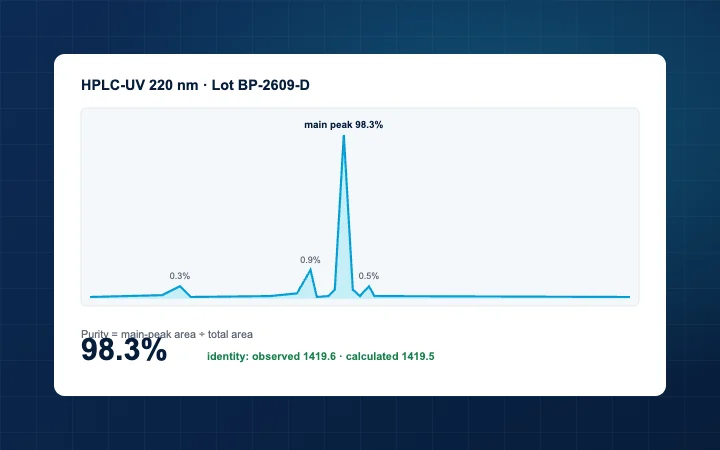
A certificate's purity line is a ratio: the amount of the intended molecule divided by the amount of everything that could be mistaken for it. The area-percent post sets out the arithmetic behind the 99.7% figures on this site. The point here is simpler. To form that ratio, the intended molecule has to be told apart from its impurities, and in a synthetic peptide the impurities are molecules that differ from the product by one residue, one protecting group or one oxidation. They have almost the same composition, almost the same mass, and identical chemistry in any reagent test.
Reversed-phase HPLC tells them apart by retention: each species holds on the column for a slightly different time, comes off as its own peak, and is integrated separately. USP <621> and the standard peptide-HPLC methods in Mant and colleagues' review describe how. Mass spectrometry tells them apart by mass, to a fraction of a dalton. Both are separations in the sense that matters, and neither fits in a kit, because a column, a pump, a detector and a calibration are the instrument.
A strip, a colour reagent, a refractometer, a scale or a handheld spectrometer does not separate anything. It reports a property of the whole sample. Whatever property that is, the deletion sequence has it too.
What a reagent test can detect
Reagent tests answer presence questions, and some of those are useful.
| Test | What it detects | What it cannot do |
|---|---|---|
| Biuret or BCA | Peptide bonds, as a total | Distinguish the product from any other peptide; both give signal |
| Ninhydrin | Free amines | Distinguish the product's amines from an impurity's, or from free amino acids, which give more signal per mass |
| Ellman's reagent | Free thiols | Say anything about a peptide with no cysteine; for one with cysteine, report only whether it is reduced |
| Melting point or appearance | Gross identity of a crystalline solid | Apply to a lyophilized amorphous cake, which has no melting point |
| Refractometer | Concentration of a dissolved solid | Distinguish peptide from salt, water or anything else dissolved |
Every one of these would give the same answer for a 60% pure lot as for a 99% one, provided the other 40% was peptide-like. Which, in a synthetic peptide, it is. That is why none of them is a purity test and why a product sold as one is selling a presence test under the wrong name.
Why the obvious instruments do not give purity either
- A balance gives mass. It cannot say what the mass is made of. The net content post explains why mass and purity are different questions even in a laboratory.
- A UV reader at 280 nm gives absorbance from tyrosine, tryptophan and cystine. It measures how much chromophore is present, not what it is attached to. Used correctly it is a concentration check, which is the next section.
- A handheld near-infrared or Raman device gives a spectrum of the whole sample. Spectra of a peptide and its single-deletion impurity are not distinguishable at the resolution those instruments have.
The bench checks that are genuinely informative
Three things can be done without a laboratory and each rules something out.
- Appearance and dissolution against the sequence. A white or off-white cake that dissolves as its sequence predicts, instantly for a short polar peptide, slowly for a hydrophobic one, is behaving as the right compound would. Colour, gumminess or insolubility where the sequence predicts none is a finding, as the vial appearance post sets out. This rules out gross problems; it does not measure purity.
- A280 against the predicted coefficient. For a sequence with tyrosine or tryptophan, the extinction coefficient at 280 nm can be predicted from the sequence by Pace and colleagues' method, and a solution of known nominal concentration should give the predicted absorbance. A reading far off predicts either wrong concentration or wrong compound. The A280 post has the method and the sequences it suits; for the many short peptides with no aromatic residue, it does not apply.
- A mass, from any accessible mass spectrometer. Many institutions have a core facility that will run a single sample for a modest fee. One mass rules out the wrong compound, the oxidised form, the dimer and the wrong salt form in a single measurement, which is why identity by mass is the first line on every certificate here. The LC-MS post explains what it proves and what it does not.
None of the three produces a purity percentage. Together they answer the question most buyers are actually asking, which is whether the vial contains the right thing in roughly the right amount.
What a laboratory test provides, and what a certificate replaces
The real purity test is an HPLC run with mass spectrometry on the lot, and it is purchasable: the independent testing post covers which laboratories accept single vials, what to send and what comes back. It is the right call when a certificate is absent, when a result matters enough to justify the cost, or when two certificates disagree.
For most buyers most of the time, a certificate for the lot does the same work in advance. The conditions that make it trustworthy are the ones the supplier-vetting post lists: the lot number on the vial matches the certificate, the laboratory is named, identity is by mass and not only by HPLC, net content is stated, and the certificate can be verified against the laboratory's own record. Every lot in the COA library meets those conditions, which is the honest answer to the kit question: the test has been run, by a laboratory, and the result is published.
Frequently asked questions
Is there any kit that measures peptide purity?
No. Purity requires separating the product from near-identical impurities, which is what a chromatograph does. Kits report properties of the whole sample and cannot separate anything.
What can a reagent test tell me?
Whether peptide is present, roughly how much protein-like material there is, or whether a thiol is free. A 60% pure sample passes those tests as readily as a 99% one.
What is the best check I can do without a laboratory?
A mass from an accessible mass spectrometer. It rules out the wrong compound, the oxidised form and the dimer in one measurement.
Does A280 work for every peptide?
No. It needs tyrosine, tryptophan or cystine in the sequence. Most of the short bioregulators have none and cannot be checked this way.
When should I pay for a laboratory test?
When there is no certificate for the lot, when the result matters enough to justify the cost, or when two certificates disagree. Otherwise the certificate is the test.
References
- United States Pharmacopeia. General Chapter <621> Chromatography. www.usp.org
- Mant CT, Chen Y, Yan Z, et al. HPLC analysis and purification of peptides. Methods in Molecular Biology 2007;386:3-55. doi.org/10.1007/978-1-59745-430-8_1
- Pace CN, Vajdos F, Fee L, et al. How to measure and predict the molar absorption coefficient of a protein. Protein Science 1995;4(11):2411-2423. doi.org/10.1002/pro.5560041120
Every product mentioned is sold for laboratory research use only and is not for human or animal use. Nothing on this page describes or recommends use of the material sold here in humans or animals.