
Putting two peptides in one bottle is not a neutral act. Each is a reactive molecule sitting in a solution designed for it, and a solution designed for two has to suit both without favouring either. Most pairs fail that test, which is why blends are the exception rather than the rule in a peptide catalogue.
Selank and Semax pass it, and the reasons are specific enough to be worth setting out — both because they explain this product and because they give you a checklist to run against any other blend you are asked to trust.
What usually goes wrong in a mixture
Four incompatibilities account for most of it.
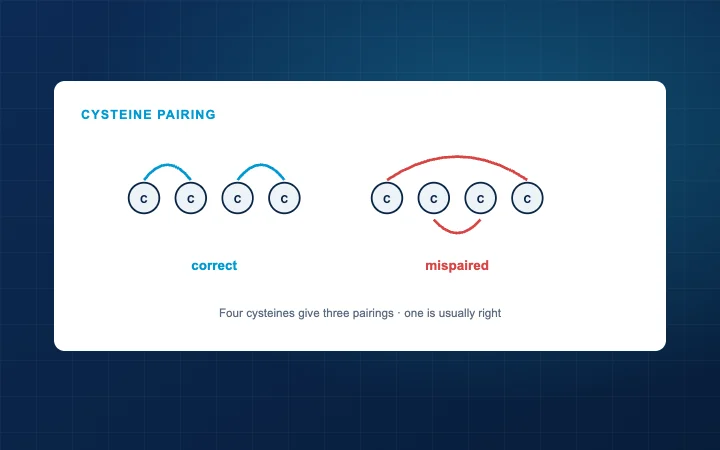
Thiol–disulphide exchange. A peptide carrying a free thiol will attack a disulphide bridge on a neighbouring molecule, swapping in and rearranging the connectivity. Nothing degrades in the ordinary sense — the mass barely moves — the molecules simply become different molecules. This is the most common hard incompatibility, and it rules out a great many otherwise sensible pairings. It is also the quietest: mass spectrometry alone may not catch it, because a scrambled isomer weighs what the original weighed.
Incompatible pH optima. Every peptide has a pH range where hydrolysis, deamidation and oxidation are all slowest. If one component is most stable mildly acidic and the other wants neutral, a single buffer cannot serve both, and whichever loses the argument is being stored badly for the life of the bottle.
Differential solubility. If one component sits comfortably within the formulation and the other is near its solubility limit, the second comes out of solution first — and often invisibly, as a faint haze or a film on the glass rather than anything you would call a precipitate.
Cross-catalysis. Degradation products of one peptide can accelerate breakdown of the other. A trace of peroxide generated in one oxidation pathway does not care which molecule it meets next. This is rarer than the first three and considerably harder to predict, which is why it has to be tested rather than reasoned about.
Why this pair avoids all four
They share a stabilising motif. Both carry a Pro-Gly-Pro tripeptide element. In Semax it is appended to the ACTH(4-10) fragment; Selank carries the same design idea attached to a tuftsin-derived sequence. The motif exists for a structural reason: proline's ring constrains the backbone and removes the amide hydrogen, which makes the adjacent bonds poor substrates for the exopeptidases that would otherwise chew in from the terminus. Two molecules built around the same protective idea tend to share a chemical character — similar backbone rigidity, similar terminal chemistry, similar susceptibility profile.
Neither has a free thiol. No cysteine in either sequence means the exchange problem simply does not arise. This is the single biggest reason the pairing is straightforward, and it is the first thing to check on any proposed blend.
Neither has a disulphide bridge. Both are linear. There is no ring for a stray thiol to attack and no scrambling failure mode — the concern that dominates handling for cyclic peptides and for compounds like oxytocin.
Similar polarity. Both are short, water-soluble and comparably polar. One buffer suits both, and neither is sitting near its solubility ceiling while the other is comfortable.
The result is a pairing where co-formulation is genuinely low-risk — not because someone decided it was convenient, but because the chemistry cooperates.
Compatible is a tested claim, not a deduction
Everything above is a good reason to try the combination. None of it is evidence that the combination works.
Each compound's own stability data was generated on a solution containing that compound alone. It says nothing about what the other one does in the same vessel. The argument from chemistry tells you which pairs are worth testing; it does not substitute for the test.
What a real compatibility assessment looks like:
| Study | What it answers |
|---|---|
| Forced degradation on the pair | Do the two sets of degradation products interfere, or co-elute with the other parent peak? |
| Method resolution | Can the assay separate both compounds and both impurity profiles in one run? |
| Real-time stability on the blend | Does either component decline faster in company than it did alone? |
| Ratio stability | Does the measured proportion between them drift over the stated shelf life? |
That last row is the one specific to blends, and it is the one most easily overlooked. Two compounds can both stay within their individual purity specifications while the proportion between them quietly moves — because they are not required to degrade at the same rate.
What it costs analytically
The real trade falls on the certificate rather than on the bottle.
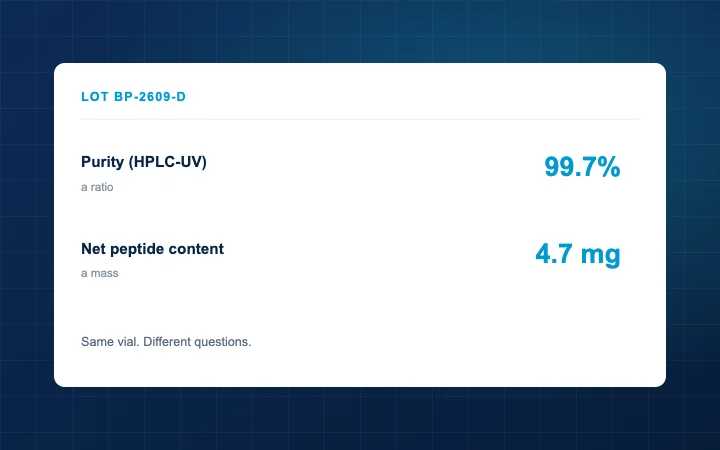
A single-compound solution has one purity figure and one identity confirmation. A two-component solution needs both, per component, and a combined figure is close to meaningless: 99% purity across a blend tells you nothing at all about the ratio between the two compounds it contains.
So a blend certificate should show identity confirmed independently for both masses, purity reported per component rather than combined, the content of each stated separately, and a ratio that was measured after formulation rather than carried over from what was weighed in. For the Selank + Semax liquid spray — 5 mg of each in 10 mL, 0.5 mg/mL each — purity is reported per component for exactly this reason.
What a blend certificate shows covers how to read one properly, including the tells that a blend has been issued a single-compound document.
Storage is set by the less robust component
A blend inherits the stricter of the two storage requirements, never the average. If one component tolerates ambient light and the other does not, the bottle is light-sensitive. If one is fine for a year refrigerated and the other for six months, the blend is a six-month product.
This is worth stating because it runs against intuition: combining two stable compounds does not produce a compound-stability figure somewhere between them. It produces one governed by whichever fails first, and a shelf life quoted for a blend should reflect that rather than the more flattering of the two inputs.
When to choose separates instead
A blend is fixed at the ratio the manufacturer chose. That is the point, and also the limitation.
Take the blend when the fixed ratio is the one you want and you would rather not combine two solutions yourself, with the transfer and measurement error that introduces.
Take them separately — Selank and Semax — when you need to vary the proportion, when only one is relevant to part of the work, or when you want each certificate to stand on its own without a shared formulation history between them.
Neither is the better choice in general. The blend removes a step and fixes a decision; separates keep the decision open and give you two independent analytical records.
Every product referenced here is supplied for laboratory research use only and is not for human or animal use.
References
- Ashmarin IP, Nezavibatko VN, Levitskaya NG, et al. Design and investigation of an ACTH(4-10) analog lacking D-amino acids and hydrophobic radicals. Neuroscience Research Communications 1995;16:105-112.
- Manning MC, Chou DK, Murphy BM, Payne RW, Katayama DS. Stability of protein pharmaceuticals: an update. Pharmaceutical Research 2010;27(4):544-575. doi.org/10.1007/s11095-009-0045-6
- Vlieghe P, Lisowski V, Martinez J, Khrestchatisky M. Synthetic therapeutic peptides: science and market. Drug Discovery Today 2010;15(1-2):40-56. doi.org/10.1016/j.drudis.2009.10.009
- Bachem. Quality Control of Amino Acids and Peptides: A Guide. www.bachem.com/knowledge-center/quality-control-of-amino-acids-peptides-a-guide
Every product mentioned is sold for laboratory research use only and is not for human or animal use. Nothing on this page describes or recommends use of the material sold here in humans or animals.