
P-21, written P021 in the papers that describe it, is a short synthetic peptide taken from the active region of ciliary neurotrophic factor and modified with an adamantane-containing residue to resist degradation. Li and colleagues reported it in 2010 as a neurotrophic peptide mimetic that promoted neurogenesis and synaptic plasticity in their mouse models. The catalogue supplies it as a 5 mg lyophilized powder for laboratory research use only, and the lot on sale has two certificates rather than one. This post explains where the compound comes from, what the certificates report, why there are two, and what a methods section should record given how thin the literature is. It does not print a sequence, for a reason given below.
Where does P-21 come from?
Ciliary neurotrophic factor is a cytokine of the gp130 family, a 200-residue protein that supports the survival of neurons in culture. Proteins that size do not cross membranes and do not survive long in a biological system, so the Iqbal group set out to make a short peptide that reproduced the activity of one region of CNTF. They mapped the region, made a series of peptides from it, and stabilised the most active one by incorporating an adamantane group, the rigid ten-carbon cage that the adamantane post describes in the context of Adamax. The compound they took forward is P021, and P-21 is the same name with a hyphen.
That lineage puts P-21 in the same design family as Dihexa, which was built to mimic a growth-factor system rather than the factor itself, and apart from Semax and PE-22-28, which are fragments of native peptides.
| P-21 | |
|---|---|
| Literature name | P021 |
| Origin | Active region of ciliary neurotrophic factor |
| Modification | Adamantane-containing residue, for stability |
| Observed mass (certificate) | 578.6 |
| Catalogue vial | 5 mg |
| Current lot | P21-5-0318 |
| Certificates | COA3388 (April 2026), COA4866 (June 2026) |
Why does this post not print a sequence?
Because the certificate does not, and the author could not reconcile a candidate structure from the literature to the observed mass of 578.6 with enough confidence to publish it under this site's certificate policy, which requires every stated number to trace to a document. A sequence that does not match the certificate's mass would be worse than no sequence. What the certificate establishes is that the material in lot P21-5-0318 has a mass of 578.6 by MALDI-MS, a purity above 99.5% and a content slightly over 5 mg; a laboratory that needs the exact structure should take it from the supplementary material of Li et al. 2010 and check that its calculated mass matches 578.6 before citing it. The five-names post explains why a research code like P021 is only as reliable as the document it points to.
What do the two certificates report?
Both were issued by Bioviridian Inc. for the same lot, and both are published unaltered on the certificate page.
| Certificate line | COA3388, 3 April 2026 | COA4866, 17 June 2026 |
|---|---|---|
| Sample | P-21 5 mg, white lyophilized powder | P-21 5 mg, clear liquid |
| Identity, MALDI-MS | P-21, 578.6 | P-21, 578.6 |
| Content, HPLC quantitation | 5.42 mg | 5.25 mg |
| Purity, RP-HPLC at 214 nm | 99.6% | 99.8% |
| Endotoxin | ≤ 0.05 EU/mL | < 0.05 EU/mL |
| Heavy metals | Not on this layout | Conforms |
| Sterility | Not on this layout | Conforms |
Why was the same lot certified twice, and once as a liquid?
The June certificate was issued against a clear liquid sample and adds sterility and heavy-metals tests that the April layout does not include. The likeliest reading, and the only one the documents support, is that the laboratory tested a reconstituted sample from the same lot under the newer certificate layout, which is what the June 2026 certificates across the catalogue look like. The product sold is the lyophilized powder, and the April certificate is the one issued against powder.
For a methods section this is not a problem; it is extra information. Both certificates report the same identity mass, and the June one adds a sterility result, which is relevant if the peptide is going into a culture without filtration. The sterility post explains what the sterility test does and does not establish for a solution, and the lot report records which compounds were re-certified when.
How does a 579-dalton adamantane-containing peptide behave?
Differently from an unmodified peptide of the same size, for the reasons the adamantane post sets out.
Solubility. The cage is strongly lipophilic. The June certificate's "clear liquid" sample shows the compound can be brought into solution, but it is likely to dissolve more slowly than a polar peptide of the same mass and to adsorb more readily to hydrophobic plastic. Low-binding tubes and a check that the solution is clear before use are sensible.
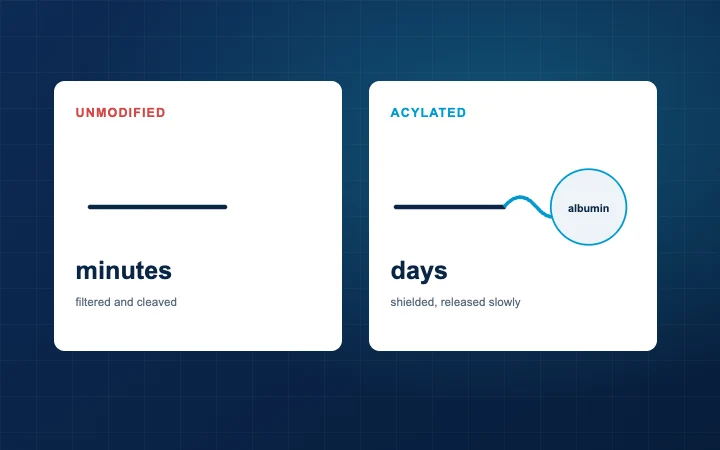
Stability. The cage was added for stability, and Li's group reports better persistence than the unmodified peptide in their systems. It is still a peptide with cleavable bonds, and the reconstituted-lifetime post rules apply.
Amount. Five milligrams at 578.6 g/mol is 8.6 µmol; in 1 mL that is an 8.6 mM stock. The molarity post covers the conversion.
What should the methods section say about the literature?
That it is thin and comes largely from one group. The product page says the same. Li et al. 2010 is the primary description; later work on P021 from the same laboratory extends it. Independent replication is limited, and a study using the compound should cite the primary paper, record the certificate code and observed mass, and avoid describing effects that the cited work did not measure. The trial-data post covers the general principle, and the methods-section post the format.
Frequently asked questions
Is P-21 the same as P021?
Yes. P021 is the name in Li et al. 2010; P-21 is the catalogue spelling of the same compound.
Why are there two certificates for one lot?
The laboratory issued a second certificate in June 2026 against a liquid sample under a newer layout that adds sterility and heavy metals. Both report the same identity mass. The product sold is the powder the April certificate describes.
Which certificate should I cite?
Both, by code, with the note that the April certificate describes the powder as supplied. If sterility matters to the study, the June certificate is the one that reports it.
Is P-21 related to CNTF itself?
It is derived from a region of CNTF and modified. It is not the protein, and CNTF's own literature does not transfer to it.
Why does the product page say the literature is thin?
Because it is. The compound is comparatively recent and most of its published characterisation comes from the group that designed it. That is a fact about the evidence, not about the material, and it belongs in the methods section.
References
- Li B, Wanka L, Blanchard J, et al. Neurotrophic peptides incorporating adamantane improve learning and memory, promote neurogenesis and synaptic plasticity in mice. FEBS Letters 2010;584(15):3359-3365. doi.org/10.1016/j.febslet.2010.06.025
- Bioviridian Inc. Certificates of analysis COA3388 (3 April 2026, lyophilized powder) and COA4866 (17 June 2026, clear liquid), both for P-21 5 mg, lot P21-5-0318. coa.html
Every product mentioned is sold for laboratory research use only and is not for human or animal use. Nothing on this page describes or recommends use of the material sold here in humans or animals.