
NAD+ is supplied in three formats: a lyophilized vial of 500 or 1000 mg, a hinged tin of thirty dissolving film strips, and a 10 mL metered spray at 50 mg/mL. The vial is the format with a certificate on file; the strips and the spray currently have none, and their pages say so. Which format suits a study depends on how much NAD+ it needs, in what state, and whether the certificate matters to the result. This post compares the three on content, molar amount, certification and handling, and points to the NAD+ handling post for the chemistry that applies to all of them. It does not describe how any format is used, because that is the study's design, not the supplier's.
What is NAD+, and why is it in a peptide catalogue?
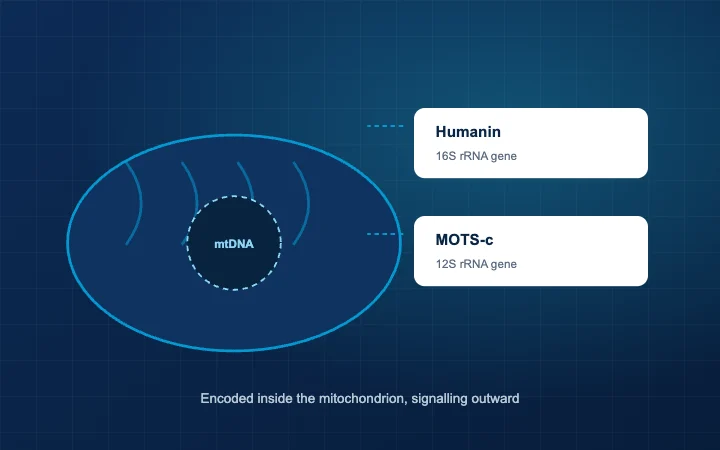
Nicotinamide adenine dinucleotide is a coenzyme, not a peptide: two nucleotides joined through their phosphates, C21H27N7O14P2, 663.4 g/mol. It is the electron carrier at the centre of cellular redox chemistry and the substrate for the sirtuins and PARPs, which is why it appears in ageing and mitochondrial research alongside MOTS-c and the mitochondrial-derived peptides. It is in the catalogue because the same laboratories order it, and it is sold in three formats because the amounts those laboratories need vary by three orders of magnitude.
What is in each format?
| NAD+ vial | NAD+ dissolving strips | NAD+ liquid spray | |
|---|---|---|---|
| Form | Lyophilized powder | Thin dissolving film, 30 strips in a hinged tin | Solution, 10 mL, metered pump |
| Content | 500 mg or 1000 mg | Per strip, as stated on the product page | 50 mg/mL, 500 mg per bottle, 5 mg per actuation |
| Certificate on file | Yes, both sizes | No | No |
| Current lot | NAD500-0803, NAD1000-0803 | See product page | See product page |
| Price | $100 (500 mg), $154 (1000 mg) | $60 | $100 |
The certificate column is the one to read first. The supplier-vetting post explains why: a format is either certified or it is not, and a certificate for the powder does not describe a strip or a spray made from a different batch by a different process.
How do the molar amounts compare?
NAD+ at 663.4 g/mol converts as follows.
| Unit | Mass | Moles | If dissolved in 10 mL |
|---|---|---|---|
| One 500 mg vial | 500 mg (certificate: 503.42 mg) | 754 µmol | 75 mM |
| One 1000 mg vial | 1000 mg (certificate: 1004.23 mg) | 1,507 µmol | 151 mM |
| One spray bottle | 500 mg | 754 µmol | Already 75 mM |
| One spray actuation | 5 mg | 7.5 µmol | n/a |
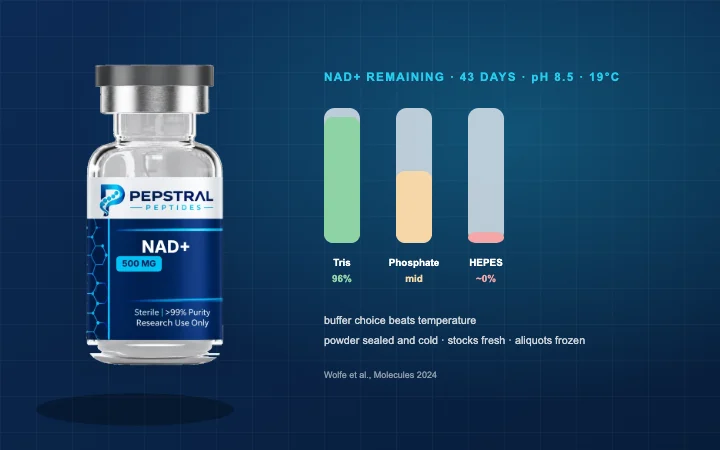
The spray bottle and the 500 mg vial hold the same mass. The difference is that the spray is already in solution at 50 mg/mL, and the handling post explains what that means for stability: NAD+ in aqueous solution degrades over weeks at room temperature and over months refrigerated, with the rate depending on pH and buffer, as Wolfe and colleagues measured in 2024. A dry vial has no such clock until it is opened. That is the trade the two formats make: the vial is stable and the spray is convenient.
Which format suits which kind of study?
A cell-culture or enzyme study that needs NAD+ at a defined molar concentration wants the vial. Weigh, dissolve, make a stock, aliquot and freeze; the handling post gives the stock arithmetic and the degradation checks, and the certificate gives the identity, purity and endotoxin lines a methods section needs. The 1000 mg vial is the better value per milligram and the worse choice for a laboratory that will use 200 mg a year, since every opening of the vial admits moisture.
A study of the format itself, dissolution rate of a film, release from a metered solution, comparison of matrices, wants the strips or the spray, and should say so in its methods rather than presenting either as a certified source of the compound.
A study that needs the certificate wants the vial, because it is the only format that has one.
What does the vial certificate report?
Both current lots were issued by Bioviridian Inc. on 17 August 2026 and are published unaltered on the certificate page.
| Certificate line | 500 mg, COA7592 | 1000 mg, COA7611 | What it tells you |
|---|---|---|---|
| Identity, LC-MS/MS | NAD+, 663.2 | NAD+, 663.2 | Matches the dinucleotide; NADH would be two units heavier, nicotinamide riboside 400 units lighter |
| Content, HPLC quantitation | 503.42 mg | 1004.23 mg | Both slightly over label |
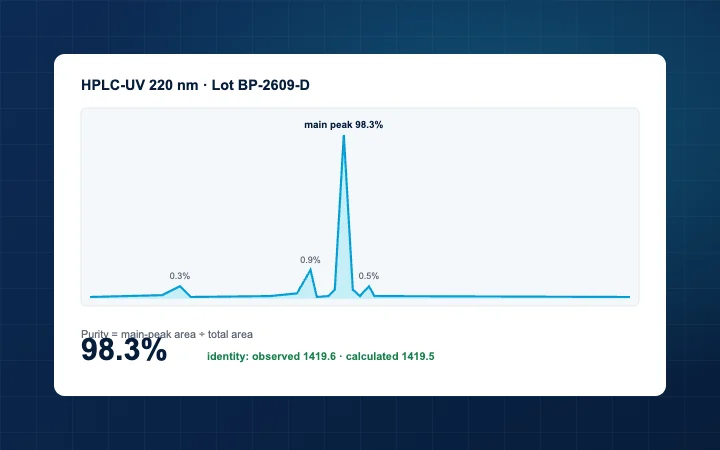
| Purity, RP-HPLC at 214 nm | 99.78% | 99.74% | The main degradation product in solution, nicotinamide, would show as a separate peak; see the handling post |
| Endotoxin | < 0.05 EU/mL | < 0.05 EU/mL | Suitable for cell work |
| Heavy metals | Conforms | Conforms | On the August 2026 layout |
The identity line does more work for NAD+ than for most compounds, because the obvious substitutions, NADH, nicotinamide mononucleotide and nicotinamide riboside, are all cheaper and all have different masses. A mass of 663 by LC-MS/MS rules out all three.
What should you know about the strips and the spray?
Three things, all from their product pages.
They are supplied for laboratory research use only, like everything else in the catalogue.
They carry no certificate at present. The strips page describes third-party testing of the film; no certificate for a strip lot has been published on the certificate page, and until one is, the honest statement is that the format is uncertified. The supplier-vetting post says to treat any product without a published certificate that way, and the rule applies to this site's own catalogue.
Their content per unit is stated on the page rather than measured on a certificate. For the spray that is 5 mg per actuation at 50 mg/mL; for the strips it is the per-strip figure on the page. A study that depends on the exact amount should measure it, which for NAD+ is straightforward by absorbance at 260 nm or by the HPLC method the certificates use.
Frequently asked questions
Is the spray the same NAD+ as the vial?
Same molecule, different batch and different process, with no certificate on file for the spray. Treat them as separate products.
Why is there no certificate for the strips?
Because none has been issued for a strip lot. The product page says so. When one is published it will appear on the certificate page with the lot number.
How long does the spray last once opened?
The handling post gives the solution-state windows: weeks at room temperature, months refrigerated, with degradation visible as a rising nicotinamide peak on HPLC or a fall in absorbance at 340 nm after enzymatic reduction. The spray is a solution from the day it is bottled.
Which vial size should a laboratory choose?
The one it will use within a few months of opening. NAD+ powder is hygroscopic, and a 1000 mg vial opened twenty times over a year takes in more moisture than two 500 mg vials opened ten times each. The vial-size post makes the general argument.
Does the nootropic strip format share anything with the NAD+ strips?
The film format and the tin. The compounds differ, and each product's page states its own content and certificate status.
References
- Wolfe KD, Alahuhta M, Himmel ME, et al. Long-term stability of nicotinamide cofactors in common aqueous buffers: implications for cell-free biocatalysis. Molecules 2024;29(22):5453. doi.org/10.3390/molecules29225453
- PubChem, National Library of Medicine. NAD+, CID 5892, C21H27N7O14P2, 663.4 g/mol. Read 27 September 2026. pubchem.ncbi.nlm.nih.gov/compound/5892
- Bioviridian Inc. Certificates of analysis COA7592 (NAD+ 500 mg, lot NAD500-0803) and COA7611 (NAD+ 1000 mg, lot NAD1000-0803), issued 17 August 2026. coa.html
Every product mentioned is sold for laboratory research use only and is not for human or animal use. Nothing on this page describes or recommends use of the material sold here in humans or animals.