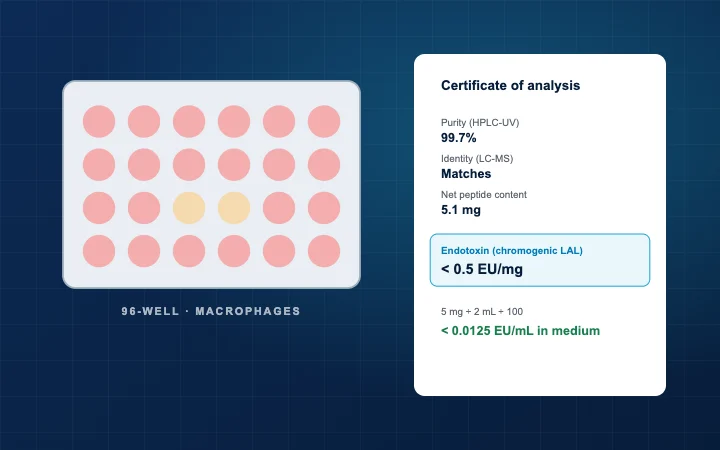

Every certificate on this site carries an endotoxin line, and most of them read "< 0.05 EU/mL". The endotoxin certificate post explains what endotoxin is, why it survives sterilisation and how to convert the certificate's figure into the units an assay needs. This post is about the test itself: where it came from, the three ways it can be read, the recombinant method that is replacing crab blood, and what the phrase "endotoxin tested" is worth when it appears on a listing without a number.
Where does the LAL reagent come from?
From the blood of the Atlantic horseshoe crab, Limulus polyphemus. In 1964 Frederik Bang and Jack Levin at Johns Hopkins reported that the crab's blood clotted in the presence of Gram-negative bacteria, and that the clotting was triggered by endotoxin, the lipopolysaccharide of the bacterial outer membrane. The crab's single blood-cell type, the amebocyte, releases a cascade of clotting enzymes when it meets endotoxin; the extract of those cells is Limulus amebocyte lysate, LAL. The Asian species Tachypleus gives the equivalent TAL.
The cascade is the detector. Endotoxin activates factor C, factor C activates factor B, factor B activates a proclotting enzyme, and the clotting enzyme cleaves coagulogen into a gel. Every LAL readout measures some stage of that chain. The reagent's sensitivity, how little endotoxin triggers it, is calibrated against a reference standard endotoxin and expressed in endotoxin units, EU, which is why certificate figures are in EU rather than in micrograms.
The crabs are bled and returned to the sea, with a mortality that is debated and is the main reason the field has pushed toward a reagent that needs no animal.
What are the three LAL readouts?
USP General Chapter <85>, the Bacterial Endotoxins Test, describes three.
| Readout | What is measured | Result type | Typical sensitivity |
|---|---|---|---|
| Gel-clot | Whether a firm gel forms that holds when the tube is inverted after incubation | Pass or fail at a stated sensitivity; semi-quantitative by dilution series | 0.03 to 0.25 EU/mL per reagent lot |
| Turbidimetric | Increase in cloudiness as coagulogen gels, read by a spectrophotometer over time | Quantitative, from a standard curve | to about 0.001 EU/mL |
| Chromogenic | Colour released when the clotting enzyme cleaves a synthetic peptide substrate carrying a chromophore | Quantitative, from a standard curve | to about 0.005 EU/mL |
Gel-clot is the original and the simplest. A tube of lysate and sample is incubated at 37 °C for an hour and turned upside down. If the gel holds, endotoxin at or above the reagent's labelled sensitivity was present. It gives a threshold, not a number, and a series of dilutions gives a rough concentration. The method is robust, needs almost no instrumentation, and is still the referee method when the others disagree.
Turbidimetric and chromogenic methods are kinetic: they read the reaction as it develops and compare its onset time or rate against standards, which gives a concentration. They are the methods behind a certificate figure with a decimal point.
All three share one requirement that decides what a certificate figure means: the sample must not interfere with the reaction. A peptide solution can inhibit the cascade, which would make endotoxin look lower than it is, or enhance it. USP <85> requires a positive product control, the sample spiked with a known amount of endotoxin, to show that the test recovered it. A certificate from a laboratory that runs the compendial method has passed that check whether or not the line says so.
What does recombinant factor C change?
The first enzyme of the cascade, factor C, can be made by recombinant expression without any crab. Recombinant factor C reagents detect endotoxin by the same first binding event and read it fluorometrically. The method has been published and in use since the early 2000s, and for most of that time its status was the problem: it was accepted as an alternative method only after case-by-case validation against LAL, which kept it a niche.
USP General Chapter <86>, Bacterial Endotoxins Test Using Recombinant Reagents, official on 1 May 2025 after early-adoption publication in late 2024, changed that. It recognises recombinant factor C and recombinant cascade reagents as compendial methods in their own right, which removes the validation burden that kept laboratories on crab blood. The European Pharmacopoeia had taken a similar step earlier. For a buyer of research peptides the practical consequence is that a certificate's endotoxin line may, from now on, come from a method that used no animal and that detects only endotoxin, where LAL can also respond to fungal glucans through a side pathway.
The certificates on this site record the method family, LAL, and the result. They do not record which readout was used, and this post does not guess.
What does "< 0.05 EU/mL" mean?
Three things, and the third is the one most often missed.
- It is a reporting limit. The test's lowest calibrated standard, at the dilution run, was 0.05 EU/mL, and the sample read below it. The true value is somewhere between zero and 0.05; the test does not say where.
- It is per millilitre of the solution tested, at whatever concentration the laboratory dissolved the peptide to. It is not per milligram of peptide and it is not per vial. The endotoxin certificate post sets out the conversion, which needs the laboratory's test concentration.
- It is not sterility. A solution can be sterile and full of endotoxin, because endotoxin is a molecule, not an organism, and survives the processes that kill bacteria. The sterility post is the three-way distinction.
What is "endotoxin tested" worth on a listing?
Without a number, a method and a lot, very little. "Endotoxin tested" says a test was run on something at some time. The questions a buyer should be able to answer from the listing are:
- Which lot? A result is for the lot tested, not for the product.
- What was the result, in EU/mL, and at what test concentration?
- By which method family, and from which laboratory?
- Is the certificate available to read, and can it be verified against the laboratory's own record?
Every lot on this site answers all four on its product page and in the COA library, and every certificate carries the laboratory's verification code. The supplier-vetting post treats "tested" without a certificate as the claim it is.
Frequently asked questions
Why is endotoxin measured in EU and not in micrograms?
Because different endotoxins have different potencies per microgram, and the test responds to activity, not mass. The endotoxin unit is defined against a reference standard so that results from different reagents and laboratories can be compared.
Can a peptide interfere with the test?
Yes, by inhibiting or enhancing the cascade. The compendial method requires a positive product control, a spiked sample, to show the test recovered a known amount. A certificate from a laboratory running USP <85> has passed that control.
Is recombinant factor C as sensitive as LAL?
Comparable, and more specific: it responds to endotoxin and not to the fungal glucans that can trigger LAL through a side pathway. USP <86> recognises it as a compendial method.
Does "< 0.05 EU/mL" mean no endotoxin?
No. It means less than the test's lowest standard at the dilution run. The endotoxin certificate post explains how to turn that limit into a worst-case amount per vial.
Does the certificate say which readout was used?
It records the method family, LAL, and the result. The three readouts all report in EU/mL and all require the same interference control.
References
- Levin J, Bang FB. The role of endotoxin in the extracellular coagulation of Limulus blood. Bulletin of the Johns Hopkins Hospital 1964;115:265-274. pubmed.ncbi.nlm.nih.gov/14209047
- United States Pharmacopeia. General Chapter <85> Bacterial Endotoxins Test. www.usp.org
- United States Pharmacopeia. General Chapter <86> Bacterial Endotoxins Test Using Recombinant Reagents. www.usp.org
- U.S. Food and Drug Administration. Guidance for Industry: Pyrogen and Endotoxins Testing: Questions and Answers. June 2012. www.fda.gov/regulatory-information/search-fda-guidance-documents/guidance-industry-pyrogen-and-endotoxins-testing-questions-and-answers
Every product mentioned is sold for laboratory research use only and is not for human or animal use. Nothing on this page describes or recommends use of the material sold here in humans or animals.