
"Peptides are unstable" is one of those statements that is true and useless. Degradation is not a slow general decay that affects every chain alike. It is a short list of named chemical reactions, each of which requires a particular amino acid to be present, and a sequence therefore tells you in advance which reactions a compound can undergo and which are simply unavailable to it.
This post is that list, and then the list applied to this catalogue. The applied part produces a result worth stating up front: the degradation route that stability textbooks lead with does not occur in any compound here, because the residue it needs is absent from every published sequence.
The six routes
Deamidation at asparagine. The headline reaction in the protein stability literature. An asparagine side chain loses its amide nitrogen as ammonia, by way of a cyclic succinimide intermediate, and becomes aspartate or isoaspartate. The molecule gains 0.98 Da and gains a negative charge. Glutamine does the same thing far more slowly. Deamidation is the reason the field talks about "molecular clocks": the rate is predictable enough from sequence that it has been used to date proteins.
Isomerisation at aspartate. The same succinimide intermediate is reachable from aspartate itself, and when the ring reopens it can do so on the other side, moving the backbone through the side chain and producing isoaspartate. The mass does not change at all. That is what makes it the quietest reaction on this list: a mass spectrometer reading the intact molecule sees nothing, and only a separation method notices that the peak has moved.
Oxidation at methionine, cysteine and tryptophan. An oxygen atom is added, the mass goes up by about 16, and on a reversed-phase trace the oxidised species usually elutes earlier than the parent because it is more polar. This site has a full post on oxidation and this one will not repeat it.
Hydrolysis of the backbone. The peptide bond itself is cleaved by water. It is slow at neutral pH and accelerates at both extremes, and it is sequence-dependent: an Asp-Pro bond is unusually labile, which makes that particular pair worth finding.
Cyclisation of an N-terminal glutamine. A glutamine at the very start of a chain can close onto the terminal amine and form pyroglutamate, losing ammonia. The chain loses 17 Da and loses its free N-terminus. Some peptides are supplied with a pyroglutamate start, in which case the reaction has already been done deliberately.
Diketopiperazine formation. The first two residues of a chain can cyclise and leave as a six-membered ring, truncating the peptide by two residues. It is most favourable when proline sits in the first or second position, which is common in short research peptides.
Five of those six need water to proceed. Only oxidation does not, and oxidation still runs faster in solution than in a dry solid. That is the entire argument for lyophilisation, and it is why a sealed dry vial and a reconstituted solution are not the same material with different convenience; they are on different timescales. The posts on what lyophilization does and how long a reconstituted peptide lasts take each side of that.
The catalogue, scored
Thirteen compounds on this site have a sequence published on their own page. Here is each one's residue inventory for the reactions above, plus any adjacent pair that is known to accelerate one of them.
| Compound | Met | Cys | Trp | Asn | Gln | Asp | Hotspot pair |
|---|---|---|---|---|---|---|---|
| BPC-157 | 0 | 0 | 0 | 0 | 0 | 2 | Asp-Asp |
| DSIP | 0 | 0 | 1 | 0 | 0 | 1 | — |
| Semax | 1 | 0 | 0 | 0 | 0 | 0 | — |
| Selank | 0 | 0 | 0 | 0 | 0 | 0 | — |
| Epithalon | 0 | 0 | 0 | 0 | 0 | 1 | Asp-Gly |
| Testagen | 0 | 0 | 0 | 0 | 0 | 1 | Asp-Gly |
| Prostamax | 0 | 0 | 0 | 0 | 0 | 1 | Asp-Pro |
| Pinealon | 0 | 0 | 0 | 0 | 0 | 1 | — |
| Vesugen | 0 | 0 | 0 | 0 | 0 | 1 | — |
| SNAP-8 | 1 | 0 | 0 | 0 | 1 | 1 | — |
| Glutathione | 0 | 1 | 0 | 0 | 0 | 0 | — |
| KPV | 0 | 0 | 0 | 0 | 0 | 0 | — |
| GHK-Cu | 0 | 0 | 0 | 0 | 0 | 0 | — |
Not one asparagine
Scan the Asn column. Thirteen sequences, zero asparagine residues.
The reaction that dominates the protein stability literature, that has its own predictive models and its own nickname, is unavailable to every compound in this table. One compound, SNAP-8, carries a glutamine, which can deamidate by the same mechanism at a small fraction of the rate.
That is not a quality claim and it is certainly not an accident of good design. These are short peptides, mostly three to nine residues, and a short sequence simply has few positions to fill. But it does reorder the priorities. A general-purpose stability checklist written for therapeutic proteins puts deamidation at the top, and for this catalogue that line is blank.
Aspartate is the route that matters here
Ten of the thirteen contain aspartate. That makes isomerisation, not deamidation, the degradation route most broadly available across this catalogue.
It is also the hardest route to see. Deamidation shifts the mass by 0.98 Da and oxidation by 16, so both announce themselves on a mass spectrum. Isoaspartate has exactly the same formula and exactly the same mass as aspartate; the backbone has been rerouted through the side chain and nothing has been gained or lost. An LC-MS identity check on an isomerised peptide returns the expected mass. What changes is the molecule's shape, and therefore its retention time, so the evidence is a shifted or split peak on an HPLC trace rather than anything on the mass readout. The posts on reading a chromatogram and what is in the one percent are the relevant reading, and what a certificate does not test for is the honest framing: a certificate's identity and purity lines are not designed to catch this.
Four sequence hotspots
A residue's rate depends on what sits next to it, because the succinimide ring has to form and a bulky neighbour obstructs it. Glycine, the smallest residue, obstructs nothing, which is why Asn-Gly and Asp-Gly are the classic accelerating pairs.
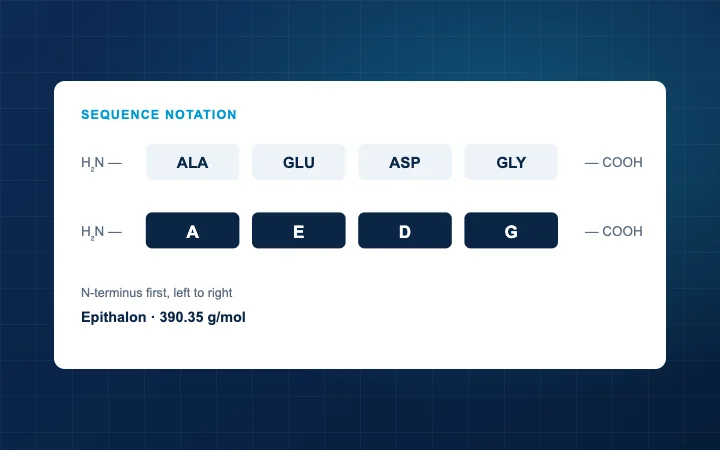
- Epithalon, Ala-Glu-Asp-Gly, carries Asp-Gly at positions three and four.
- Testagen, Lys-Glu-Asp-Gly, carries the same pair in the same place.
- Prostamax, Lys-Glu-Asp-Pro, carries Asp-Pro, which is the labile backbone bond rather than the isomerisation pair, so its sensitive reaction is cleavage rather than rearrangement.
- BPC-157 carries Asp-Asp at positions ten and eleven, two adjacent aspartates in a fifteen-residue chain.
Four of thirteen compounds, each flagged by a pair rather than by a single residue. Notice that epithalon and testagen differ by one residue at the far end of a four-residue chain and share an identical liability, which is the kind of thing the bioregulator comparison is useful for.
Three contain sulfur, and the formula says so
Semax, glutathione and SNAP-8 are the three compounds carrying methionine or cysteine. All three, and only those three, have an S in their published molecular formula: C37H51N9O10S, C10H17N3O6S and C41H70N16O16S.
That makes the formula a complete and free screen for the two sulfur-bearing oxidation risks. If there is no sulfur in the formula there is no methionine and no cysteine, with no sequence required. The test is silent about tryptophan, which contains no sulfur and which only DSIP carries among these thirteen, so a formula screen catches two of the three oxidation-prone residues and misses one.
Four compounds with none of it
Selank, KPV and GHK-Cu carry no asparagine, no aspartate, no methionine, no cysteine and no tryptophan. Every reaction in the first three categories above is unavailable to them. They are not indestructible; backbone hydrolysis applies to any peptide, all three are proline-rich or short enough for diketopiperazine chemistry to be worth considering, and GHK-Cu is a copper complex with its own chemistry that has nothing to do with the amino acids. But the specific named routes are off the table, and that is a real difference from the rest of the list.
What this does not tell you
It tells you which reactions are chemically available. It does not tell you how fast any of them runs, and this post gives no rate, no half-life and no shelf-life for any compound, because predicting those from sequence alone is not something the arithmetic supports. Rates depend on pH, temperature, water activity, buffer identity and the conformation the molecule adopts, and the only honest way to get one is to measure it. How to run a peptide stability study covers what measuring it involves, and where a lyophilized expiry date comes from covers what the date on a vial is actually based on.
The practical use of a map like this is narrower and more useful than a prediction. It tells you what to look for when something has changed. A new small peak ahead of the main one on a reversed-phase trace, in a compound containing methionine, is a different hypothesis from the same peak in a compound containing neither sulfur nor tryptophan. A mass 0.98 Da high points at a glutamine. A mass that has not changed at all, in a compound carrying Asp-Gly, points at the one reaction that does not change a mass.
Frequently asked questions
Which degradation route is most common across peptides generally?
Deamidation at asparagine, followed by backbone hydrolysis. That general ranking is why it leads every stability review. It does not transfer to this catalogue, where no published sequence contains an asparagine.
Why is aspartate isomerisation so hard to detect?
Because isoaspartate has the same molecular formula and the same mass as aspartate. The backbone has been rerouted, not added to or subtracted from. Only a method that separates by shape, such as reversed-phase HPLC, sees the difference.
What does a mass 16 higher than expected mean?
An added oxygen, so oxidation. Check whether the sequence contains methionine, cysteine or tryptophan, and remember that the formula's sulfur count answers the first two without needing the sequence.
Does a compound with no vulnerable residues last indefinitely?
No. The backbone itself hydrolyses, short chains can cyclise and leave, and physical processes such as aggregation and adsorption are separate from chemistry altogether. Absence of these residues removes specific named routes, not degradation.
Why does a dry vial last so much longer than a solution?
Five of the six routes need water as a reactant. Removing the water removes the reaction rather than slowing it, which is a difference in kind and not in degree.
Can I use this table to choose a storage temperature?
Not on its own. The table says which reactions are available; temperature changes how fast they run, and the rate is what a storage recommendation is based on. Use the storage post for that, and the certificate for what has actually been measured on the lot in hand.
References
- Manning MC, Chou DK, Murphy BM, Payne RW, Katayama DS. Stability of protein pharmaceuticals: an update. Pharmaceutical Research 2010;27(4):544-575. The survey underlying the route list and the primacy of deamidation and hydrolysis. doi.org/10.1007/s11095-009-0045-6
- Robinson NE, Robinson AB. Molecular clocks: deamidation of asparaginyl and glutaminyl residues in peptides and proteins. The source for sequence dependence and the Asn-Gly effect. pubmed.ncbi.nlm.nih.gov/11087862
- Li S, Schoneich C, Borchardt RT. Chemical instability of protein pharmaceuticals: mechanisms of oxidation and strategies for stabilization. Biotechnology and Bioengineering 1995;48(5):490-500. doi.org/10.1002/bit.260480511
- Geiger T, Clarke S. Deamidation, isomerization, and racemization at asparaginyl and aspartyl residues in peptides. Journal of Biological Chemistry 1987;262(2):785-794. The succinimide intermediate and the aspartate isomerisation route. doi.org/10.1016/S0021-9258(19)75855-4
- Pepstral compound reference data and compound guides: the thirteen sequences scored here are those published on this site's own compound pages. Residue counts and adjacent-pair analysis run 5 October 2026; molecular formulas from the same records. pepstral.com/research-peptide-reference-table.html
Every product mentioned is sold for laboratory research use only and is not for human or animal use. Nothing on this page describes or recommends use of the material sold here in humans or animals.