
"Bioregulator" appears across peptide catalogues as though it were an established pharmacological class alongside agonists and antagonists. It is not. It is a term from one particular research programme, and knowing which one changes how you read everything written about these compounds.
Where the term comes from
The short-peptide bioregulator series originated in Soviet and later Russian research, associated principally with Vladimir Khavinson and the St Petersburg Institute of Bioregulation and Gerontology. The programme began with peptide preparations extracted from animal tissue and moved towards defined synthetic sequences of two to four residues.
The naming convention follows from that history. Epithalon, Pinealon, Vesugen, Testagen, Prostamax and the rest are programme names rather than systematic chemical ones, which is why they do not look like the naming used elsewhere in peptide chemistry. Why one peptide has five names covers that distinction more generally.
What the sequences have in common
The defining feature is length. These are two to four residues — genuinely tiny by the standards of the signalling peptides most researchers handle.
| Compound | Sequence | Residues |
|---|---|---|
| Epithalon | Ala-Glu-Asp-Gly | 4 |
| Pinealon | Glu-Asp-Arg | 3 |
| Vesugen | Lys-Glu-Asp | 3 |
| Testagen | Lys-Glu-Asp-Gly | 4 |
For comparison, oxytocin is nine residues, Semax is seven, and a GLP-1 analogue runs past thirty. A tripeptide is closer in size to a small molecule than to what most people picture when they hear "peptide".
The composition is also notable: heavy in charged residues — glutamate, aspartate, lysine, arginine. That makes them highly water-soluble and straightforward to get into solution, which is a practical advantage whatever one concludes about the biology.
The caveat that has to come with them
The primary literature is largely Russian-language, much of it published in journals with limited international circulation, and the independent Western replication record is thin.
This is worth stating directly rather than skirting, and it cuts both ways.
It does not mean the work is wrong. Research programmes outside the English-language mainstream are under-cited for reasons that have nothing to do with quality, and dismissing a literature because of its language of publication is not scepticism, it is provincialism.
It does mean the usual assurance is absent. When a finding has been reproduced by unaffiliated groups in different systems, you can lean on it. Where most of the record comes from one programme, you cannot lean on it in the same way, and any honest description has to say so.
The right posture is neither acceptance nor dismissal: treat the sequences as well defined and the biological claims as unreplicated, and read accordingly.
Why they are common in catalogues
Three practical reasons, none of them about efficacy.
Synthesis is easy. Two or three couplings, high yield, clean crude product. Compare that with a thirty-residue chain where every step compounds.
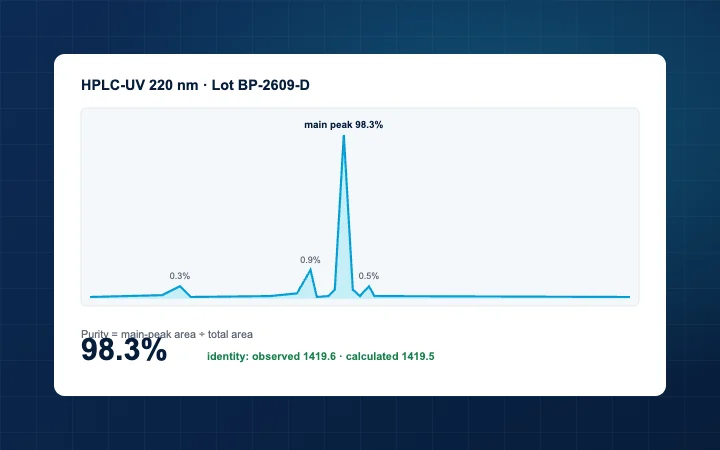
Characterisation by mass is decisive. A deletion in a tripeptide changes the mass by a third, which is trivially resolved. The analytical weaknesses at this length are elsewhere — reading a certificate for a tripeptide covers what HPLC struggles with here.
They are stable and soluble. Charged, short, no complex folding to preserve. They go into water readily and stay there, which is why several are practical as ready-made solutions rather than powders.
Reading the literature on them
Four habits.
Separate the chemistry from the claims. A paper establishing that Glu-Asp-Arg is Glu-Asp-Arg is doing something different from a paper claiming an outcome for it. The first kind is uncontroversial.
Check the system. Cell culture, animal model and human observation are three different claims. The bioregulator literature spans all three and they are sometimes summarised together.
Note the affiliation. Not to dismiss it, but to know whether you are reading independent replication or a continuation of one programme.
Watch for translated overstatement. Claims phrased cautiously in the original are sometimes rendered assertively in secondary English-language summaries. The secondary source is usually where the overstatement enters.
The practical side
For the bench, the short bioregulator sequences are among the easier things in a catalogue to handle. Highly soluble, no aggregation problem worth worrying about, and stable enough that Pinealon as a ready-made solution is a reasonable format rather than a compromise.
Why short peptides behave that way — and where the exceptions are — is covered in why tripeptides behave differently in solution.
Every product referenced here is supplied for laboratory research use only and is not for human or animal use.
References
- Khavinson VK. Peptides and ageing. Neuroendocrinology Letters 2002;23 Suppl 3:11-144.
- Khavinson VK, Malinin VV. Gerontological Aspects of Genome Peptide Regulation. Karger, Basel, 2005.
- Anisimov VN, Khavinson VK. Peptide bioregulation of aging: results and prospects. Biogerontology 2010;11(2):139-149.
- Bachem. Quality Control of Amino Acids and Peptides: A Guide. www.bachem.com/knowledge-center/quality-control-of-amino-acids-peptides-a-guide
Every product mentioned is sold for laboratory research use only and is not for human or animal use. Nothing on this page describes or recommends use of the material sold here in humans or animals.