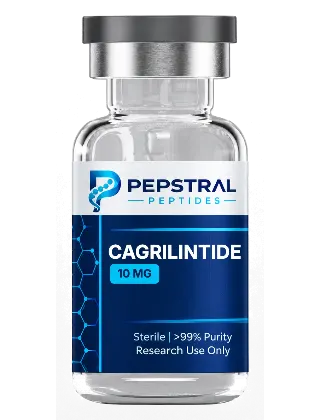
What is PEP-CAG-A, and what is it studied for?
PEP-CAG-A is a long-acting synthetic analogue of amylin, the 37-residue hormone co-secreted with insulin by pancreatic beta cells, formula C194H312N54O59S2, mass 4409, CAS 1415456-99-3. It is acylated with a fatty-acid chain to bind albumin and is studied in receptor pharmacology and preclinical models of amylin and calcitonin receptor signalling. It is an investigational compound in regulated trials; no certificate for the current stock has been published, and the product page says so. The material is for in-vitro research only.
What is the structure of PEP-CAG-A?
A 37-residue amylin analogue with substitutions that remove amylin's tendency to aggregate, a disulfide ring near the N-terminus, a C-terminal amide, and a C20 fatty-diacid chain attached through a linker to a lysine. The acylation is why it dissolves slowly and why the certificate mass, when published, must be read against the full conjugate. Kruse and colleagues described the design in 2021.
| Identifier | Value |
|---|---|
| Molecular formula | C194H312N54O59S2 |
| Molecular weight | 4409 g/mol |
| Residues | not recorded |
| CAS number | 1415456-99-3 |
| PubChem CID | 171397054 |
| Current lot | not recorded |
How is PEP-CAG-A thought to work?
Agonist at amylin receptors, which are calcitonin receptors paired with receptor activity-modifying proteins, and at the calcitonin receptor itself; signalling is through Gs and cAMP. Amylin and incretin receptors act on separate pathways, which is why the compound is studied alongside GLP-1 receptor agonists in receptor-selectivity and combination experiments.
Which research areas use PEP-CAG-A?
| Area | Typical models and endpoints |
|---|---|
| Amylin and calcitonin receptor pharmacology | cAMP assays in cells co-expressing the calcitonin receptor and RAMPs. |
| Receptor selectivity | Comparison with native amylin, pramlintide and salmon calcitonin. |
| Aggregation-resistant analogue design | A case study in substitutions that prevent amyloid formation. |
| Acylated peptide behaviour | Albumin binding, slow dissolution and extended-presence pharmacokinetics in animals. |
What does the published literature show?
Kruse et al. (Journal of Medicinal Chemistry, 2021) described the development of the analogue. Lau et al. Research use of the material here is in-vitro and preclinical.
How is PEP-CAG-A handled in the laboratory?
Dissolves slowly; allow time and swirl rather than shake, as the acylated-peptide post explains. Contains a disulfide, so avoid reducing agents, and a methionine, so protect from light and air. Store lyophilized at minus 20 °C; aliquot and freeze. The concentration table covers dilution volumes and microlitre aliquots; the storage guide covers stability by compound class.
What does the current certificate show?
A laboratory certificate for the current lot has not been published yet; email support with the lot number on your vial and we will send it. Sold as 10 mg per vial at $170, for laboratory research only.
Certificate history for PEP-CAG-A
Every certificate the library holds for this compound, newest first. A replaced lot stays listed so the history can be read; the certificate dataset reads all 114 together.
No certificate for this compound has been published yet.
Frequently asked questions
Why is there no certificate?
Because the laboratory has not issued one for the current stock. The product page states it, and the library will list it when published; ask support for the lot report before ordering.
How is PEP-CAG-A different from a GLP-1 agonist?
It acts at amylin and calcitonin receptors, a separate receptor system from the incretin receptors that PEP-SMG-1, PEP-TZP-2 and PEP-RTA-3 target. The amylin-analogues post explains the family.
Is this an approved drug?
No. PEP-CAG-A is investigational; no product containing it is approved anywhere. The material here is a research-grade peptide for in-vitro research only.
References
- Kruse T, Hansen JL, Dahl K, et al. J Med Chem. 2021;64(15):11183-11194.
- Lau DCW, Erichsen L, Francisco AM, et al. Lancet. 2021;398(10317):2160-2172.
- PubChem CID 171397054, PEP-CAG-A. National Library of Medicine. Read 2 October 2026.
Clinical results cited above describe regulated trials of pharmaceutical products and are given as context for research interest only. Nothing on this page describes or recommends use of the material sold here in humans or animals.